
Q1. What are the core job roles in this branch?
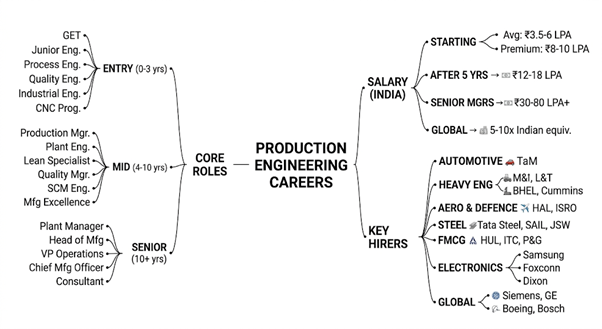
The career paths in Production Engineering are diverse and well-paying. At the entry level (0–3 years), you can expect roles like: Graduate Engineer Trainee (GET) in manufacturing companies, Junior Production Engineer, Process Engineer, Quality Engineer, Industrial Engineer, CNC Programmer / Process Planner, and Manufacturing Engineer in product companies. At the mid-level (4–10 years): Production Manager, Plant Engineer, Lean Specialist, Quality Manager, Supply Chain Engineer, and Manufacturing Excellence Manager. At the senior level (10+ years): Plant Manager, Head of Manufacturing, VP — Operations, Chief Manufacturing Officer, and Management Consultant (Manufacturing Practice).
Q2. What is the average starting salary in India?
For a fresh Production Engineering graduate from a decent college with good skills and a project portfolio, the average starting salary in India ranges from ₹3.5 LPA to ₹6 LPA. In premium placements — large automotive OEMs, aerospace companies, defence PSUs — it can go up to ₹8 to ₹10 LPA. After 5 years with certifications (Six Sigma Green Belt, Lean certification), salaries of ₹12 to ₹18 LPA are common. Senior managers and plant heads in large conglomerates can earn ₹30 to ₹80 LPA or more. In global roles (manufacturing in Germany, Japan, the USA), salaries can be 5 to 10 times the Indian equivalent.
Q3. Which companies hire heavily in this field?
In India, the top hiring companies are: Automotive — Tata Motors, Mahindra & Mahindra, Maruti Suzuki, Hero MotoCorp, Toyota Kirloskar, Bajaj Auto. Heavy Engineering — Larsen & Toubro, BHEL, Thermax, Cummins India. Aerospace and Defence — HAL, DRDO, BEL, ISRO, Hindustan Aeronautics. Steel and Metals — Tata Steel, SAIL, JSW Steel, Bharat Forge. FMCG and Consumer Goods — Godrej Industries, HUL, ITC, Procter & Gamble India. Electronics — Dixon Technologies, Samsung India, Foxconn. Internationally, companies like Siemens, GE, Boeing, ABB, Bosch, and Toyota actively recruit production engineering talent globally.
Q4. What is the future demand (2025–2040)?
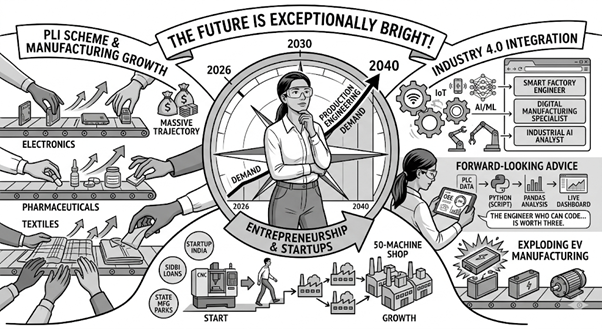
The future for Production Engineering is exceptionally bright. Here is why. India’s manufacturing sector is on a massive growth trajectory under the Production Linked Incentive (PLI) scheme covering electronics, pharmaceuticals, automotive, textiles, and more — all of which need production engineers. Industry 4.0 — the integration of IoT, AI, machine learning, and cyber-physical systems into manufacturing — is creating a new generation of roles like Smart Factory Engineer, Digital Manufacturing Specialist, and Industrial AI Analyst. These roles require production engineering knowledge plus digital skills. Electric Vehicle (EV) manufacturing is exploding — battery pack assembly, motor manufacturing, and EV-specific production lines all need production engineers. The global push for precision manufacturing, sustainable production, and supply chain resilience ensures that production engineers will be in demand for the foreseeable future.
Forward-Looking Advice: Learn Python alongside your core subjects. The production engineer who can write a script to pull data from a PLC, analyse it with Pandas, and generate a live OEE dashboard is worth three engineers who cannot. This is not the future — it is already the present in companies like Tata, L&T, and Bosch.
Q5. Can this branch lead to entrepreneurship or startups?
Absolutely — and this is one of the most underrated aspects of Production Engineering. You understand manufacturing processes, tooling, supply chains, quality systems, and production economics. This is exactly the knowledge base you need to start a manufacturing MSME, a contract manufacturing business, or a product startup. Many successful Indian entrepreneurs in the manufacturing space — precision component manufacturers, automation product companies, specialty tooling manufacturers — have a production engineering background. Schemes like the Startup India programme, SIDBI manufacturing loans, and various state government manufacturing parks make this more accessible than ever. I have personally mentored engineers who started machining units with a single CNC centre and grew them into 50-machine shops within a decade.
Conclusion:
Production Engineering offers career opportunities in manufacturing industries, automobile sector, and industrial management. It is a stable and in-demand career path.
CTA:
Explore different job roles and identify your area of interest. Share this blog and move to Day 6 to learn how AI and automation are changing this field.