
Q1. How will AI impact this branch?
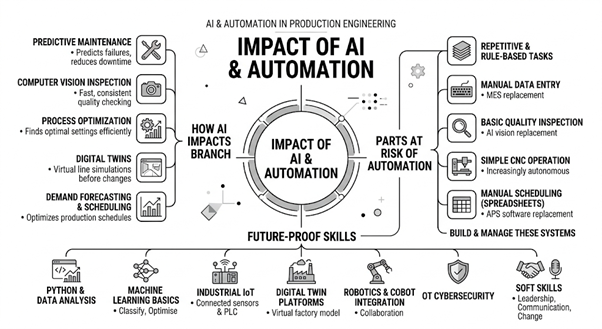
Artificial Intelligence is not replacing production engineers — it is multiplying their capabilities. AI in manufacturing manifests as: Predictive Maintenance — ML models analyse vibration data from CNC spindles and predict bearing failure before it happens, avoiding costly unplanned downtime. Computer Vision Quality Inspection — cameras with deep learning models inspect parts at 10 to 50 times the speed of a human inspector, with higher consistency. AI-powered process parameter optimisation — instead of running 50 manual trials using Design of Experiments, an AI algorithm finds the optimal cutting parameters for a new material in hours. Digital Twins — a virtual replica of your production line runs 1,000 simulations of a layout change before a single machine is moved. Demand forecasting and production scheduling — AI tools analyse market signals, inventory levels, and machine capacities to generate optimal production schedules automatically.
Q2. What parts of this field are at risk of automation?
Honest answer: repetitive, rule-based, and low-skill tasks are at the highest risk. These include: manual data entry into production tracking systems (already being replaced by MES — Manufacturing Execution Systems), basic quality inspection by visual checking (being replaced by AI vision systems), simple CNC operation (machines increasingly run autonomously), and manual scheduling using spreadsheets (being replaced by advanced planning and scheduling software). However, these risks create opportunities for engineers who adapt. The production engineer who understands AI and automation is the one who BUILDS and MANAGES these systems — not the one who is replaced by them.
Q3. What skills make me future-proof in this domain?
To be future-proof in Production Engineering over the next 20 years, invest in these skills: Python for data analysis and automation scripting. Machine learning basics — especially supervised learning for quality classification and regression for process optimisation. Industrial IoT — connecting sensors, PLCs, and MES systems. Knowledge of digital twin platforms like NVIDIA Omniverse or Siemens Tecnomatix. Robotics and collaborative robot (cobot) integration. Cybersecurity basics for OT (Operational Technology) systems. Soft skills — the ability to lead cross-functional teams, communicate technical insights to non-technical managers, and drive change management in factories.
Q4. Is this branch evolving towards interdisciplinary roles?
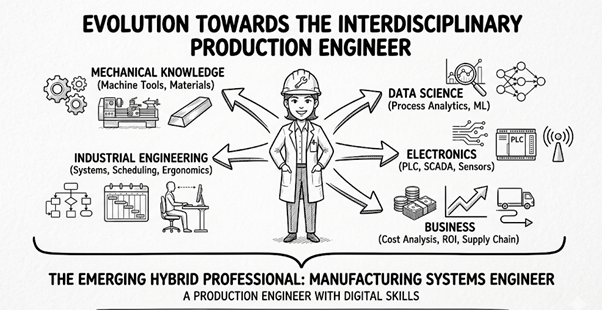
Yes, and this is one of the most exciting developments in the field. The modern production engineer is becoming a hybrid professional. They combine mechanical knowledge (machine tools, materials), industrial engineering (systems, scheduling, ergonomics), data science (process analytics, ML), electronics (PLC, SCADA, sensors), and business (cost analysis, ROI, supply chain). The emerging title of “Manufacturing Systems Engineer” or “Smart Factory Engineer” is essentially a production engineer with digital skills. This interdisciplinary evolution means that a production engineering degree, combined with deliberate upskilling in digital tools, positions you at the intersection of multiple high-demand domains.
Conclusion:
Automation, robotics, and AI are transforming production engineering. Smart factories and Industry 4.0 are making manufacturing faster and more efficient.
CTA:
Start learning about automation and modern technologies. Follow this series and continue to Day 7 to understand the challenges of this field.