
Q1. What are the current industry trends?
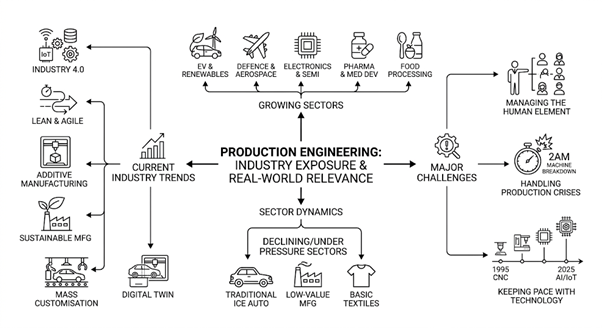
The manufacturing industry globally is undergoing its most significant transformation since the first Industrial Revolution. The key trends shaping Production Engineering today are: Industry 4.0 and Smart Manufacturing — integrating IoT sensors, AI, big data analytics, and cyber-physical systems into traditional production lines. Lean and Agile Manufacturing — reducing waste and enabling rapid response to customer demand changes. Additive Manufacturing (3D Printing) — moving from prototyping to actual production of metal and polymer components. Sustainable Manufacturing — reducing carbon footprint, energy consumption, and material waste, often mandated by customers and regulators. Mass Customisation — producing highly personalised products at near-mass-production efficiency (think custom cars, personalised packaging). Digital Twin implementation — creating virtual factory models for simulation, testing, and predictive control before committing physical resources.
Q2. Which sectors are growing or declining?
Growing sectors for production engineers in India and globally: Electric Vehicle manufacturing, Defence and aerospace (driven by Aatmanirbhar Bharat), Electronics and semiconductor manufacturing (PLI scheme), Pharmaceutical and medical device manufacturing, Renewable energy equipment manufacturing (solar panels, wind turbines), and Food processing and FMCG. Sectors under pressure: Traditional internal combustion engine (ICE) component manufacturing (being disrupted by EVs), Labour-intensive low-value manufacturing (being automated), and some segments of textile manufacturing (competing with automation). Smart production engineers pivot to growth sectors and bring their skills with them. The core knowledge transfers — only the application changes.
Q3. What are the major challenges faced in this field?
The real challenges that no textbook adequately prepares you for: Managing the human element — machines are predictable; people are not. Leading a team of 50 workers on a rotating shift requires emotional intelligence, conflict resolution skills, and cultural sensitivity. Dealing with production crises — a machine breakdown at 2 AM before a critical shipment, a sudden spike in defects on a high-volume line, a material shortage that threatens the monthly target — these are tests of your technical knowledge AND your composure under pressure. Keeping pace with technology — the tools and systems evolve rapidly. The production engineer who learned CNC programming in 1995 had to relearn for 5-axis machining in 2005, for CAM software in 2010, for IoT integration in 2020, and now for AI-driven process control. Continuous learning is not optional.
Q4. Are there government initiatives supporting this branch?
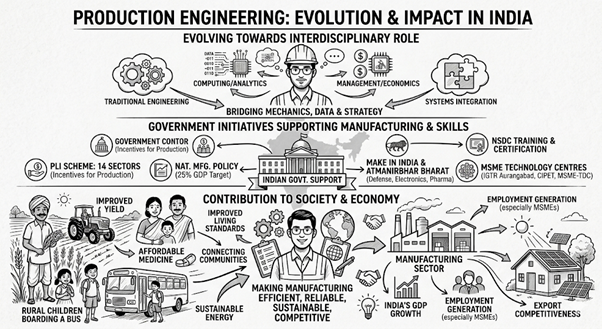
Yes — and in the current Indian context, this is extremely favourable for production engineers. The Production Linked Incentive (PLI) Scheme offers financial incentives across 14 manufacturing sectors, directly driving demand for production engineering talent. The National Manufacturing Policy targets a 25% share of GDP for manufacturing. Make in India and Atmanirbhar Bharat prioritise domestic production across defence, electronics, and pharmaceuticals. The National Skill Development Corporation (NSDC) funds training and certification in manufacturing skills. MSME Technology Centres (formerly Tool Rooms) across India — like IGTR Aurangabad, CIPET, and MSME-TDC — provide affordable advanced manufacturing training.
Q5. How does this field contribute to society and economy?
Production Engineering is the backbone of economic development. Every product that improves a person’s life — a tractor that increases a farmer’s yield, an affordable medicine that saves a child’s life, a bus that connects a remote village, a solar panel that brings electricity to an off-grid home — was produced through a manufacturing system designed, managed, and improved by production engineers. India’s GDP growth, employment generation (especially in MSME-driven manufacturing), and export competitiveness all depend fundamentally on the quality of its manufacturing sector. Production engineering makes manufacturing more efficient, more reliable, more sustainable, and more competitive — and that directly translates to higher living standards for society as a whole.
Conclusion:
Production Engineering can be challenging due to technical concepts and practical work, but it becomes easier with consistent learning and practice.
CTA:
Stay focused and keep improving your skills. Move to Day 8 to explore the latest industry trends in production engineering.