
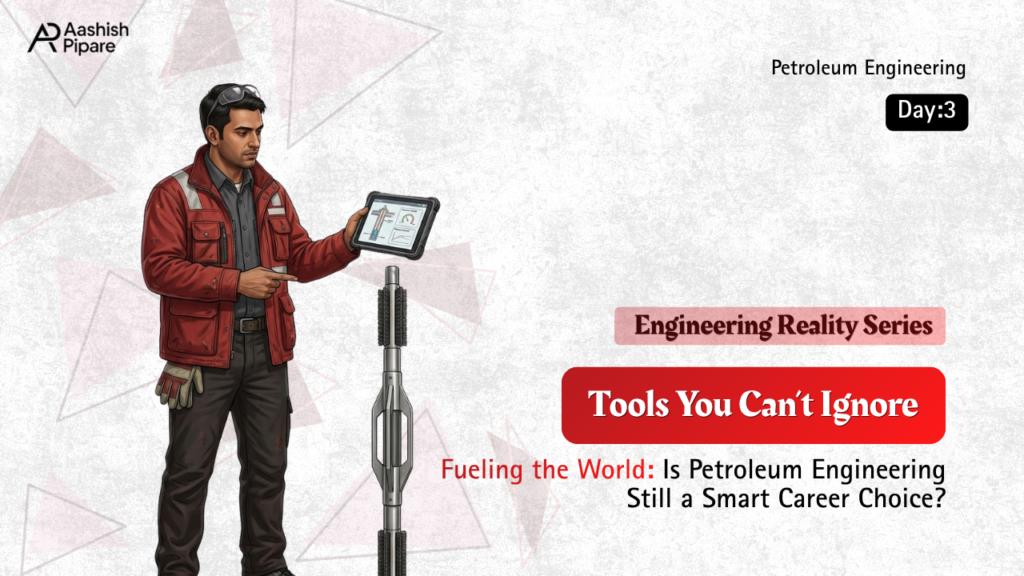
1. What software tools are essential?
When I started digging deeper into Petroleum Engineering, one thing that surprised me was how heavily the industry depends on software. Initially, I thought most of the work would happen on-site, but in reality, a lot of critical decisions are made using simulations and data analysis tools before any physical operation even begins. One of the most important categories of tools is reservoir simulation software like Eclipse or CMG, which are used to create models of underground reservoirs and predict how oil and gas will flow over time. These tools help engineers decide where to drill and how to maximize recovery. Then there are drilling and well design software such as Landmark or WellPlan, which are used to plan drilling paths, manage pressure, and avoid risks like blowouts.
Apart from these industry-specific tools, I realized that general-purpose software plays a huge role too. Tools like MATLAB are widely used for numerical modeling and solving engineering problems, while Python has become extremely valuable for handling large datasets, automating repetitive tasks, and even applying AI-based solutions. Even Excel, which many students underestimate, becomes powerful when you start working with real production data. From my experience, students who start learning at least one technical tool early—especially Python—adapt much faster during internships and job training.
2. What hardware or lab exposure is required?
One thing I appreciated about this branch is that it doesn’t stay limited to books—you actually get some level of physical exposure, even if it’s not full-scale industry equipment. In college labs, I remember working with experiments that demonstrated rock properties like porosity and permeability, which are fundamental to understanding how oil is stored underground. You also come across setups that simulate fluid flow through porous media, which helps connect theory with reality.
Some institutes also provide exposure to drilling simulators, which give a virtual understanding of how drilling operations are controlled, including pressure management and safety measures. While this is still far from real oil rigs, it builds a strong base. The real game-changer, though, is industrial training or site visits. Even a short visit to a refinery or drilling site gives you clarity that no textbook can provide. From what I’ve seen, students who actively seek these experiences tend to understand concepts much faster and perform better in interviews because they can relate theory to real-world situations.
3. Which programming languages (if any) are needed?
To be honest, programming wasn’t something I initially associated with Petroleum Engineering, but that mindset changed quickly. The industry is becoming more data-driven, and having programming skills is now a strong advantage rather than an optional extra. Among all languages, Python stands out because it’s relatively easy to learn and extremely powerful for data analysis, visualization, and automation. You can use it to analyze production data, predict trends, or even build simple models.
MATLAB is also useful, especially in academic settings and for solving mathematical models related to fluid flow and reservoir behavior. In some advanced or specialized roles, knowledge of data science, machine learning, or even basic scripting can give you a big edge. From my experience, you don’t need to master coding like a software engineer, but having a working knowledge makes you far more efficient and future-ready.
4. What are the must-have technical skills for freshers?
From what I’ve observed, companies hiring freshers don’t expect you to be an expert, but they do expect you to be strong in fundamentals and ready to learn. The most important thing is clear understanding of core subjects like fluid mechanics, thermodynamics, and reservoir engineering. If your basics are strong, you can pick up tools and technologies much faster on the job.
Another skill that really stands out is problem-solving ability. In this field, problems are rarely straightforward—you often deal with incomplete data and uncertain conditions. Being able to think logically and make informed decisions is very important. Data interpretation skills are also becoming essential, as engineers constantly work with production data, pressure readings, and simulation outputs.
I also realized that communication skills are more important than most students think. Engineers often work in teams, and being able to clearly explain your ideas or findings can make a big difference. Lastly, even a small amount of practical exposure, like internships, workshops, or projects, can set you apart from others because it shows you understand how things work beyond textbooks.
5. What certifications add value in this domain?
Over time, I understood that certifications are not just about adding lines to your resume—they can actually guide your learning in the right direction if chosen wisely. One of the most recognized organizations in this field is the Society of Petroleum Engineers, and being associated with it can help you stay updated with industry trends, attend workshops, and connect with professionals.
For students interested in field roles, certifications related to well control and drilling safety are highly valued because safety is a top priority in the oil and gas industry. There are also specialized certifications in reservoir simulation, production optimization, and energy management, which can help you build expertise in specific areas.
What I’ve noticed recently is that certifications in digital skills—like Python, data analytics, or even AI—are becoming increasingly relevant because the industry is moving towards automation and digital oilfields. From my experience, the best strategy is not to collect too many certifications randomly, but to choose ones that align with your career path and actually add practical value.