
Q1. Why should I choose this branch over others?
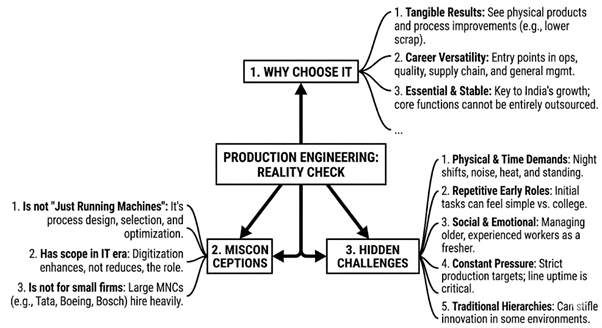
Choose Production Engineering if you want a career where you can see the tangible result of your work every single day. Unlike software, where your output is lines of code, in production engineering you see a finished component, a running assembly line, a reduction in scrap from 5% to 0.3%. Choose it if you want versatility — this degree gives you entry points into operations, quality, supply chain, maintenance, industrial engineering, and general management, in any industry that makes physical products. Choose it if you are excited about India’s manufacturing growth story and want to be at the centre of it. Choose it if you want a career that cannot be entirely offshored or outsourced, because you need to be physically present to manage a factory.
Q2. What are the biggest misconceptions about this field?
Misconception 1: “Production Engineering is just about running machines.” Wrong. Running machines is the operator’s job. The production engineer designs the process, selects the machine, optimises the parameters, solves quality problems, and leads continuous improvement. Misconception 2: “This field has no scope in the IT era.” Wrong. Every physical product is made in a factory, and every factory needs production engineers. The digitisation of manufacturing has ADDED scope, not reduced it. Misconception 3: “It is only for people who want to work in small, obscure companies.” Wrong. Tata Motors, Bosch, Siemens, Boeing, Toyota, L&T — these are not small companies. All of them hire large numbers of production engineers.
Q3. What are the hidden challenges no one talks about?
The unspoken realities: Night shifts and weekend work in the early years are very common — this is not discussed during campus placements. The factory environment can be physically demanding — noise, heat, and standing for extended periods are real. Early career roles can feel repetitive — the gap between what you learned in college and what you actually do in the first six months can be discouraging. Managing workers much older and more experienced than you is socially and emotionally challenging for freshers. Production targets create constant pressure — “the line must run” is a non-negotiable reality in manufacturing. Bureaucratic and hierarchical cultures in large PSUs or traditional family-owned businesses can slow down innovation-minded young engineers.
Q4. If I fail in core roles, what are my backup career paths?
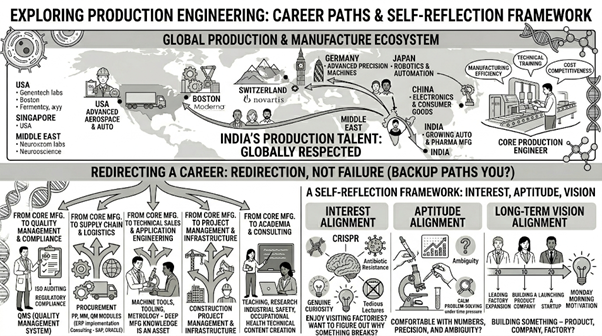
The production engineering degree is remarkably versatile. If core manufacturing roles do not suit you, excellent alternatives include: Quality Management and Compliance (QMS, ISO auditing, regulatory compliance). Supply Chain and Procurement Management. ERP Implementation Consulting (SAP, Oracle, Microsoft Dynamics — specialising in the PP, MM, or QM modules). Technical Sales and Application Engineering for machine tool, tooling, or metrology companies — your deep manufacturing knowledge is a huge asset in selling to engineers. Project Management in construction or infrastructure. Teaching and academia. Industrial safety and occupational health. Technical content creation, training, and consulting.
Q5. Is this branch aligned with my interest, aptitude, and long-term vision?
This is the most important question, and only you can answer it. But here is a framework I give to every student I mentor. Ask yourself: Do you enjoy visiting factories, workshop visits, or seeing how things are assembled? When something breaks, is your instinct to figure out why? Are you comfortable with numbers, measurements, and precision? Can you stay calm and problem-solve effectively under time pressure? Do you feel energised by variety — moving between people, machines, data, and design — in a single day? If most of your answers are “yes,” Production Engineering is likely a strong fit for your aptitude. If your long-term vision includes building something — a product, a company, a factory — Production Engineering gives you one of the best possible foundations.
Conclusion:
Production Engineering is a strong career choice for those interested in manufacturing, efficiency, and innovation. It offers stability, growth, and opportunities across industries.
CTA:
If this field matches your interest, start building your skills today. Share this complete guide and take the first step toward a successful career in production engineering.