
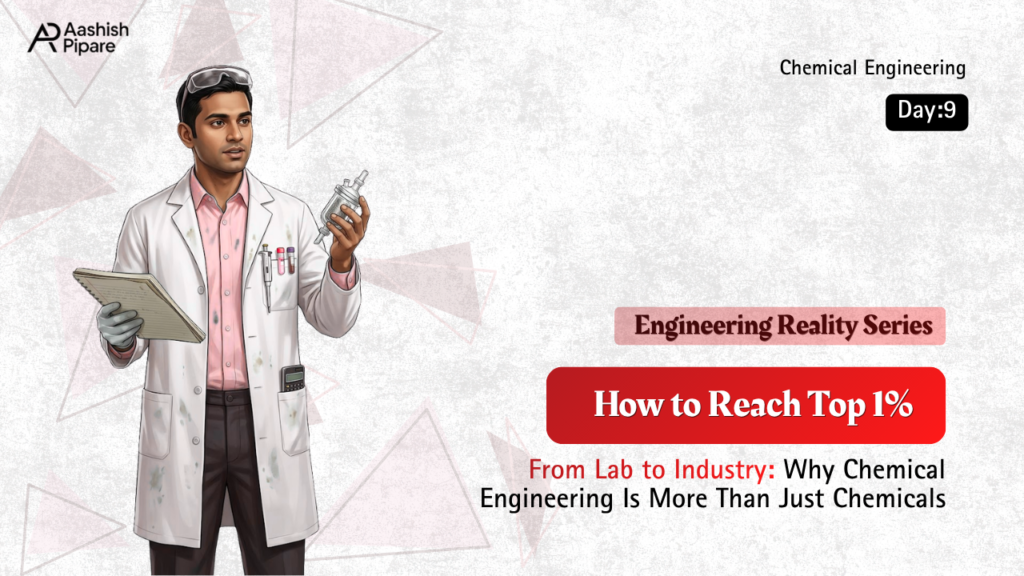
DAY 9. ADVANCED GROWTH PATH
a. What are the specializations available in this branch?
Chemical Engineering is a broad field that offers several specialized areas as you progress in your studies and career. These specializations allow engineers to develop expertise in specific industries and technologies, helping them solve complex industrial challenges and contribute to innovation.
1. Petrochemical Engineering
Petrochemical Engineering focuses on the processing of crude oil, natural gas, and petroleum products. Engineers in this field work in refineries and petrochemical plants to convert raw hydrocarbons into valuable products such as fuels, plastics, synthetic fibers, detergents, and chemicals used in everyday life.
Key areas of work:
- Oil refining processes
- Natural gas processing
- Production of petrochemicals
- Fuel manufacturing
- Process optimization and safety
2. Pharmaceutical Engineering
Pharmaceutical Engineering combines chemical engineering principles with medicine and biotechnology. Professionals in this field design and manage processes used to manufacture drugs, vaccines, and healthcare products while ensuring strict quality and safety standards.
Key areas of work:
- Drug manufacturing
- Vaccine production
- Quality assurance
- Regulatory compliance
- Bioprocess engineering
3. Environmental Engineering
Environmental Engineering focuses on protecting the environment and promoting sustainable industrial practices. Engineers develop technologies to reduce pollution, manage waste, treat water, and minimize the environmental impact of industrial operations.
Key areas of work:
- Wastewater treatment
- Air pollution control
- Waste management
- Environmental impact assessment
- Sustainable process design
b. Should I pursue higher studies (M.Tech, MS, MBA, PhD)?
Pursuing higher studies after a Bachelor’s degree in Chemical Engineering is a personal and career-oriented decision. While a B.Tech or B.E. degree provides a strong foundation for entering the industry, higher education can significantly improve your technical expertise, research capabilities, leadership potential, and career growth. The right choice depends on your interests, career goals, financial situation, and long-term aspirations.
Why Consider Higher Studies?
Higher studies help engineers gain specialized knowledge, develop advanced problem-solving skills, and access better career opportunities. Many industries today seek professionals with expertise in emerging fields such as renewable energy, sustainable technologies, advanced materials, biotechnology, and process optimization.
Benefits of higher studies include:
- Greater technical expertise
- Better job opportunities and higher salaries
- Access to research and innovation projects
- Opportunities to work in multinational companies
- Career advancement into leadership and management roles
- Eligibility for academic and research careers
1. M.Tech (Master of Technology)
An M.Tech is ideal for students who want to deepen their technical knowledge and specialize in a particular area of Chemical Engineering.
Key Features:
- Usually a 2-year postgraduate program.
- Focuses on advanced engineering concepts and industrial applications.
- Available in specializations such as Process Engineering, Energy Engineering, Environmental Engineering, and Biochemical Engineering.
Benefits:
- Strong technical expertise.
- Better opportunities in core engineering industries.
- Enhanced chances of obtaining technical leadership positions.
- Useful for careers in design, production, and process optimization.
Career Opportunities:
- Process Engineer
- Design Engineer
- Production Manager
- Technical Consultant
- Research Engineer
Suitable For:
Students who enjoy technical problem-solving and wish to build a career in core Chemical Engineering industries.
c. What are the research opportunities in this field?
Chemical Engineering is a highly research-oriented field that plays a vital role in solving global challenges related to energy, sustainability, healthcare, manufacturing, and environmental protection. Research in Chemical Engineering focuses on developing innovative processes, improving industrial efficiency, creating new materials, and reducing the environmental impact of industrial activities.
As technology advances, Chemical Engineers are increasingly involved in cutting-edge research that contributes to sustainable development and industrial innovation.
1. Sustainable and Green Technologies
One of the most important research areas in Chemical Engineering is the development of sustainable and environmentally friendly technologies. Researchers work on designing processes that consume less energy, produce fewer emissions, and minimize waste generation.
Key Research Areas:
- Green chemical manufacturing
- Sustainable production methods
- Carbon capture and storage (CCS)
- Circular economy technologies
- Biodegradable materials and plastics
- Waste-to-energy conversion
Importance:
These technologies help industries reduce their environmental footprint while maintaining productivity and profitability.
Example:
Researchers are developing biodegradable plastics made from renewable resources to reduce plastic pollution and dependence on petroleum-based products.
2. Renewable Energy Systems
The growing demand for clean energy has created significant research opportunities in renewable energy technologies. Chemical Engineers contribute to the development of sustainable energy solutions that can replace fossil fuels.
Key Research Areas:
- Biofuels and biodiesel production
- Hydrogen energy systems
- Fuel cells
- Solar energy materials
- Energy storage technologies
- Battery development and optimization
Importance:
Research in renewable energy helps address climate change, improve energy security, and reduce greenhouse gas emissions.
Example:
Scientists are developing eco-friendly fuels from agricultural waste and algae to provide sustainable alternatives to conventional fuels.
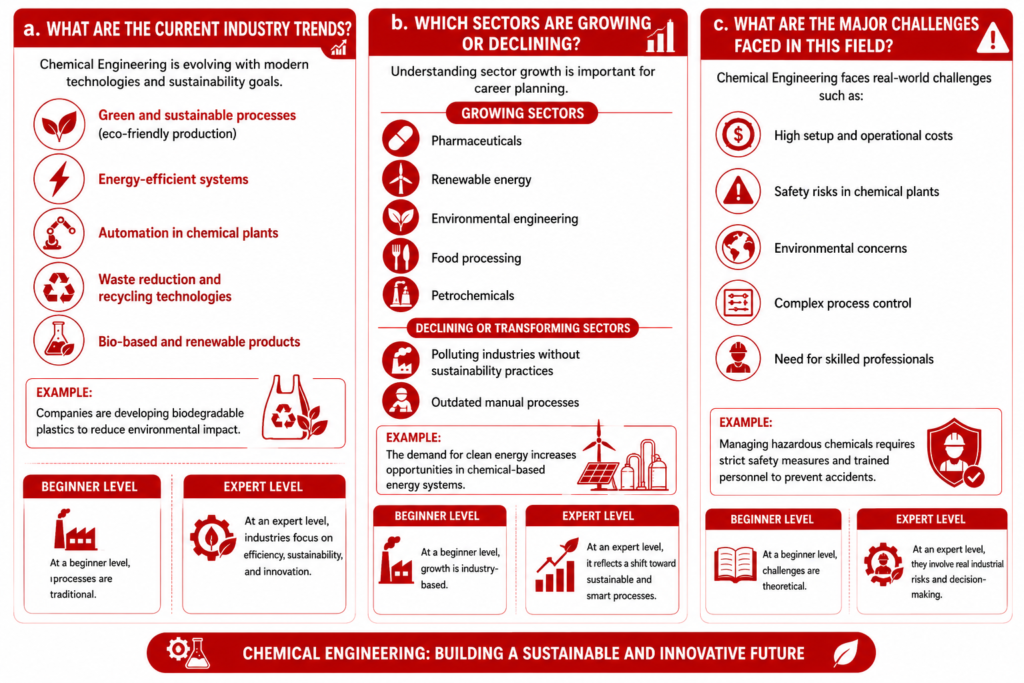
d. What global opportunities exist in this field?
Chemical Engineering is one of the most globally recognized engineering disciplines because it supports essential industries such as energy, oil and gas, pharmaceuticals, chemicals, food processing, environmental management, biotechnology, and advanced manufacturing. As industries worldwide continue to expand and adopt new technologies, the demand for skilled Chemical Engineers remains strong across many countries.
Global opportunities allow Chemical Engineers to work on large-scale industrial projects, cutting-edge research, sustainable technologies, and international collaborations. With the right skills, experience, and specialization, engineers can build successful careers almost anywhere in the world.
Why Is Chemical Engineering in Global Demand?
Chemical Engineers are responsible for designing, operating, optimizing, and improving processes that convert raw materials into valuable products. Industries worldwide depend on these professionals to ensure efficiency, safety, profitability, and sustainability.
Major factors driving global demand include:
- Growing energy needs
- Expansion of pharmaceutical manufacturing
- Development of renewable energy technologies
- Environmental regulations and sustainability goals
- Increasing demand for chemicals and materials
- Advances in biotechnology and healthcare
As a result, Chemical Engineers have opportunities in both developed and emerging economies.
1. Middle East – Oil and Gas Industry
The Middle East is one of the world’s largest producers of oil and natural gas. Countries such as Saudi Arabia, United Arab Emirates (UAE), Qatar, Kuwait, and Oman offer numerous opportunities for Chemical Engineers.
Key Industries:
- Oil refining
- Petrochemical manufacturing
- Natural gas processing
- Fertilizer production
- Industrial utilities
Job Roles:
- Process Engineer
- Production Engineer
- Refinery Engineer
- Operations Engineer
- Safety Engineer
Benefits:
- High salaries
- Tax-free income in some countries
- Large-scale industrial projects
- International work environment
Example:
Chemical Engineers working in Gulf countries help convert crude oil into fuels, plastics, chemicals, and industrial products used worldwide.
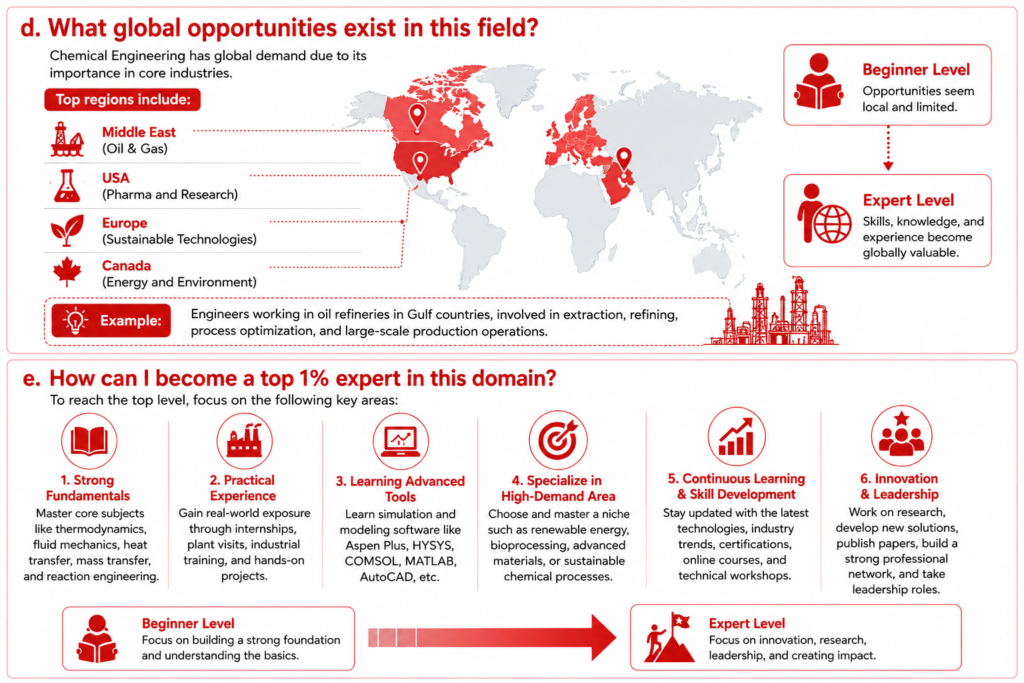
e. How can I become a top 1% expert in this domain?
Becoming a top 1% expert in Chemical Engineering requires much more than earning a degree. It involves building strong technical foundations, gaining practical industry experience, mastering advanced technologies, developing specialized expertise, and continuously learning throughout your career. Top professionals are not only technically skilled but also contribute to innovation, solve complex industrial problems, and lead teams and projects that create significant impact.
The journey from beginner to expert is gradual and requires dedication, curiosity, and a commitment to lifelong learning.
1. Build Strong Fundamentals
Every successful Chemical Engineer starts with a solid understanding of core engineering principles. These fundamentals form the foundation for solving real-world industrial challenges and learning advanced concepts later in your career.
Key Subjects to Master:
- Thermodynamics
- Fluid Mechanics
- Heat Transfer
- Mass Transfer
- Chemical Reaction Engineering
- Process Control
- Material and Energy Balances
- Transport Phenomena
Why It Matters:
Strong fundamentals enable engineers to understand how chemical processes work, troubleshoot problems effectively, and make informed engineering decisions.
Example:
An engineer designing a heat exchanger must understand heat transfer principles to optimize performance and reduce energy consumption.
2. Gain Practical Experience Early
Theory alone is not enough. Practical exposure helps engineers understand how industrial processes operate in real-world environments.
Ways to Gain Experience:
- Industrial internships
- Plant visits
- Summer training programs
- Laboratory projects
- Industrial certifications
- Hands-on manufacturing experience
Benefits:
- Understanding industrial equipment
- Learning safety procedures
- Exposure to plant operations
- Improved problem-solving skills
Example:
Working in a refinery or chemical plant allows students to see how reactors, distillation columns, pumps, and control systems function in practice.
CONCLUSION:
Advanced growth in Chemical Engineering depends on specialization, higher education, and practical experience. With continuous learning and skill development, professionals can achieve global opportunities and leadership roles. This field offers long-term growth, stability, and the chance to contribute to innovation and sustainability.