
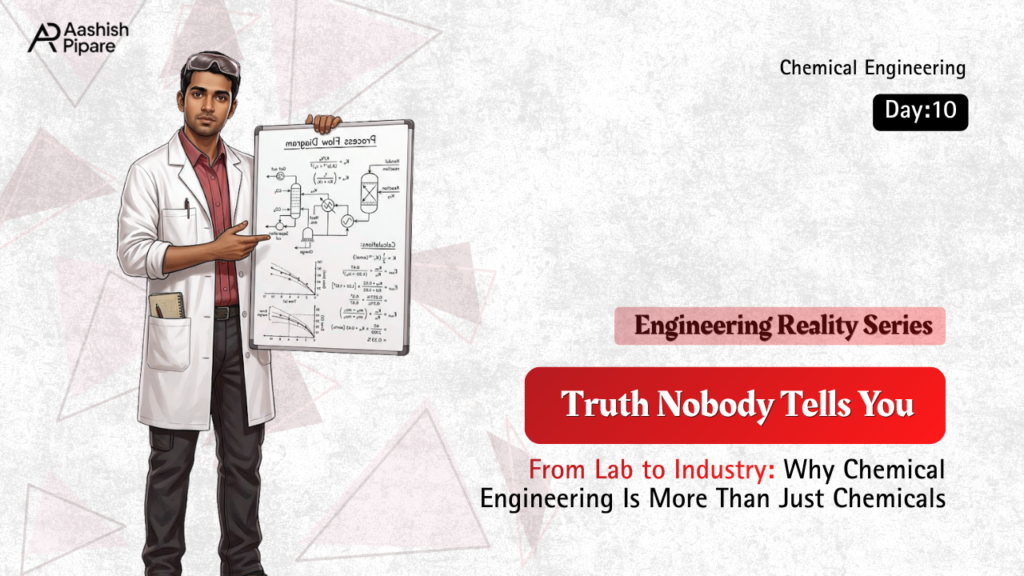
a. Why should I choose this branch over others?
Choosing an engineering branch is one of the most important career decisions you will make. Chemical Engineering stands out because it combines chemistry, physics, mathematics, biology, and engineering principles to solve real-world industrial problems. It is a branch that directly impacts everyday life by helping produce essential products such as fuels, medicines, fertilizers, plastics, food products, cosmetics, clean water, and renewable energy solutions.
If you are interested in understanding how raw materials are transformed into useful products on a large scale, Chemical Engineering can be an excellent choice.
What Makes Chemical Engineering Unique?
Unlike many engineering disciplines that focus primarily on machines, electronics, or software, Chemical Engineering focuses on designing and optimizing processes that convert raw materials into valuable products.
Chemical Engineers work on:
- Large-scale manufacturing systems
- Industrial process design
- Production optimization
- Energy management
- Environmental protection
- Product development
- Process safety
This makes Chemical Engineering one of the most versatile and interdisciplinary engineering fields.
Who Should Choose Chemical Engineering?
1. Students Who Enjoy Chemistry and Science
Chemistry is the foundation of Chemical Engineering. If you enjoy understanding chemical reactions, materials, and how substances interact, you will likely find this branch interesting.
However, Chemical Engineering is not just about studying chemicals. It involves applying scientific principles to solve industrial and societal challenges.
Example:
Understanding how crude oil is converted into fuels, how medicines are manufactured, or how wastewater is treated requires a combination of chemistry and engineering knowledge.
2. Students Who Like Analytical and Numerical Problem Solving
Chemical Engineering involves significant mathematical and analytical thinking. Engineers regularly use calculations and models to design processes, optimize operations, and solve technical problems.
Key skills include:
- Logical reasoning
- Data analysis
- Mathematical modeling
- Critical thinking
- Problem-solving
Example:
A Chemical Engineer may calculate how much heat is needed in a reactor or determine the most efficient way to separate chemicals in a production plant.
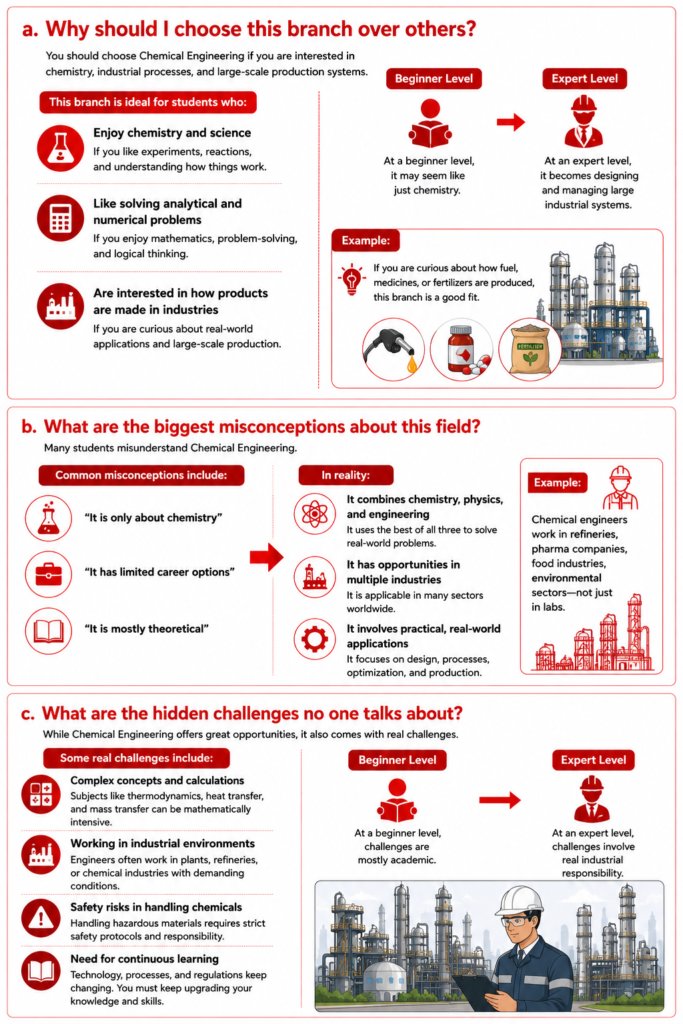
b. What are the biggest misconceptions about this field?
Chemical Engineering is one of the most misunderstood engineering disciplines. Many students make assumptions about the field based solely on its name and often overlook the wide range of opportunities and applications it offers. These misconceptions can prevent students from considering a branch that may actually align well with their interests and career goals.
Understanding the reality behind these misconceptions is important for making an informed career decision.
Misconception 1: “Chemical Engineering Is Only About Chemistry”
This is probably the most common misconception.
Because the word Chemical appears in the name, many students assume that Chemical Engineering is simply an advanced version of chemistry. In reality, chemistry is only one part of the discipline.
The Reality
Chemical Engineering combines several subjects, including:
- Chemistry
- Physics
- Mathematics
- Thermodynamics
- Fluid Mechanics
- Heat and Mass Transfer
- Process Control
- Material Science
- Engineering Design
Chemical Engineers focus on designing, operating, and improving industrial processes rather than just studying chemical reactions.
Example
A chemist may study how a reaction works in a laboratory.
A Chemical Engineer designs a process that can safely and economically perform that reaction on a large scale in a factory producing thousands of tons of product every year.
This distinction is what makes Chemical Engineering an engineering discipline rather than a pure science.
Misconception 2: “Chemical Engineers Only Work in Chemical Factories”
Many students believe Chemical Engineers can only work in chemical manufacturing plants.
The Reality
Chemical Engineering graduates work across numerous industries because their skills in process design, optimization, and problem-solving are highly transferable.
Industries That Hire Chemical Engineers
- Oil and Gas
- Petrochemicals
- Pharmaceuticals
- Biotechnology
- Food Processing
- Cosmetics
- Renewable Energy
- Environmental Engineering
- Water Treatment
- Materials Manufacturing
- Consulting
- Research and Development
Example
A Chemical Engineer may work in:
- A pharmaceutical company producing medicines.
- A food processing company improving manufacturing efficiency.
- A renewable energy company developing biofuels.
- An environmental organization designing wastewater treatment systems.
The field offers far more diversity than most students realize.
c. What are the hidden challenges no one talks about?
Chemical Engineering is often presented as a field with excellent career opportunities, strong industrial demand, and diverse applications. While these advantages are true, every profession comes with challenges that are not always discussed openly. Understanding these challenges before choosing the branch can help students prepare better and develop realistic expectations about their future careers.
The good news is that these challenges can be managed successfully with the right mindset, skills, and preparation. In fact, overcoming these difficulties is often what helps Chemical Engineers become highly valued professionals.
1. Complex Concepts and Calculations
One of the first challenges students encounter is the technical complexity of the subject.
Chemical Engineering is not limited to chemistry. It combines:
- Mathematics
- Physics
- Chemistry
- Thermodynamics
- Fluid Mechanics
- Heat Transfer
- Mass Transfer
- Reaction Engineering
- Process Control
Many students enter the branch expecting mostly chemistry and are surprised by the amount of mathematics and engineering analysis involved.
Why It Is Challenging
The concepts are interconnected and often require a strong understanding of multiple subjects at the same time.
For example:
- Designing a reactor may require knowledge of chemistry, heat transfer, fluid flow, and reaction kinetics.
- Optimizing a production process may involve mathematical modeling and data analysis.
How to Overcome It
- Build strong fundamentals from the first year.
- Focus on understanding concepts rather than memorizing formulas.
- Solve numerical problems regularly.
- Use simulation software to visualize engineering processes.
2. Transition from Classroom Learning to Real Industry
Many students perform well academically but find industrial environments very different from classrooms and laboratories.
Why It Is Challenging
Industrial facilities are large, complex, and operate continuously. Engineers must understand:
- Production processes
- Equipment operation
- Safety procedures
- Industrial regulations
- Team coordination
In a real plant, problems often do not have textbook solutions.
Example
A process that appears perfect on paper may behave differently due to equipment limitations, environmental conditions, or operational constraints.
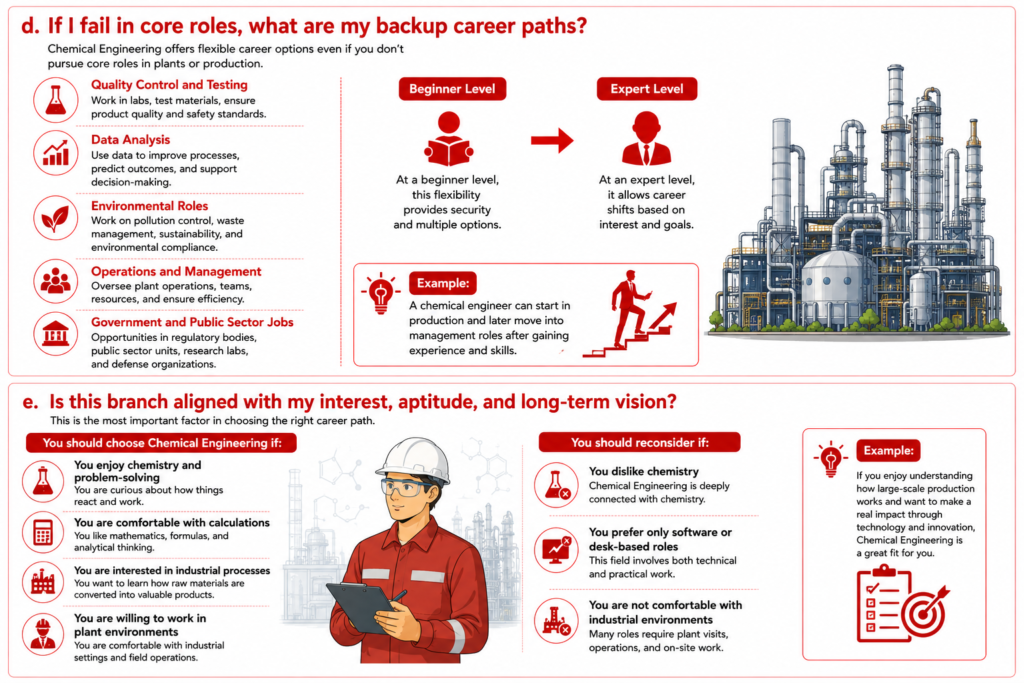
d. If I fail in core roles, what are my backup career paths?
One of the biggest advantages of Chemical Engineering is its versatility. Many students worry that if they are unable to secure a core job in a refinery, chemical plant, pharmaceutical company, or manufacturing facility, their degree may become less useful. In reality, Chemical Engineering develops analytical thinking, problem-solving ability, process understanding, and technical skills that are valuable across many industries.
This means that even if you do not continue in traditional core roles, there are numerous alternative career paths available. In fact, many successful professionals start in one area and later transition into completely different fields based on their interests, strengths, and career goals.
Why Chemical Engineers Have Strong Backup Options
Chemical Engineering teaches students how to:
- Analyze complex systems
- Solve technical problems
- Work with data
- Optimize processes
- Manage resources efficiently
- Understand industrial operations
These skills are useful in many professions beyond traditional chemical industries.
As a result, Chemical Engineers can move into technical, managerial, environmental, analytical, and government-related roles.
1. Quality Control and Testing
Quality Control (QC) and Quality Assurance (QA) are among the most common backup career paths for Chemical Engineering graduates.
What You Do
Professionals in quality-related roles ensure that products meet required standards before they reach customers.
Responsibilities include:
- Product testing
- Laboratory analysis
- Quality inspections
- Process monitoring
- Regulatory compliance
- Documentation and reporting
Industries
Manufacturing
Pharmaceuticals
Food Processing
Chemicals
Cosmetics
Consumer Goods
e. Is this branch aligned with my interest, aptitude, and long-term vision?
This is perhaps the most important question to ask before choosing any engineering branch. A branch may offer excellent career opportunities, high salaries, and global demand, but if it does not match your interests, abilities, and long-term goals, you may struggle to stay motivated and succeed in the field.
Chemical Engineering is a rewarding and versatile discipline, but it is not the right choice for everyone. Understanding whether it aligns with your personality, strengths, and career aspirations can help you make a confident and informed decision.
Why Alignment Matters
Students often choose branches based on:
- Placement statistics
- Popularity
- Peer pressure
- Family recommendations
- Salary expectations
While these factors are important, long-term career satisfaction usually comes from working in a field that genuinely interests you and matches your natural abilities.
A Chemical Engineer may spend decades working with industrial processes, production systems, energy technologies, pharmaceuticals, or environmental solutions. Therefore, personal interest and aptitude play a major role in long-term success.
You Should Choose Chemical Engineering If…
1. You Enjoy Chemistry and Science
Chemistry is one of the foundational subjects in Chemical Engineering.
Although the field involves much more than chemistry, you will frequently encounter concepts related to:
- Chemical reactions
- Material properties
- Process chemistry
- Industrial chemical production
If you enjoy understanding how substances interact and transform, you are likely to find many aspects of Chemical Engineering interesting.
Example
You may enjoy learning how:
- Crude oil becomes fuel.
- Raw materials become fertilizers.
- Active ingredients become medicines.
- Waste materials are converted into useful products.
Curiosity about these processes is a strong indicator that the field may suit you.
2. You Like Problem-Solving and Analytical Thinking
Chemical Engineers solve complex technical problems every day.
You should be comfortable with:
- Logical reasoning
- Critical thinking
- Data analysis
- Troubleshooting
- Process optimization
Many engineering challenges do not have straightforward solutions. Engineers often need to evaluate multiple options and determine the most efficient and economical approach.
Example
If a production process is consuming too much energy, a Chemical Engineer must analyze the system and identify ways to improve efficiency without compromising product quality.
Students who enjoy solving puzzles, analyzing systems, and finding solutions often thrive in this field.
CONCLUSION:
Chemical Engineering is a challenging but highly valuable branch that offers stable and diverse career opportunities. It is the right choice only for students who are genuinely interested in chemistry, industrial processes, and problem-solving. A clear understanding of its demands and realities helps in making an informed and confident career decision.