
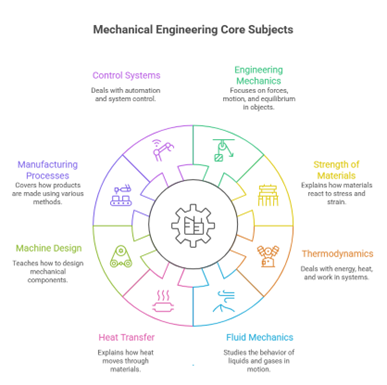
1. What are the key subjects I must master in this branch?
Mechanical Engineering is structured around a set of core subjects that build your understanding step by step—from basic physics to advanced system design.
🔹 1. Engineering Mechanics
This is the foundation of the branch. It deals with forces, motion, and equilibrium. Students learn how objects behave under different loads and conditions. For example, analyzing how a beam supports weight is part of this subject.
🔹 2. Strength of Materials
This subject explains how materials react under stress and strain. It helps engineers determine whether a component will bend, deform, or break. For instance, designing a bridge support or machine shaft requires this knowledge.
🔹 3. Thermodynamics
One of the most important subjects, thermodynamics deals with energy, heat, and work. It explains how engines, refrigerators, and power plants function. Understanding energy conversion is central to mechanical engineering.
🔹 4. Fluid Mechanics
This subject studies the behavior of liquids and gases in motion. It is used in designing pumps, pipelines, turbines, and aerodynamic systems. For example, airflow over an airplane wing is explained using fluid mechanics.
🔹 5. Heat Transfer
Heat transfer focuses on how heat moves through materials via conduction, convection, and radiation. It is essential in designing cooling systems, heat exchangers, and thermal devices.
🔹 6. Machine Design
This subject teaches how to design mechanical components like gears, shafts, and bearings. It combines theory and application to create safe and efficient machines.
🔹 7. Manufacturing Processes
It covers how products are made using processes like casting, welding, machining, and forming. Engineers must understand production methods to design manufacturable products.
🔹 8. Control Systems
This subject deals with automation and system control. It is used in robotics, industrial automation, and smart systems.
Mastering these subjects ensures you can analyze, design, and build real-world mechanical systems.
2. What level of mathematics is required?
Mathematics is a core tool in Mechanical Engineering, and the level required is generally moderate to advanced.
🔹 Basic Mathematics
At the initial level, students use algebra and trigonometry to solve simple problems. These are important for understanding geometry and motion.
🔹 Calculus (Very Important)
Calculus is heavily used in subjects like thermodynamics, fluid mechanics, and heat transfer. Engineers use differentiation and integration to analyze changes in temperature, velocity, and pressure.
For example:
- Heat transfer rates are calculated using calculus
- Fluid flow equations depend on differential equations
🔹 Differential Equations
These are used to model dynamic systems, such as vibrations in machines or temperature variation in systems over time.
🔹 Linear Algebra
Used in simulations, matrix operations, and control systems. It is especially important in advanced analysis and computational methods.
🔹 Statistics and Probability
Statistics is used in quality control, reliability analysis, and data interpretation. For example, engineers analyze production data to improve quality. In summary:
Mechanical Engineering requires strong mathematical understanding, but it is always applied to real-world problems, not just abstract theory.
3. Which scientific principles are fundamental here?
Mechanical Engineering is deeply rooted in physics and applied science. These principles form the backbone of all engineering concepts.
🔹 Newton’s Laws of Motion
These laws explain how objects move and respond to forces. Every machine—from vehicles to robots—operates based on these laws.
🔹 Laws of Thermodynamics
These laws govern energy conversion and heat transfer. For example, they explain how engines generate power and why energy losses occur.
🔹 Conservation Principles
- Conservation of Energy
- Conservation of Mass
- Conservation of Momentum
These principles ensure that physical systems behave predictably.
🔹 Fluid Flow Principles
Concepts like Bernoulli’s equation and continuity equations explain how fluids behave. These are used in designing pipelines, pumps, and aircraft.
🔹 Material Science
This explains how materials behave under stress, temperature, and environmental conditions. Engineers must choose materials based on strength, durability, and cost.
🔹 Heat Transfer Principles
These include conduction, convection, and radiation, which explain how heat moves through systems.
These scientific principles help engineers predict behavior, design systems, and solve real-world problems.
4. What are the most difficult concepts students struggle with?
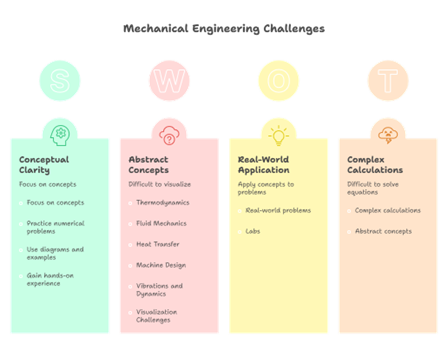
Mechanical Engineering is concept-heavy, and certain topics are known to be challenging for students.
🔹 Thermodynamics
Students often struggle with understanding energy cycles and abstract concepts like entropy. It requires both conceptual clarity and mathematical application.
🔹 Fluid Mechanics
Visualizing fluid flow and solving equations related to pressure and velocity can be difficult. Concepts like turbulence are complex.
🔹 Heat Transfer
Understanding different modes of heat transfer and solving real-world problems can be challenging due to complex calculations.
🔹 Machine Design
Designing components requires combining multiple concepts—materials, forces, and safety factors. It demands precision and understanding.
🔹 Vibrations and Dynamics
These topics involve complex mathematics and require strong conceptual understanding of motion and oscillations.
🔹 Visualization Challenges
Many concepts involve imagining how systems behave internally, such as stress distribution or fluid flow, which is not easy initially.
The key to overcoming these challenges:
✔ Focus on concepts, not memorization
✔ Practice numerical problems regularly
✔ Use diagrams and real-world examples
✔ Gain hands-on experience in labs
5. Is this branch more theoretical, practical, or hybrid?
Mechanical Engineering is best described as a hybrid branch, combining both theory and practical application.
🔹 Theoretical Aspect
Students learn scientific laws, mathematical models, and engineering concepts. For example, thermodynamics explains how energy behaves in theory.
🔹 Practical Aspect
Lab work and workshops allow students to apply these concepts. For instance:
- Testing material strength in labs
- Performing heat transfer experiments
- Working on machines in workshops
🔹 Industrial Application
In real industries, engineers apply both theory and practice. For example, designing an engine requires theoretical calculations and practical testing.
🔹 Balance of Both
Focusing only on theory is not enough. Similarly, practical work without understanding theory leads to errors. Success in mechanical engineering requires balancing both.
CONCLUSION
Mechanical Engineering is built on a strong academic foundation that combines science, mathematics, and real-world application.
✔ Core subjects provide technical knowledge
✔ Mathematics helps in analysis and modeling
✔ Scientific principles explain system behavior
✔ Challenges develop problem-solving skills
✔ Hybrid nature prepares engineers for real-world work