
🔹 How will AI impact this branch?
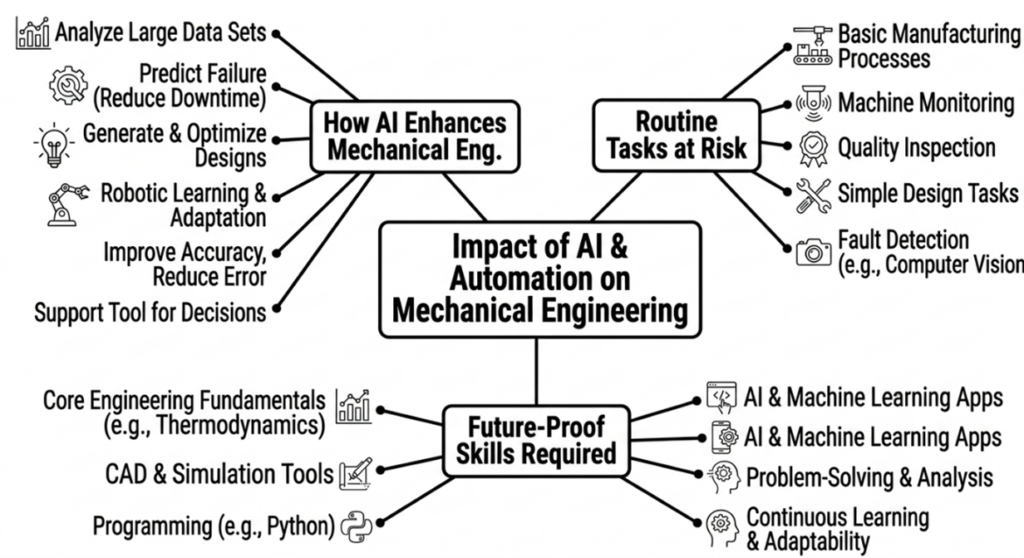
AI will enhance mechanical engineering by making systems smarter, faster, and more efficient. It allows engineers to analyze large amounts of data from machines and make better decisions. For example, in a factory, AI can monitor machine performance and predict when a component might fail, reducing downtime. In design, AI can generate multiple design options and optimize them based on performance criteria like weight or strength. This reduces the time required for product development. AI is also used in robotics, where machines can learn and adapt to tasks. In manufacturing, AI-driven automation improves accuracy and reduces human error. Engineers will increasingly rely on AI tools for simulation, analysis, and decision-making. However, human expertise is still required to interpret results and make final decisions. Overall, AI acts as a powerful support tool, not a replacement for engineers.
🔹 What parts of this field are at risk of automation?
Certain routine and repetitive tasks in mechanical engineering are at risk of automation. Basic manufacturing processes, such as assembly line operations, are already being handled by robots. Machine monitoring and data collection are increasingly automated using sensors and AI systems. For example, quality inspection in factories can now be done using computer vision systems instead of manual checking. Simple design tasks that follow standard patterns can also be automated using software tools. Maintenance tasks like detecting faults are increasingly handled by predictive systems. However, complex problem-solving, innovation, and decision-making cannot be fully automated. Engineers are still needed to design systems, interpret data, and solve unexpected problems. Therefore, automation mainly replaces repetitive work, not skilled engineering roles. Engineers who focus only on routine tasks may face challenges, while those with advanced skills will remain valuable.
🔹 What skills make me future-proof in this domain?
To remain relevant in the future, mechanical engineers must develop a combination of core engineering knowledge and modern technical skills. Strong fundamentals in subjects like thermodynamics, mechanics, and materials are essential. Along with this, knowledge of CAD and simulation tools is highly important. Learning programming languages like Python helps in data analysis and automation. Understanding AI and machine learning applications in engineering provides a competitive advantage. For example, using data to predict machine failure is a valuable skill. Problem-solving and analytical thinking remain critical in all roles. Communication skills are also important for teamwork and project management. Engineers should focus on continuous learning and adaptability. Keeping up with new technologies ensures long-term career growth. These combined skills make an engineer future-proof and industry-ready.
🔹 Is this branch evolving towards interdisciplinary roles?
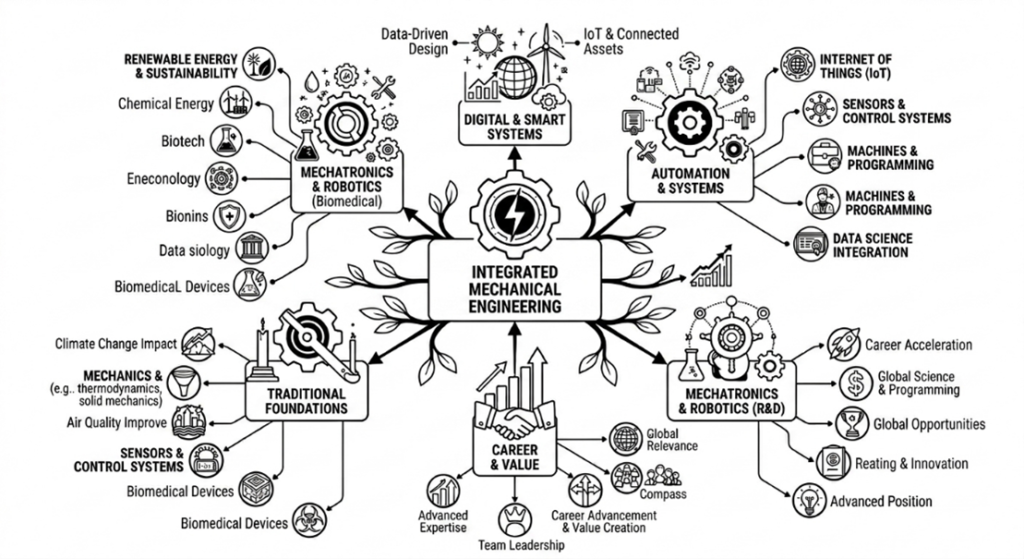
Yes, mechanical engineering is increasingly evolving into an interdisciplinary field, combining knowledge from multiple domains. Modern engineering problems require integration of mechanical systems with electronics, software, and data science. For example, robotics combines mechanical design with sensors and control systems. Mechatronics is a field that merges mechanical and electrical engineering. In automation, engineers must understand both machines and programming. Renewable energy systems require knowledge of environmental science along with mechanical design. Biomedical engineering uses mechanical principles to design medical devices. This shift means engineers can no longer rely only on traditional mechanical knowledge. Learning additional skills increases career opportunities and flexibility. Interdisciplinary knowledge also helps in innovation and research. The future of mechanical engineering lies in integration with modern technologies.
CONCLUSION
AI and automation are not threats—they are tools that redefine mechanical engineering.
✔ AI improves efficiency and decision-making
✔ Automation replaces repetitive tasks, not skilled engineers
✔ Future-proof engineers combine core knowledge with modern skills
✔ The field is evolving into interdisciplinary domains
The key to success is simple:
Adapt, learn, and upgrade your skills continuously