(This is the part most students underestimate—but it’s what actually decides whether you struggle or grow in this branch.)
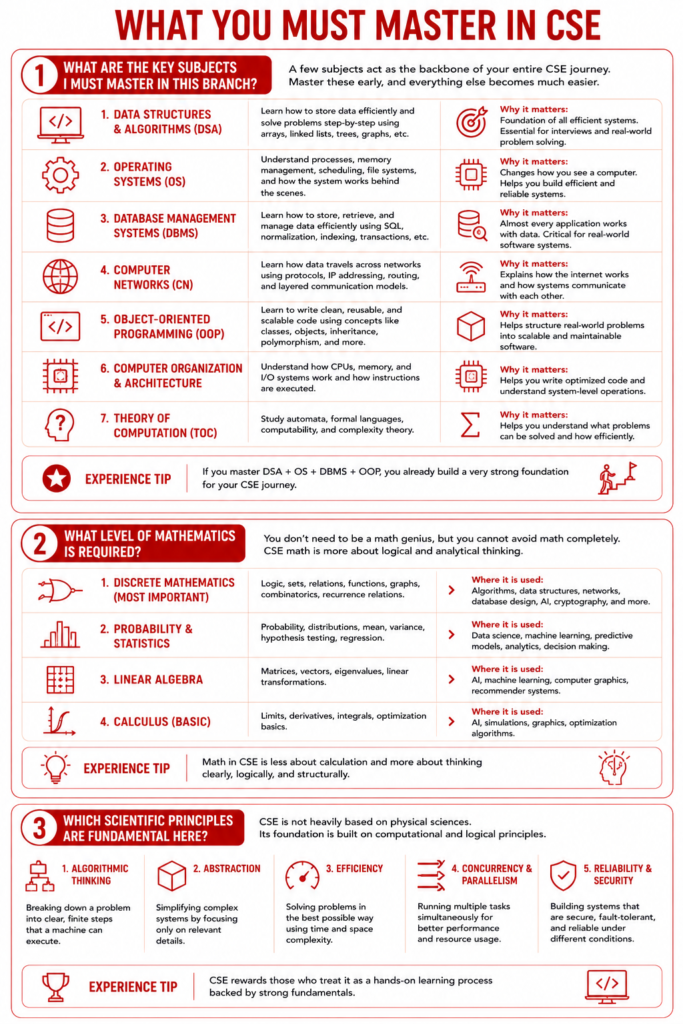
1. What are the key subjects I must master in this branch?
When I look back, one mistake many students make is treating all subjects equally. In reality, a few subjects act as the backbone of your entire CSE journey. If you get these right early, everything else becomes much easier.
The first and most important is Data Structures & Algorithms (DSA). This is where you learn how to store data efficiently and solve problems step-by-step. At first, it feels abstract—arrays, linked lists, trees—but later you realize this is exactly what companies test in interviews and what real systems depend on. Every efficient app or system you use is built on strong algorithmic thinking.
Then comes Operating Systems (OS). This subject completely changes how you see a computer. Before OS, you think your code runs directly. After OS, you understand processes, memory management, scheduling, and how the system actually works behind the scenes. It’s one of those subjects that feels confusing initially but becomes powerful once it clicks.
Another major subject is Database Management Systems (DBMS). Almost every real-world application deals with data, and DBMS teaches you how to store, retrieve, and manage that data efficiently. Concepts like normalization, indexing, and transactions might seem dry at first, but they are critical in real systems.
You’ll also study Computer Networks (CN), which explains how data travels across the internet. Earlier, I never thought about what happens when I click “send”—but CN explains protocols, IP addresses, and communication layers that make everything possible.
Then there’s Object-Oriented Programming (OOP). This is where you learn how to write clean, reusable, and scalable code using concepts like classes, inheritance, and polymorphism. It’s less about syntax and more about structuring real-world problems into code.
Finally, subjects like Computer Organization & Architecture and Theory of Computation (TOC) give you deeper insight into how machines think and what problems are even solvable.
From experience, if you master DSA + OS + DBMS + OOP, you already build a very strong foundation.
2. What level of mathematics is required?
This is something many students worry about, so let me be very honest: you don’t need to be a math genius, but you cannot avoid math completely in CSE.
The math here is not about solving long equations like in traditional engineering branches. Instead, it’s more about logical and analytical thinking.
You’ll encounter Discrete Mathematics, which is probably the most important type of math in CSE. It includes logic, sets, relations, graphs, and combinatorics. At first, it feels very different from school math, but it directly connects to algorithms and problem-solving.
For example, understanding graphs in math helps you understand network routing or social media connections.
Concepts like the Pythagorean relationship may seem basic, but similar mathematical thinking extends into algorithm optimization and computational geometry.
You’ll also use Probability and Statistics, especially if you go into data science or machine learning. This includes understanding distributions, averages, and prediction models.
Some parts of Linear Algebra and Calculus are used in advanced areas like AI, graphics, and simulations—but for most core software roles, you won’t use heavy calculus daily.
From what I’ve seen, math in CSE is less about calculation and more about thinking clearly, logically, and structurally.
3. Which scientific principles are fundamental here?
Unlike branches like mechanical or civil engineering, CSE is not heavily based on physical sciences like physics or chemistry. Instead, its foundation is built on computational and logical principles.
The most important principle is algorithmic thinking—breaking down a problem into clear, finite steps that a machine can execute.
Then comes abstraction, which means simplifying complex systems by focusing only on relevant details. For example, when you use an app, you don’t think about how memory is managed internally—that complexity is abstracted away.
Another key principle is efficiency—time complexity and space complexity. It’s not enough to solve a problem; you need to solve it in the best possible way.
You’ll also encounter concurrency and parallelism, especially in operating systems and modern computing, where multiple tasks run at the same time.
From my experience, CSE is less about memorizing scientific laws and more about understanding how systems behave and interact logically.
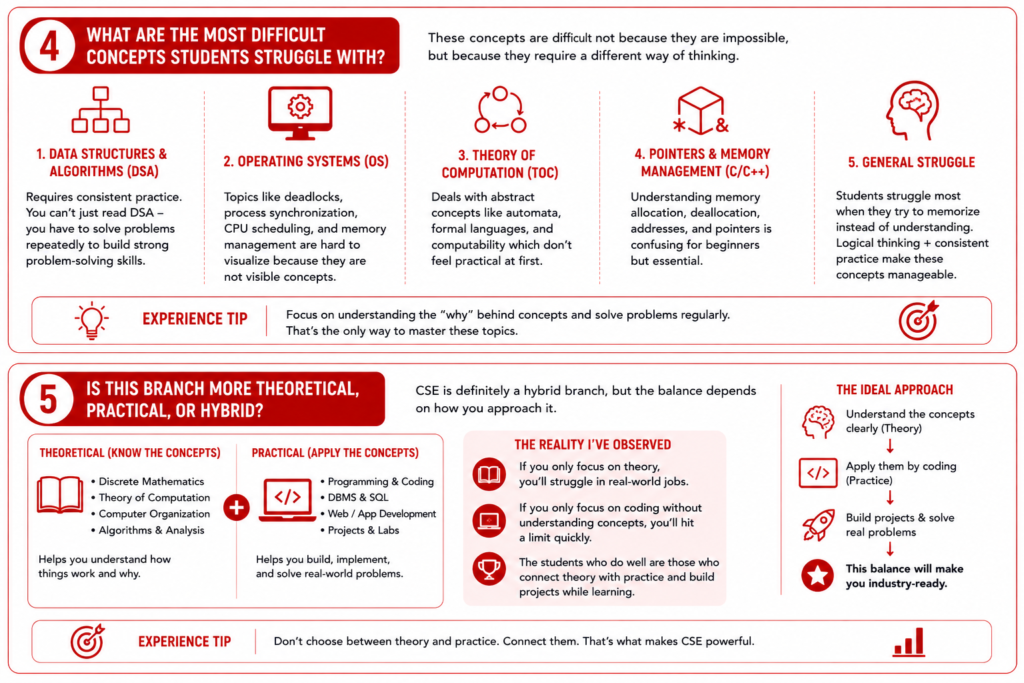
4. What are the most difficult concepts students struggle with?
This is where most students face reality. Some concepts in CSE are not hard because they are complicated—they are hard because they require a different way of thinking.
The first major struggle is Data Structures & Algorithms. Not because the concepts are impossible, but because they require practice. You can’t just read DSA—you have to solve problems repeatedly.
Another challenging subject is Operating Systems, especially topics like deadlocks, process synchronization, and memory management. These are not visible concepts, so students often struggle to visualize them.
Theory of Computation (TOC) is another subject that many students find difficult. It deals with abstract concepts like automata and computability, which don’t feel directly practical at first.
Pointers and memory management in languages like C/C++ also confuse many beginners because they require understanding how memory works internally.
From what I’ve seen, students struggle most when they try to memorize instead of understanding. Once you start thinking logically and practicing consistently, these subjects become manageable.
5. Is this branch more theoretical, practical, or hybrid?
CSE is definitely a hybrid branch, but the balance depends on how you approach it.
In college, you’ll notice a mix of theory and practicals. Subjects like TOC and Discrete Math are more theoretical, while programming, DBMS, and projects are more practical.
But here’s the reality I’ve observed:
If you only focus on theory, you’ll struggle in real-world jobs.
If you only focus on coding without understanding concepts, you’ll hit a limit quickly.
The students who do well are those who connect theory with practice. For example, when you learn a data structure, you should also implement it. When you learn databases, you should build a project using them.
From my experience, CSE rewards those who treat it as a hands-on learning process backed by strong fundamentals.