(This is the layer where theory finally meets reality—and where most students either stand out or get left behind.)
1. What software tools are essential?
When I started, I genuinely believed that if I just learned a programming language well, I’d be ready for jobs. But the first time I worked on even a small project, I realized something important:
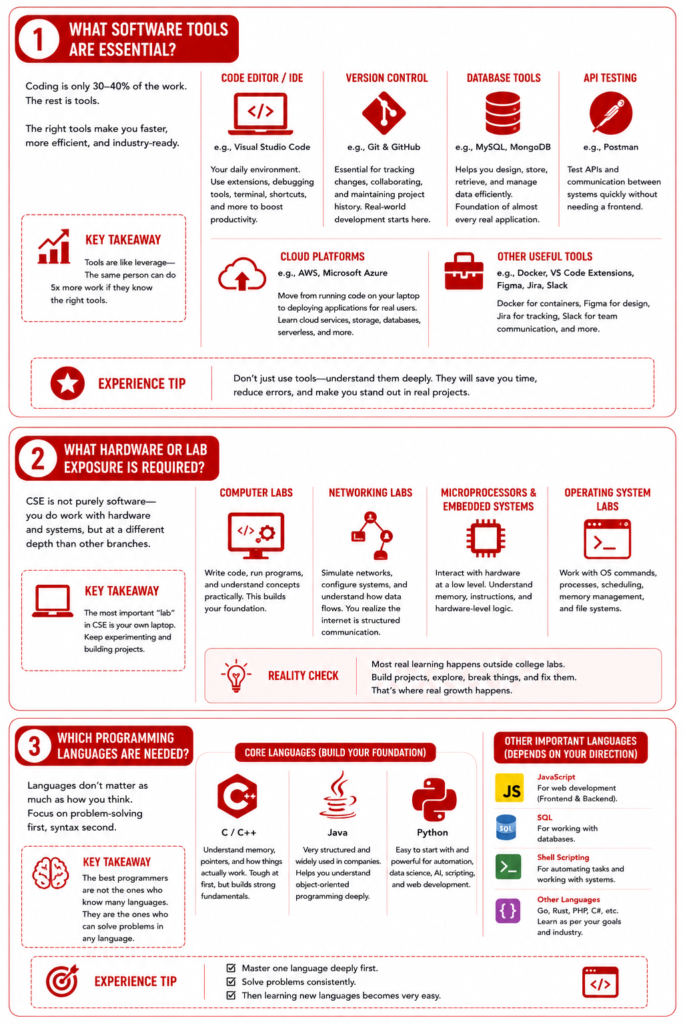
Coding is only 30–40% of the work. The rest is tools.
The first tool you’ll live inside is your code editor or IDE. Something like Visual Studio Code becomes your daily environment. Initially, you just write code. But over time, you start using extensions, debugging tools, terminal integration, and shortcuts. That’s when productivity increases. I’ve seen students waste hours doing things manually that could be done in seconds if they knew their editor properly.
Then comes version control, and honestly, this is where students start realizing how real-world development works. Tools like Git and platforms like GitHub are not optional. The first time you accidentally break your code and can’t go back—you understand why Git exists. The first time you collaborate with someone—you realize how important version control is.
Next is database tools. Most beginner projects ignore proper data handling, but real applications depend heavily on it. Using systems like MySQL or MongoDB teaches you how to think in terms of data flow, storage, and retrieval—not just code.
Another underrated tool is API testing using Postman. When you build applications, different parts need to communicate. Postman helps you test that communication without needing a full frontend. It saves time and helps you debug faster.
As you move forward, you’ll enter the world of cloud computing. Platforms like Amazon Web Services and Microsoft Azure change your perspective completely. You go from “running code on your laptop” to “deploying applications for real users.”
From my experience, tools are like leverage—
The same person can do 5x more work if they know the right tools.
2. What hardware or lab exposure is required?
One of the biggest myths I had was that CSE doesn’t involve hardware at all. That’s not entirely true—but it’s also not like mechanical or civil engineering.
In college, you’ll spend time in computer labs, writing code, running programs, and understanding concepts practically. At first, it feels basic—but this is where your fundamentals start forming.
You may also encounter networking labs, where you simulate networks, configure systems, and understand how data flows. This is the first time many students realize that the internet is not “magic”—it’s structured communication.
Some courses introduce microprocessors or embedded systems, where you interact with hardware at a low level. This can feel difficult because now you’re closer to the machine—dealing with memory, instructions, and hardware-level logic.
But let me be very real here:
The most important “lab” in CSE is your own laptop.
Everything that actually matters—projects, coding practice, learning frameworks, deploying apps—happens outside college labs. Students who depend only on college infrastructure usually stay average.
From what I’ve seen, the students who grow the fastest are the ones who treat their laptop like a personal lab and keep experimenting.
3. Which programming languages are needed?
This is where most beginners get stuck. I’ve seen students jump from one language to another—C, then Python, then Java—without mastering any.
Here’s what I learned the hard way:
Languages don’t matter as much as how you think.
Still, some languages are extremely useful:
- C/C++ → This is where your brain gets trained. You understand memory, pointers, and how things actually work. It’s tough at first, but it builds strong fundamentals.
- Java → Very structured, widely used in companies. Helps you understand object-oriented programming deeply.
- Python → Easy to start with, powerful for automation, data science, and AI.
Later, depending on your direction:
- JavaScript → For web development
- SQL → For working with databases
- Shell scripting → For working with systems
But here’s something I wish someone told me earlier:
The best programmers are not the ones who know many languages
They are the ones who can solve problems in any language
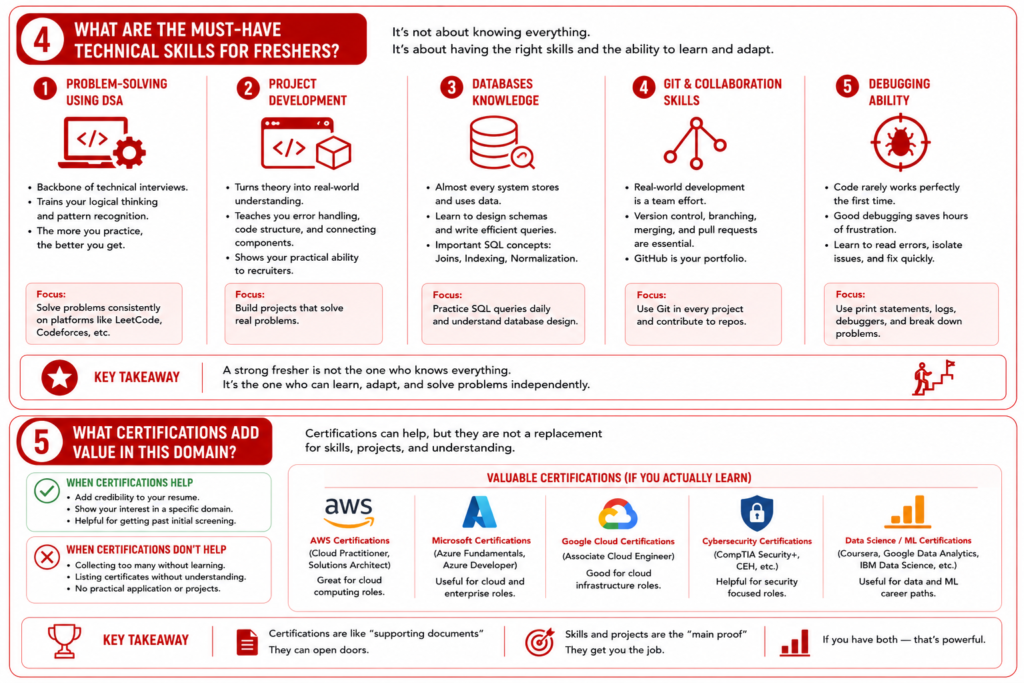
4. What are the must-have technical skills for freshers?
This is the most important part—and also where reality hits.
I’ve seen students with high marks struggle in placements, and average students get great jobs. The difference is not intelligence—it’s skills.
The first must-have skill is problem-solving using Data Structures & Algorithms (DSA). This is the backbone of technical interviews. But more than that, it trains your thinking. Initially, problems feel impossible. But after solving enough, your brain starts recognizing patterns.
Second is project development. This is where theory becomes real. Building even a simple project teaches you things no textbook can—like handling errors, structuring code, and connecting different components.
Third is understanding databases. Almost every real system uses data. Knowing how to design and query databases makes you much more practical.
Fourth is Git and collaboration skills. In real jobs, you don’t work alone. Knowing how to manage code with others is essential.
Fifth is debugging ability. This is underrated. In real life, code rarely works perfectly the first time. Being able to identify and fix issues quickly is a huge advantage.
From what I’ve observed:
A strong fresher is not the one who knows everything
It’s the one who can learn, adapt, and solve problems independently
5. What certifications add value in this domain?
Let me be very honest here, because many students misunderstand this.
I’ve seen people collect 10–15 certificates and still struggle to get interviews. At the same time, I’ve seen students with zero certificates get selected—because they had strong skills and projects.
Certifications from platforms or companies like Amazon Web Services or Microsoft can add value, especially in areas like cloud computing.
Certifications in data science, cybersecurity, or specific technologies can also help—but only if you actually understand the content.
From experience:
Certifications are like “supporting documents”
Skills and projects are the “main proof”
If you have both, that’s powerful. If you only have certificates, it doesn’t help much.