
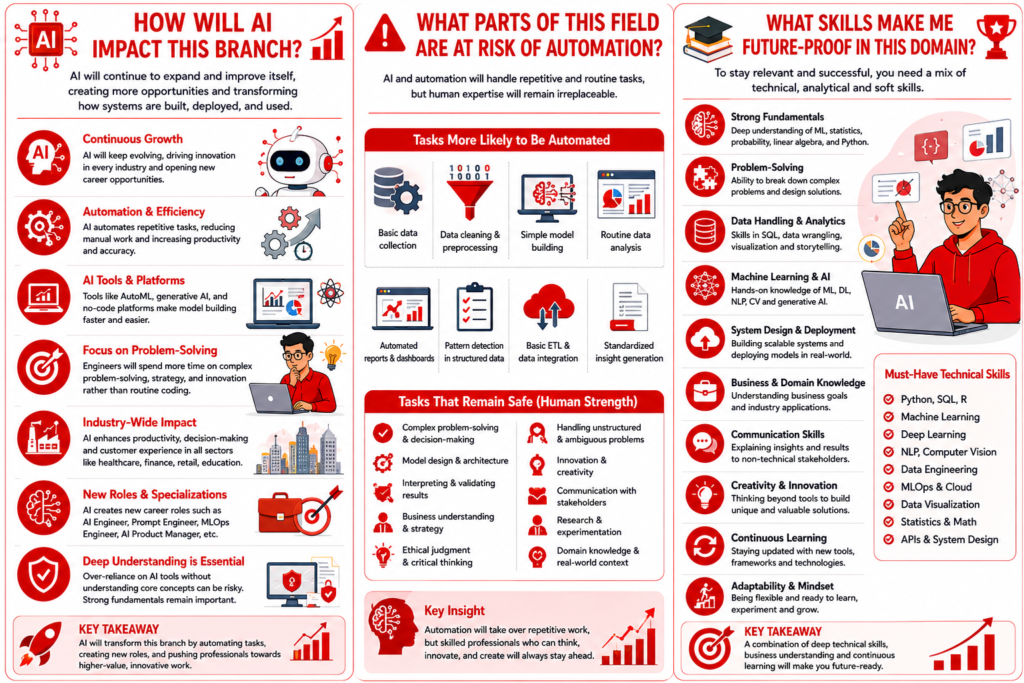
➤How will AI impact this branch?
Artificial Intelligence is not only the foundation of AI & Data Science but also the driving force behind its future evolution. As AI technologies continue to advance, this branch will experience rapid transformation in the way data is collected, analyzed, processed, and used to solve real-world problems. Between now and the coming decades, AI will become more powerful, accessible, and integrated into almost every industry. Rather than replacing the field, AI will expand its capabilities, create new career opportunities, and redefine the roles of AI & Data Science professionals.
One of the biggest impacts of AI will be increased automation. Many repetitive and time-consuming tasks such as data cleaning, feature engineering, model selection, hyperparameter tuning, report generation, and basic coding will increasingly be handled by AI-powered tools. Technologies like AutoML, GitHub Copilot, ChatGPT, Google Vertex AI, Azure AI, and Amazon SageMaker are already helping developers build, test, and deploy machine learning models much faster. This automation allows professionals to spend less time on routine work and more time solving complex business problems.
➤What parts of this field are at risk of automation?
Artificial Intelligence is rapidly changing the way professionals work in AI & Data Science. As AI-powered tools become more advanced, many repetitive and time-consuming tasks are being automated. However, automation is designed to assist professionals rather than replace them completely. It eliminates routine work, allowing engineers and data scientists to focus on solving complex business problems, creating innovative solutions, and making strategic decisions. Understanding which tasks are likely to be automated helps students prepare for the future by developing skills that remain valuable.
One of the areas most affected by automation is data cleaning and preprocessing. Traditionally, data scientists spent a significant amount of time handling missing values, removing duplicate records, correcting formatting issues, detecting outliers, and transforming raw data into a usable format. Today, many AI-powered tools and data preparation platforms can perform these repetitive tasks automatically. Although human supervision is still required to ensure data quality, automation significantly reduces manual effort.
➤What skills make me future-proof in this domain?
The field of Artificial Intelligence (AI) & Data Science is evolving at an extraordinary pace. New algorithms, tools, frameworks, and technologies emerge every year, making continuous learning essential for long-term success. While AI can automate many routine tasks, professionals with strong technical knowledge, analytical thinking, creativity, and business understanding will continue to be in high demand. To build a successful and sustainable career, students must focus on developing a combination of technical skills, problem-solving abilities, communication skills, and adaptability. These are the qualities that will make you future-proof in this rapidly changing domain.
One of the most important skills is strong problem-solving and analytical thinking. AI professionals are expected to solve complex real-world problems rather than simply write code. They must analyze business requirements, identify patterns in data, evaluate different solutions, and select the most appropriate machine learning approach. Companies value professionals who can think critically, break down difficult problems, and design practical, data-driven solutions.
➤Is this branch evolving towards interdisciplinary roles?
Yes, Artificial Intelligence (AI) & Data Science is rapidly evolving into one of the most interdisciplinary fields in the world. Rather than existing as a standalone technology, AI is now being integrated with almost every major industry to solve complex real-world problems. As digital transformation accelerates, organizations increasingly require professionals who possess not only strong AI and Data Science skills but also an understanding of the industries in which these technologies are applied. This combination of technical expertise and domain knowledge creates exciting interdisciplinary career opportunities.
One of the strongest examples is the integration of AI with healthcare. AI-powered systems are helping doctors detect diseases earlier, analyze medical images, predict patient outcomes, recommend personalized treatments, and accelerate drug discovery. Technologies such as computer vision, deep learning, and predictive analytics are improving the accuracy and efficiency of healthcare services. AI professionals working in this field often collaborate with doctors, researchers, hospitals, and pharmaceutical companies. Understanding medical terminology, healthcare regulations, and clinical workflows becomes just as important as machine learning expertise.
Conclusion
AI is continuously evolving and transforming its own field. While automation may replace basic tasks, it also creates advanced opportunities. To stay relevant, you must focus on higher-level skills and adaptability. Understanding concepts deeply is more important than relying on tools. The future belongs to those who can evolve with technology. Learning in AI is a lifelong process.