
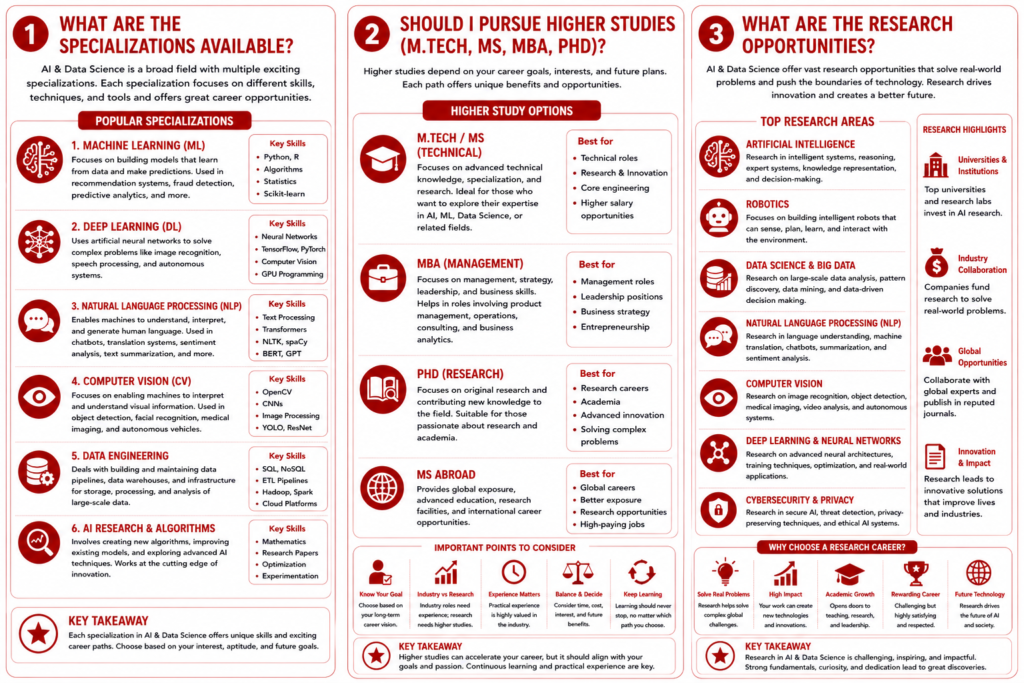
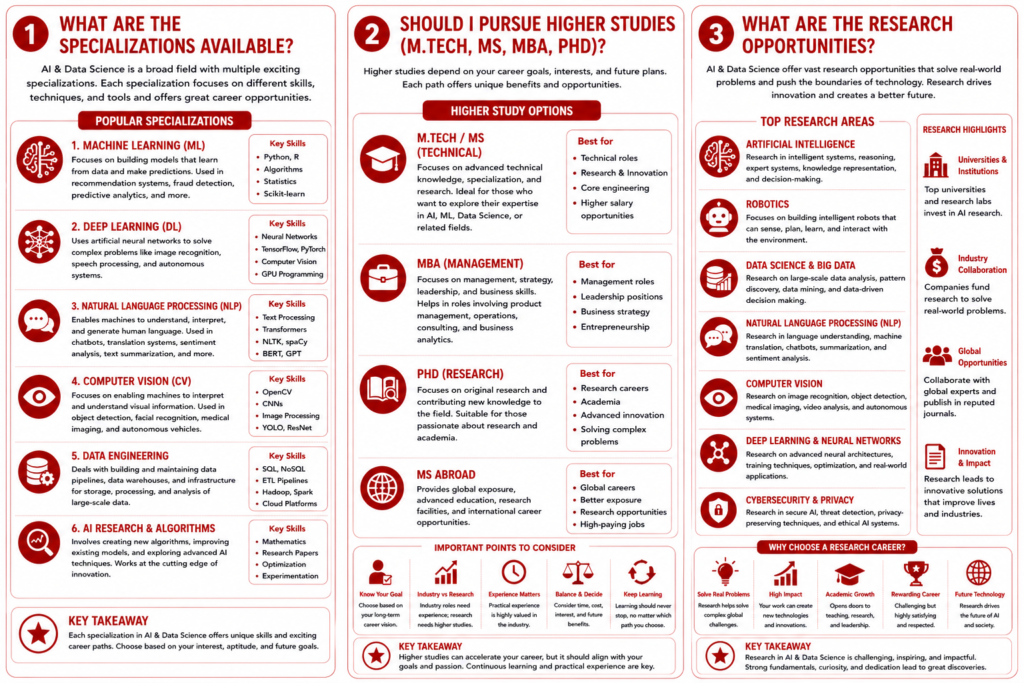
➤ What are the specializations available?
Artificial Intelligence (AI) & Data Science is a vast and rapidly evolving field with numerous specializations that cater to different interests, industries, and career goals. As AI continues to transform sectors such as healthcare, finance, manufacturing, education, agriculture, and entertainment, professionals can choose from a wide range of specialized domains based on their passion and strengths. Each specialization focuses on solving different types of real-world problems and requires a unique combination of technical skills, mathematical knowledge, programming expertise, and domain understanding.
Choosing a specialization is an important career decision because it allows students to develop deep expertise in a specific area rather than having only broad knowledge. While all AI professionals should have a strong foundation in programming, mathematics, machine learning, and statistics, specialization helps them become experts in solving particular types of challenges. Students should first explore multiple domains through projects, internships, online courses, and competitions before selecting the area that best matches their interests.
➤Should I pursue higher studies (M.Tech, MS, MBA, PhD)?
Pursuing higher studies after completing a Bachelor’s degree in Artificial Intelligence (AI) & Data Science is a personal decision that should be based on your career goals, interests, financial situation, and long-term aspirations. While a bachelor’s degree is sufficient to secure many AI-related jobs, higher education can help you gain specialized knowledge, improve technical expertise, increase earning potential, and open doors to research, leadership, and international career opportunities. There is no single path that suits everyone—the right choice depends on where you want your career to go.
Before deciding, students should ask themselves questions such as: Do I enjoy research? Do I want to become a technical expert? Am I interested in management? Do I want to work abroad? Your answers to these questions can help determine whether you should pursue an M.Tech, MS, MBA, PhD, or enter the industry directly.
➤What are the research opportunities?
Artificial Intelligence (AI) & Data Science is one of the most research-intensive and rapidly evolving fields in the world today. Every year, researchers develop new algorithms, improve existing models, and discover innovative ways to apply AI to solve complex real-world problems. Research in AI is not limited to universities—it is also carried out by technology companies, government organizations, startups, healthcare institutions, and international research laboratories. As AI continues to transform industries, the demand for skilled researchers who can develop next-generation intelligent systems is growing rapidly.
Research in AI & Data Science focuses on solving challenging problems that current technologies cannot fully address. Researchers aim to improve the accuracy, efficiency, fairness, security, and scalability of AI systems while discovering new methods that can benefit society. Their work contributes to scientific advancement, technological innovation, and economic development.
➤What global opportunities exist in this field?
Artificial Intelligence (AI) & Data Science is one of the most globally recognized and in-demand career fields today. Unlike many professions that are limited to specific industries or regions, AI professionals have opportunities to work across countries, industries, and technologies. As organizations worldwide embrace digital transformation, automation, cloud computing, and intelligent systems, the demand for skilled AI engineers, data scientists, and machine learning specialists continues to grow rapidly. This makes AI & Data Science one of the best career choices for students seeking international exposure, high salaries, and long-term career growth.
One of the biggest advantages of this field is that AI skills are universally applicable. Programming languages such as Python, SQL, Java, and C++, along with AI frameworks like TensorFlow, PyTorch, Scikit-learn, and cloud platforms such as AWS, Microsoft Azure, and Google Cloud, are used worldwide. This means that the skills learned in one country can easily be applied in another, making AI professionals highly mobile in the global job market.
➤How can I become a top 1% expert in this domain?
Becoming a top 1% expert in Artificial Intelligence (AI) & Data Science is a long-term journey that requires dedication, curiosity, consistency, and continuous learning. The field evolves rapidly, with new algorithms, tools, and technologies emerging every year. The professionals who reach the highest level are not necessarily the ones with the highest degrees, but those who continuously improve their skills, solve real-world problems, and contribute to the AI community. Achieving expertise requires mastering the fundamentals, gaining practical experience, building innovative projects, collaborating with experts, and staying updated with the latest advancements in technology.
The first step toward becoming an expert is to build an exceptionally strong foundation. Before diving into advanced AI models, you must master the core subjects that form the backbone of Artificial Intelligence. These include programming, mathematics, statistics, data structures, algorithms, databases, and computer science fundamentals. Understanding why algorithms work is far more valuable than simply learning how to use AI libraries.
Conclusion
AI offers unlimited growth opportunities if you choose the right path. Specialization helps in building expertise in a specific domain. Higher studies can add value but are not mandatory for success. Global opportunities are strong in this field. Becoming a top expert requires consistency and deep understanding. Long-term vision and dedication are key to success.