
➤How will AI impact this branch?
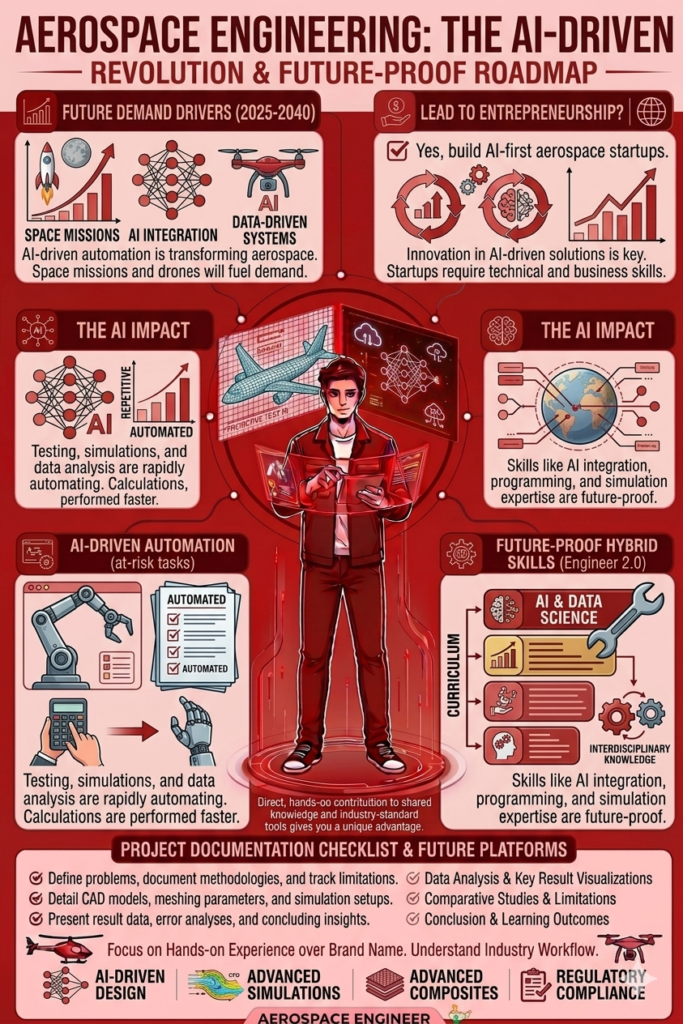
AI is transforming aerospace through automation and smart systems. It improves design and maintenance processes. For example, AI predicts aircraft failures before they occur. It enhances safety and efficiency. Engineers use AI for simulations. AI reduces human error. It also speeds up development. Integration of AI is increasing rapidly. Aerospace is becoming more data-driven.
➤What parts of this field are at risk of automation?
Repetitive tasks like testing, simulation, and data analysis are being automated. AI tools can perform calculations faster. For example, simulation results can be generated automatically. However, creative design still يحتاج humans. Complex decision-making cannot be fully automated. Engineers must adapt to changes. Automation reduces manual workload. It increases efficiency.
➤What skills make me future-proof in this domain?
Skills like AI integration, programming, and simulation expertise are future-proof. Engineers must adapt to new technologies. For example, combining aerospace with data science is valuable. Continuous learning is essential. Problem-solving remains important. Interdisciplinary knowledge gives an advantage. Engineers must stay updated. Future roles require hybrid skills.
➤Is this branch evolving towards interdisciplinary roles?
Yes, aerospace is becoming interdisciplinary. It combines electronics, AI, and robotics. Engineers work across multiple domains. For example, drones require knowledge of sensors and programming. Collaboration is increasing. Industry demands versatile engineers. Interdisciplinary skills improve opportunities. This trend will continue in the future.
Conclusion
AI is reshaping aerospace, and engineers who adapt to technology and develop interdisciplinary skills will remain highly valuable.