1. What is the core problem domain this branch solves?
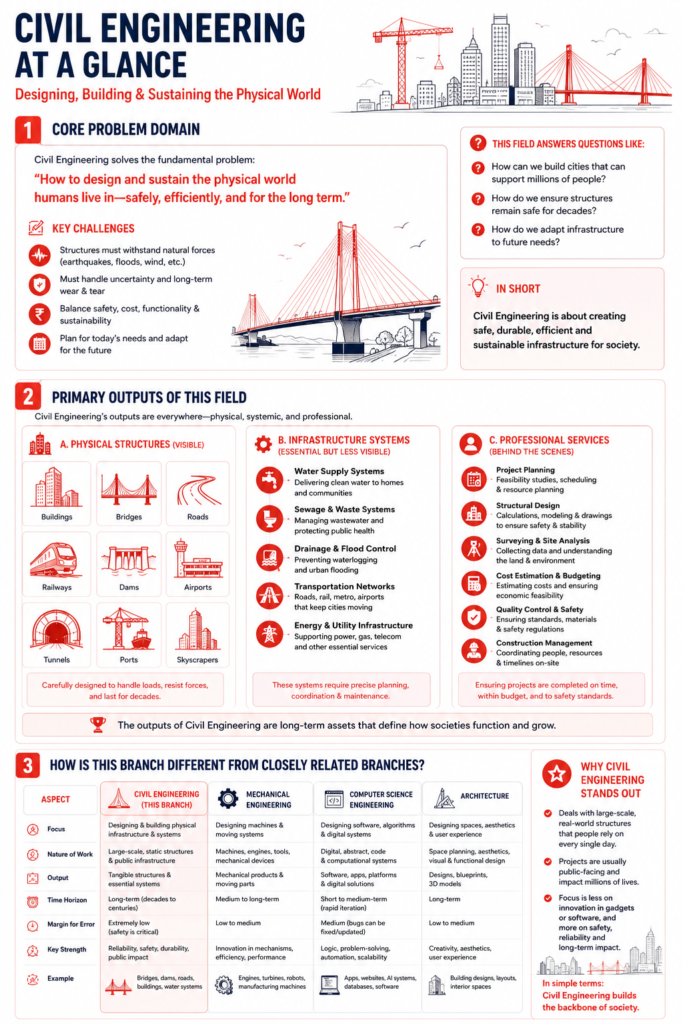
When I started looking at Civil Engineering beyond the textbook definition, I realized it’s fundamentally about solving one big problem: how to design and sustain the physical world humans live in. Every society, no matter how advanced, depends on infrastructure—places to live, roads to travel, systems for water, and structures that can withstand natural forces. Civil Engineering exists to make all of this possible in a safe, efficient, and long-lasting way.
The challenge is not just building something that stands—it’s building something that can handle uncertainty. Structures have to survive earthquakes, floods, heavy traffic, weather changes, and long-term wear and tear. Engineers must predict these forces even before construction begins. What makes this field complex is that once something is built, fixing mistakes is extremely expensive or sometimes impossible.
From what I’ve understood, Civil Engineering is really about balancing safety, cost, functionality, and sustainability, all at once. It answers questions like: How can we build cities that can support millions of people? How do we ensure structures remain safe for decades? How do we adapt infrastructure to future needs? That’s the real problem this branch is solving.
2. What are the primary outputs of this field (products, systems, services)?
One thing that stands out about Civil Engineering is that its outputs are everywhere—you interact with them every single day, often without realizing it. The most visible outputs are physical structures like buildings, bridges, roads, railways, dams, airports, and tunnels. These are not just constructions; they are carefully designed systems meant to handle loads, resist environmental forces, and last for years.
But beyond physical structures, there are also infrastructure systems that are equally important but less visible. For example, water supply systems that bring clean water to homes, sewage systems that manage waste, drainage systems that prevent flooding, and transportation networks that keep cities moving. These systems require precise planning and coordination, because even a small failure can affect thousands or millions of people.
Another major output is professional services. Civil engineers are deeply involved in project planning, structural design, surveying, cost estimation, quality control, and construction management. They ensure that projects are completed within budget, on time, and according to safety standards. From my perspective, what makes this branch unique is that its outputs are not short-term—they are long-term assets that define how societies function and grow.
3. How is this branch different from closely related branches?
At first glance, many engineering branches seem similar, especially to beginners. But once you look closely, Civil Engineering has a very distinct role. Unlike Mechanical Engineering, which focuses on machines and moving systems, Civil Engineering deals with static, large-scale structures that are fixed in place. Unlike Computer Science, which is mostly digital and abstract, Civil Engineering is completely physical and visible—you can literally see the results of your work in the real world.
Compared to Architecture, which focuses more on aesthetics, space planning, and user experience, Civil Engineering is more about structural safety, strength, and technical feasibility. Both fields work closely together, but their priorities are different.
Another key difference I’ve noticed is that Civil Engineering projects are usually large-scale, long-term, and public-facing. Once a bridge or building is constructed, it becomes part of people’s daily lives for decades. That means the margin for error is extremely low, and the responsibility is very high. In simple terms, Civil Engineering is less about innovation in gadgets or software, and more about reliability, safety, and long-term impact.
4. What are the real-world applications of this field?
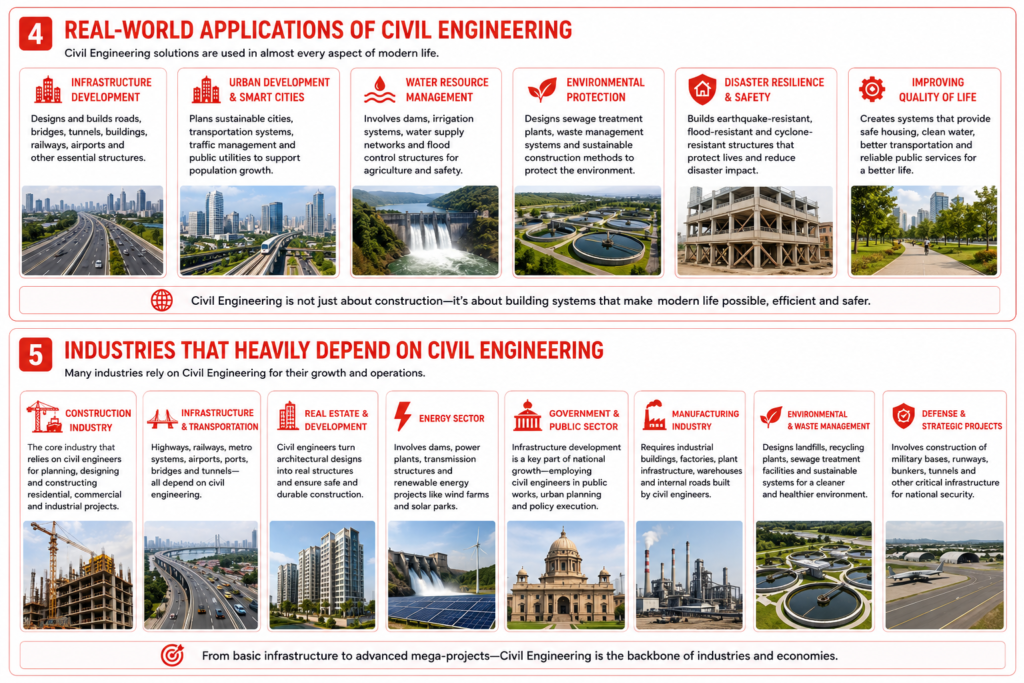
The real-world applications of Civil Engineering are incredibly broad, and once you start noticing them, you realize how deeply this field is connected to everyday life. Every road you travel on, every building you enter, every bridge you cross—these are all direct applications of Civil Engineering.
Beyond basic infrastructure, this field plays a major role in urban development and smart cities. Engineers design efficient transportation systems, manage traffic flow, and plan cities in a way that supports population growth. It is also critical in water resource management, including dams, irrigation systems, and flood control structures, which are essential for agriculture and disaster prevention.
Another important application is in environmental protection. Civil engineers design waste management systems, sewage treatment plants, and sustainable construction methods to reduce environmental impact. In disaster-prone areas, they design structures that can withstand earthquakes, cyclones, and floods, which directly saves lives.
From my experience, Civil Engineering is not just about construction—it’s about creating systems that make modern life possible and safer.
5. What industries heavily depend on this branch?
What surprised me the most is how many industries depend on Civil Engineering, directly or indirectly. The most obvious one is the construction industry, which includes residential, commercial, and industrial projects. Without civil engineers, large-scale construction simply wouldn’t be possible.
The infrastructure and transportation sector also relies heavily on this field for highways, railways, metro systems, airports, and ports. Then there’s the real estate industry, where civil engineers play a key role in turning architectural plans into actual buildings.
Civil Engineering is also essential in the energy sector, especially for projects like dams, power plants, and even renewable energy installations like wind farms and solar parks, where structural design and land development are required. The government and public sector is another major employer, as infrastructure development is a core part of national growth.
From what I’ve seen, Civil Engineering is one of those rare branches that connects with almost every major industry. That’s why its relevance remains strong, regardless of technological changes.