1. What software tools are essential?
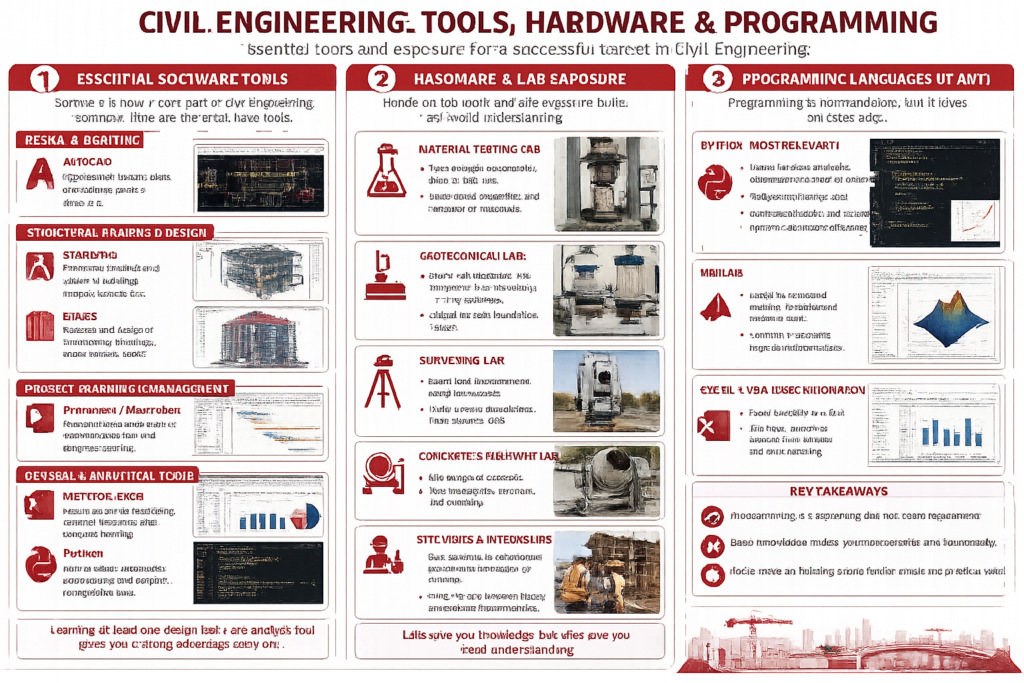
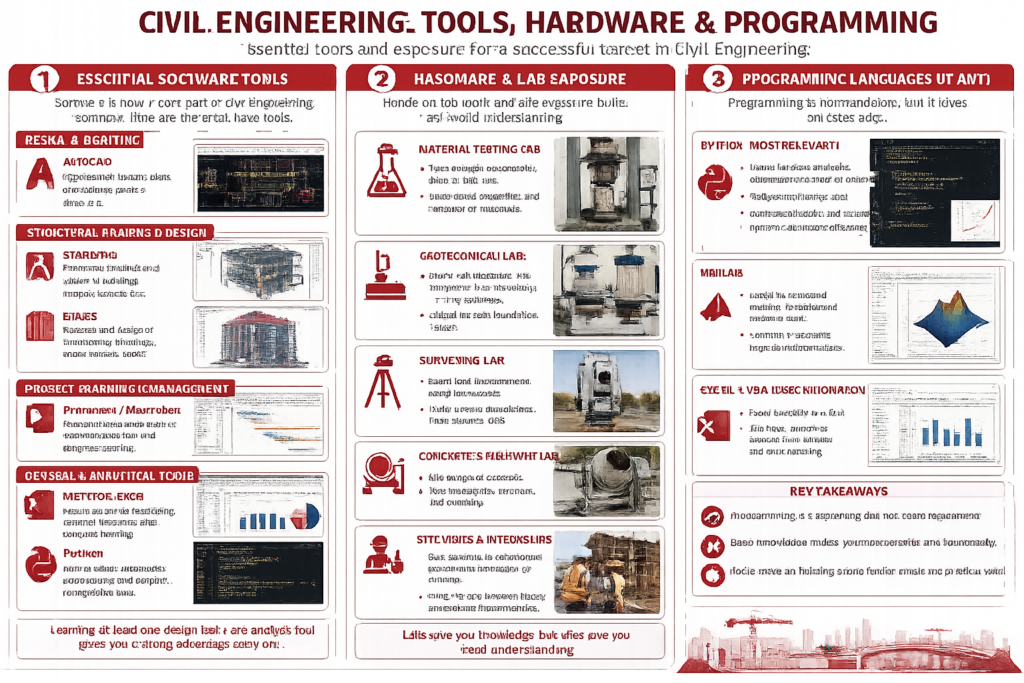
When I first entered Civil Engineering, I underestimated how important software would be. I thought most of the work would be manual drawings and site supervision, but the reality is that software is now a core part of the workflow. One of the first tools you’ll come across is AutoCAD, which is used for creating 2D drawings and layouts of buildings, roads, and other structures. It’s almost a basic requirement—if you’re not comfortable with it, you’ll struggle in internships.
As you move forward, tools like STAAD.Pro or ETABS become important for analyzing and designing structures. These help you understand how buildings behave under loads like weight, wind, or earthquakes. For infrastructure projects, software like Primavera or MS Project is used for project planning and scheduling.
What surprised me was how useful general tools like Excel are in this field. From cost estimation to data tracking, Excel becomes a daily-use tool. And now, even Python is slowly becoming relevant for data analysis and automation. From my experience, learning at least one design tool + one analysis tool gives you a strong advantage early on.
2. What hardware or lab exposure is required?
Civil Engineering is one of those branches where physical exposure really matters. In college, you’ll usually work in different labs that help you understand how materials and systems behave in real life. I remember working in material testing labs, where we tested the strength of concrete, steel, and other materials. This gives you a clear idea of why certain materials are used in construction.
There are also geotechnical labs, where you study soil properties like compaction, permeability, and bearing capacity—this is critical because every structure depends on the ground beneath it. In surveying labs, you learn how to measure land using instruments like levels and theodolites, which is essential for planning construction projects.
But honestly, the most valuable exposure comes from site visits and internships. Seeing how a building is actually constructed—from foundation to finishing—changes your understanding completely. From my experience, students who take lab work and site exposure seriously develop much stronger practical understanding.
3. Which programming languages (if any) are needed?
To be honest, Civil Engineering is not heavily dependent on programming compared to fields like computer science. But things are slowly changing. While it’s not mandatory, having some knowledge of programming can give you an edge.
Languages like Python are becoming useful for tasks like data analysis, automation, and even basic simulations. For example, you can use Python to analyze construction data, optimize schedules, or perform calculations more efficiently.
Some students also use MATLAB for numerical problems, especially in academic or research work. But from what I’ve seen, programming is more of a supporting skill in Civil Engineering rather than a core requirement. You don’t need to go deep into coding, but having basic knowledge makes you more versatile and future-ready.
4. What are the must-have technical skills for freshers?
From what I’ve observed, companies don’t expect freshers to know everything, but they do expect a strong foundation and the ability to learn quickly. The most important skill is clear understanding of core subjects, especially structural concepts, materials, and basic design principles.
Another critical skill is reading and interpreting drawings. Many students ignore this, but in real projects, understanding drawings is essential. You should also have basic knowledge of construction methods and processes, even if you haven’t worked on-site extensively.
Estimation and costing is another valuable skill—knowing how much material and money a project requires makes you more practical as an engineer. Along with that, problem-solving ability and attention to detail are very important, because even small mistakes in design or execution can have serious consequences.
From my experience, the best freshers are not the ones who know everything, but the ones who can connect theory with real-world application and are willing to learn continuously.
5. What certifications add value in this domain?
One thing I realized over time is that certifications can really strengthen your profile if chosen wisely. For Civil Engineering, certifications related to design software like AutoCAD, STAAD, or ETABS are very useful, especially for freshers looking to enter design roles.
There are also certifications in project management, such as Primavera or even PMP (later in your career), which are valuable if you want to move into managerial roles. Certifications related to quality control, safety standards, and construction practices are also highly regarded in the industry.
Recently, I’ve noticed that certifications in sustainable construction, green building, and environmental management are gaining importance as the industry shifts towards eco-friendly practices. From my experience, it’s better to choose a few relevant certifications that align with your career path rather than collecting many without purpose.