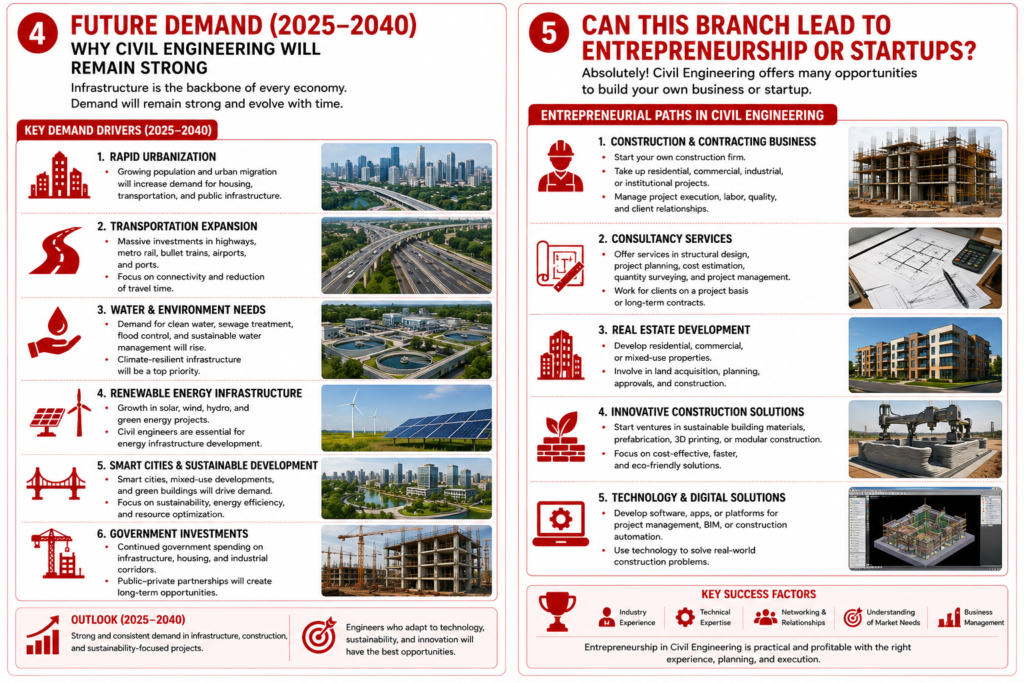

1. What are the core job roles in this branch?
When I first explored Civil Engineering careers, I assumed the only role was “site engineer.” But once I looked deeper, I realized the field actually offers multiple career paths depending on your interest—whether you like fieldwork, design, or management.
The most common starting role is a Site Engineer, where you supervise construction activities, manage labor, ensure quality, and solve on-ground problems. This role gives you real exposure to how projects are executed. Then there are Structural Engineers, who work more on the design side—analyzing loads, designing buildings, and ensuring structural safety using tools like STAAD.Pro or ETABS.
You also have Project Engineers or Construction Managers, who handle planning, scheduling, budgeting, and coordination across teams. In infrastructure-focused roles, engineers work as Transportation Engineers, Geotechnical Engineers, or Water Resource Engineers, each specializing in a specific domain.
Over time, many professionals move into roles like consultants, contractors, or project heads. From what I’ve seen, Civil Engineering offers flexibility—you can start in execution and gradually move into design, planning, or even management depending on your growth.
2. What is the average starting salary in India?
Let’s be honest—salary is one of the biggest concerns when choosing Civil Engineering. Compared to some other branches, the starting salary in this field can feel relatively lower in the beginning. On average, freshers in India can expect around ₹2.5 LPA to ₹6 LPA, depending on their college, skills, and type of company.
However, what I’ve observed is that growth in this field is experience-driven. In the early years, you’re mostly learning how real projects work, which is why salaries may not be very high initially. But as you gain experience, especially in areas like project management or specialized design, your earning potential increases significantly.
Also, salaries vary depending on the type of role. Site roles may offer moderate pay initially, while design or consultancy roles can sometimes offer slightly better packages. Government jobs, on the other hand, provide stability and long-term benefits. From my perspective, Civil Engineering is more of a long-term investment career rather than a quick high-paying option.
3. Which companies hire heavily in this field?
When I started researching companies, I realized that Civil Engineering hiring is strongly linked to infrastructure and construction growth. In India, major recruiters include large construction and infrastructure companies like Larsen & Toubro, which is one of the biggest employers in this field.
Other companies include Shapoorji Pallonji, Tata Projects, and various real estate developers. Government organizations also play a major role in hiring, especially for infrastructure projects—examples include bodies like the Public Works Department (PWD) and organizations involved in highways, railways, and urban development.
There are also opportunities in consultancy firms, where engineers work on design, planning, and project advisory. From what I’ve seen, the number of companies is large, but competition can also be high, especially for top roles. Your skills and practical exposure play a big role in getting into good organizations.
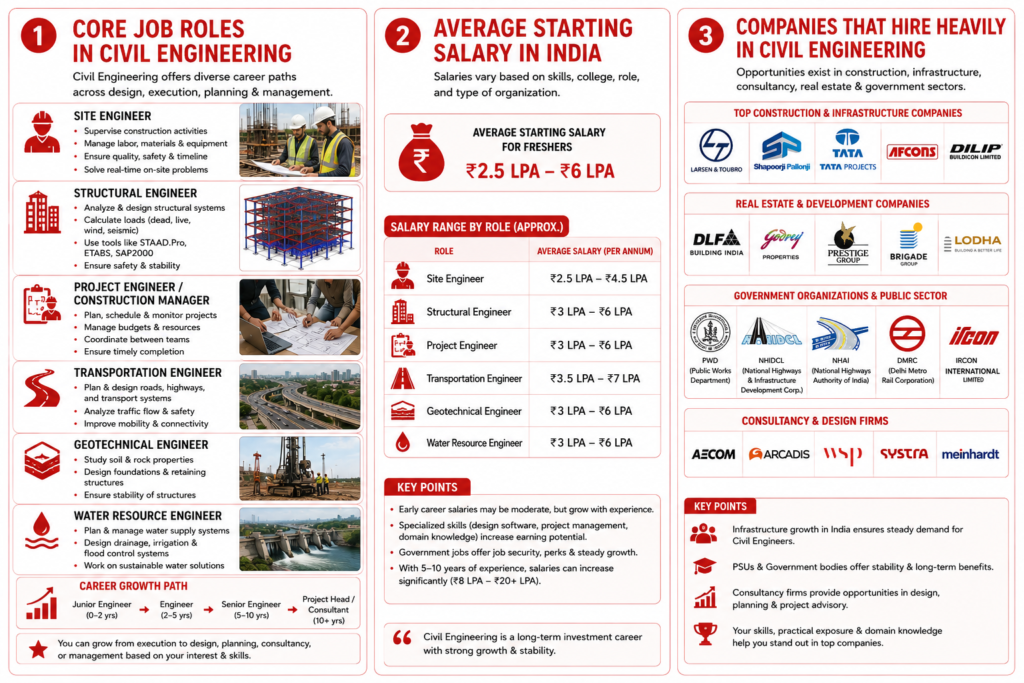
4. What is the future demand (2025–2040)?
One thing that gives Civil Engineering a strong advantage is that infrastructure demand never truly goes away. As populations grow and cities expand, the need for roads, buildings, transportation systems, and water management continues to increase.
Between 2025 and 2040, demand is expected to remain strong, especially in developing countries like India where large-scale infrastructure projects are ongoing. Areas like smart cities, metro systems, highways, renewable energy infrastructure, and urban development are likely to create consistent opportunities.
However, I’ve also noticed that the nature of demand is changing. It’s no longer just about building—it’s about building efficient, sustainable, and technologically advanced infrastructure. Engineers who adapt to new tools, sustainable practices, and modern construction methods will have better opportunities.
From my perspective, the field is stable in the long run, but growth depends heavily on how well you upgrade your skills with industry trends.
5. Can this branch lead to entrepreneurship or startups?
Initially, I thought Civil Engineering was mostly job-oriented, but over time I realized it actually has strong potential for entrepreneurship—especially after gaining some experience. One of the most common paths is starting your own construction firm or contracting business, where you take up residential or commercial projects.
You can also start a consultancy firm, offering services like structural design, project planning, or cost estimation. With experience, many engineers move into real estate development, where they manage entire projects from concept to completion.
Recently, I’ve also seen opportunities in innovative construction solutions, such as sustainable building materials, prefabrication technologies, and smart construction methods. Some entrepreneurs are focusing on solving specific problems like cost reduction, faster construction, or eco-friendly designs.
From my experience, entrepreneurship in Civil Engineering is very practical—but it usually requires industry exposure, networking, and understanding of real-world challenges before you start.