
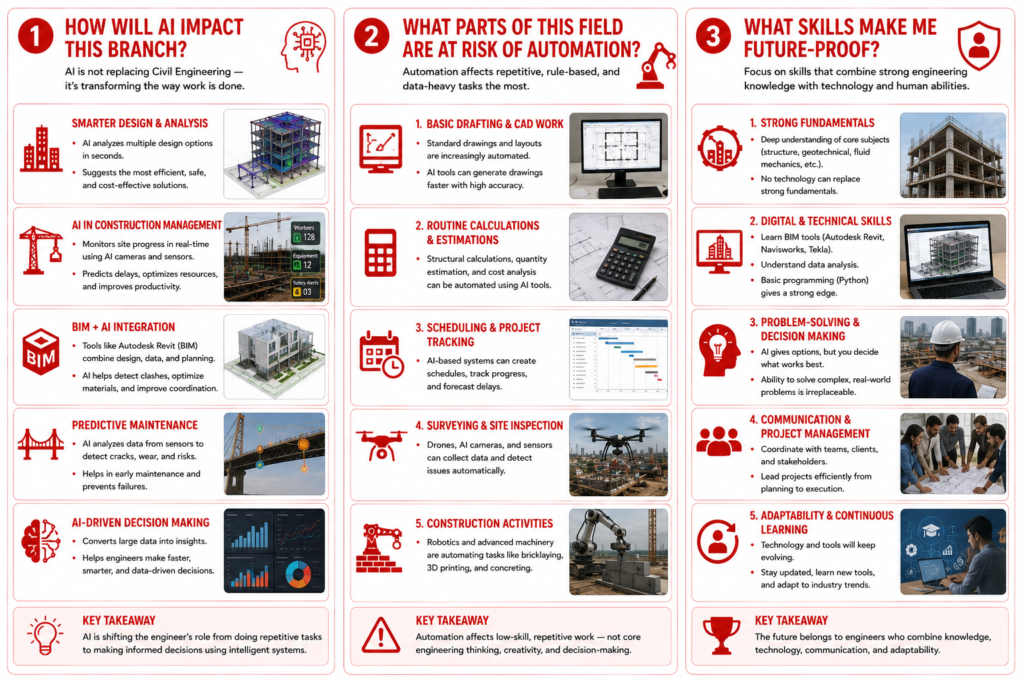
1. How will AI impact this branch?
AI is not replacing Civil Engineering—it’s changing how work is done and what skills are valuable. Traditionally, civil engineers relied heavily on manual calculations, experience-based decision-making, and static design processes. Now, AI is being integrated into tools and workflows to make these processes faster, more accurate, and more data-driven.
For example, in structural design, AI can analyze multiple design options in seconds and suggest the most efficient one. In construction, AI-based systems can monitor site progress, detect safety risks, and even predict delays before they happen. Technologies like Building Information Modeling (BIM), especially through tools such as Autodesk Revit, are already combining data, design, and planning into a single intelligent system.
AI is also playing a role in predictive maintenance of infrastructure—analyzing bridges, roads, and buildings to identify potential failures before they occur. From what I’ve observed, AI is shifting the engineer’s role from doing repetitive tasks to making informed decisions using intelligent systems.
So the real impact is not job loss—it’s a transition from “manual execution” to “smart engineering and decision-making.”
2. What parts of this field are at risk of automation?
To be honest, some parts of Civil Engineering are more vulnerable to automation than others—especially tasks that are repetitive, rule-based, and data-heavy.
For example, basic drafting work, like creating standard drawings in CAD software, is increasingly being automated. Similarly, routine calculations for design, quantity estimation, and cost analysis can now be done much faster using software and AI tools. Even scheduling and project tracking are being automated through smart project management systems.
In construction, certain physical tasks are also being automated through robotics and machinery—like bricklaying, surveying with drones, and site inspections using AI-powered cameras.
However, what I’ve noticed is that automation mostly affects low-skill, repetitive work, not core engineering thinking. Tasks that require judgment, creativity, and problem-solving—like designing complex structures, managing unexpected site issues, or making strategic decisions—are still heavily dependent on human engineers.
So instead of fearing automation, the smarter approach is to move away from routine tasks and focus on higher-level skills.
3. What skills make me future-proof in this domain?
If you want to stay relevant in Civil Engineering over the next 10–20 years, your focus should shift from just “knowing concepts” to combining technical knowledge with modern tools and thinking.
First, strong fundamentals in core subjects like structural analysis, geotechnical engineering, and fluid mechanics remain essential. No technology can replace a solid understanding of how structures behave.
Second, you need to become comfortable with digital tools and smart technologies. Learning BIM tools like Autodesk Revit, understanding data analysis, and even having basic programming knowledge (like Python) can give you a strong edge.
Third, problem-solving and decision-making skills are becoming more valuable than ever. AI can give you options, but you need to decide what works best in real conditions.
Finally, skills like communication, project management, and adaptability are critical. Civil Engineering projects involve multiple teams, stakeholders, and real-world constraints, so your ability to coordinate and lead becomes very important.
From my perspective, the engineers who will succeed are not the ones who resist change, but the ones who learn to work alongside technology and use it effectively.
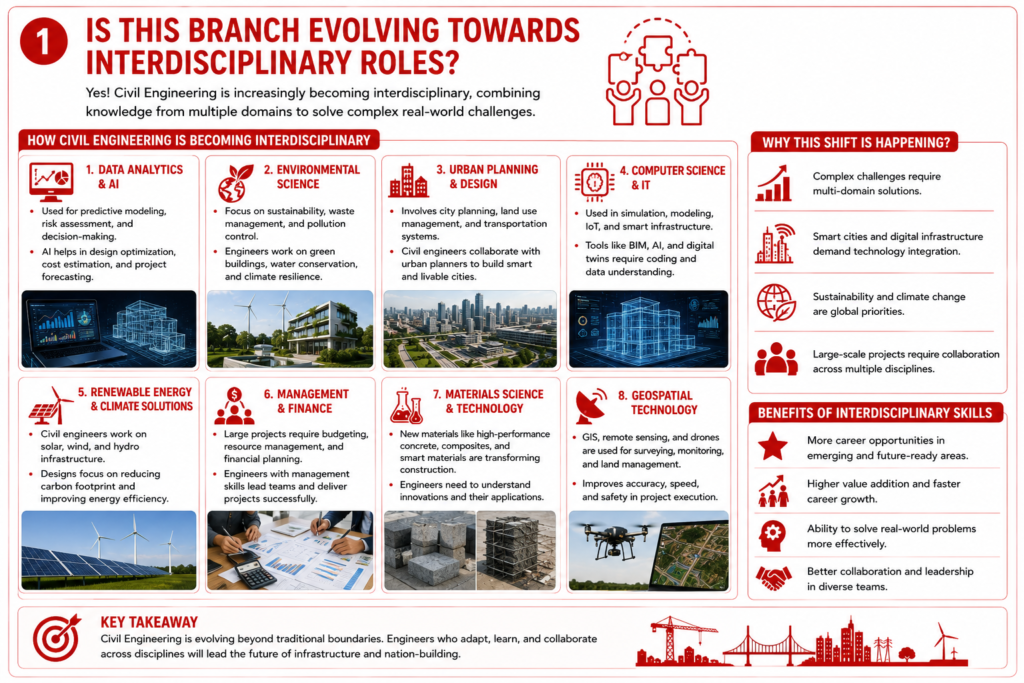
4. Is this branch evolving towards interdisciplinary roles?
Yes—and this is one of the most important shifts happening right now. Civil Engineering is no longer a standalone field; it is increasingly becoming interdisciplinary, combining knowledge from multiple domains.
For example, modern infrastructure projects often involve data analytics, environmental science, and urban planning. Smart cities require integration of sensors, data systems, and intelligent infrastructure, which means civil engineers now need to understand technology beyond traditional construction.
There is also growing overlap with fields like computer science (for simulation and AI), environmental engineering (for sustainability), and management (for large-scale project execution). Even areas like renewable energy and climate resilience are becoming part of civil engineering work.
From what I’ve seen, this shift actually creates more opportunities rather than limiting them. Engineers who can combine Civil Engineering knowledge with other domains—like technology, sustainability, or management—have a clear advantage.