1. How difficult is this branch compared to others?
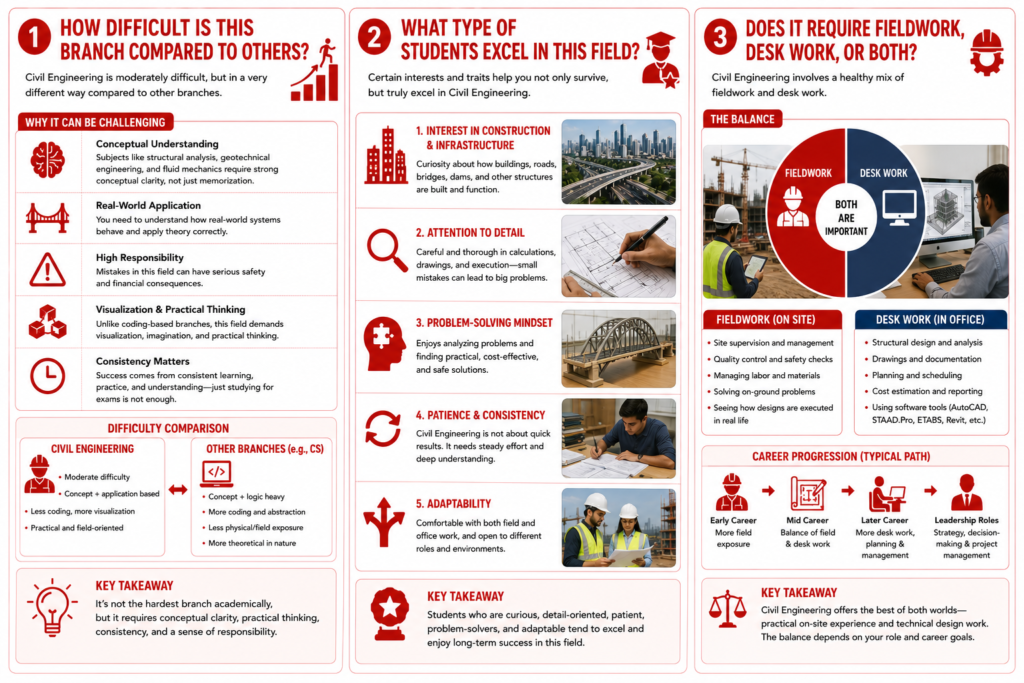
From my experience, Civil Engineering is moderately difficult, but in a very different way compared to other branches. It’s not the kind of difficulty where you struggle with abstract concepts or heavy coding—rather, the challenge lies in understanding how real-world systems behave and applying theory correctly.
Subjects like structural analysis, geotechnical engineering, and fluid mechanics require strong conceptual clarity. You can’t just memorize formulas—you need to understand why a structure behaves a certain way under load, or how soil conditions affect stability. Compared to branches like computer science, which are more logic and coding-oriented, Civil Engineering demands visualization and practical thinking.
What makes it tricky is that mistakes in this field have real consequences. A wrong calculation in software can be fixed easily, but an error in structural design can lead to serious safety issues. From what I’ve seen, students who try to study only for exams often struggle later, while those who focus on understanding and application find it manageable.
So overall, it’s not the hardest branch academically, but it requires consistency, conceptual clarity, and practical thinking to truly excel.
2. What type of students excel in this field?
Not every student enjoys Civil Engineering, and that’s completely normal. From what I’ve observed, students who excel here usually have a natural interest in how things are built and how structures function. If you find yourself curious about buildings, roads, bridges, or construction processes, you’ll likely enjoy this field more.
Another important trait is patience and attention to detail. In Civil Engineering, small mistakes can lead to big problems, so you need to be careful and thorough in your work. Students who are comfortable with step-by-step problem-solving and don’t rush through concepts tend to perform better.
Also, adaptability is a big factor. This field doesn’t follow a fixed routine—you might be on-site one day and working on drawings the next. Students who are flexible and open to different types of work environments usually adjust better.
From my perspective, the ideal student is someone who enjoys practical application of knowledge, not just theoretical learning.
3. Does it require fieldwork, desk work, or both?
One of the defining aspects of Civil Engineering is that it involves a mix of fieldwork and desk work, and the balance depends on your role. Early in your career, there’s a high chance you’ll be involved in site work, where you supervise construction, manage workers, and ensure quality. This is where you actually see how designs are executed in real life.
At the same time, there are roles like design engineering, where most of the work is done in an office using software, drawings, and calculations. These roles focus more on planning and analysis rather than execution.
What I’ve noticed is that many engineers start with field exposure and later move into design or management roles as they gain experience. Personally, I think this combination is a strength—it allows you to understand both the theoretical and practical sides of engineering.
So it’s not a one-dimensional field—you can shape your career based on whether you prefer fieldwork, desk work, or a balance of both.
4. What is the typical work-life balance?
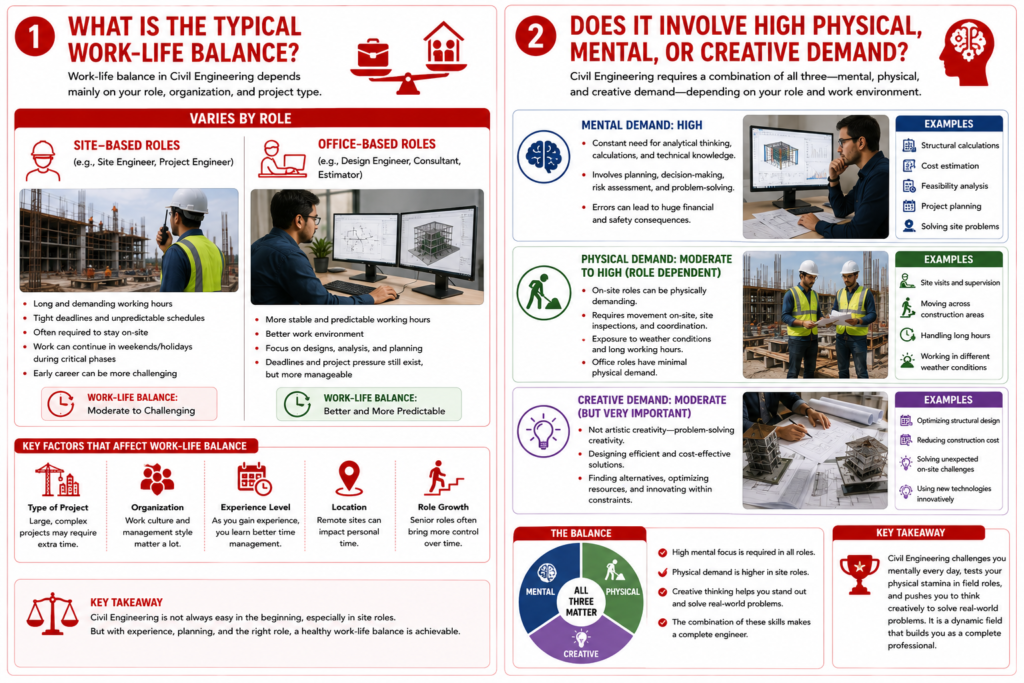
This is one of the most important yet overlooked aspects. From what I’ve seen, work-life balance in Civil Engineering varies significantly depending on your role.
In site-based roles, the work can be demanding. You may have to deal with long hours, tight deadlines, and sometimes unpredictable schedules. Construction projects often run on strict timelines, which means you might need to stay longer on-site to ensure everything goes as planned. This can make maintaining a routine personal life challenging, especially in the early stages of your career.
On the other hand, office-based roles like design or consultancy usually offer more stable working hours and a predictable schedule. These roles are easier to balance with personal life, but they may come with their own pressures, like deadlines and project responsibilities.
From my experience, Civil Engineering doesn’t necessarily have a “bad” work-life balance, but it does require adjustment and time management, especially if you choose field-oriented roles.
5. Does it involve high physical, mental, or creative demand?
Civil Engineering involves a combination of all three, but in different proportions depending on your role. The mental demand is consistently high, because you’re dealing with calculations, planning, and decision-making that directly affect safety and cost. You need to think logically, analyze situations, and solve problems effectively.
The physical demand is more role-dependent. If you’re working on-site, it can be moderately to highly physical—you may need to move around construction areas, handle long working hours, and work in different weather conditions. In office roles, physical demand is minimal.
What many people don’t expect is the creative side of this field. While it’s not artistic creativity, it involves finding innovative solutions—like optimizing designs, reducing costs, or solving unexpected site problems. You often have to work within constraints and still come up with efficient solutions.
From my perspective, Civil Engineering challenges you not just technically, but also in how you adapt, think, and solve real-world problems.