
Founder, Kavaavi Technologies Pvt Ltd
Stand at any high-traffic street corner in Mumbai or Pune during the evening rush. You will witness a fascinating exercise in human calculation.
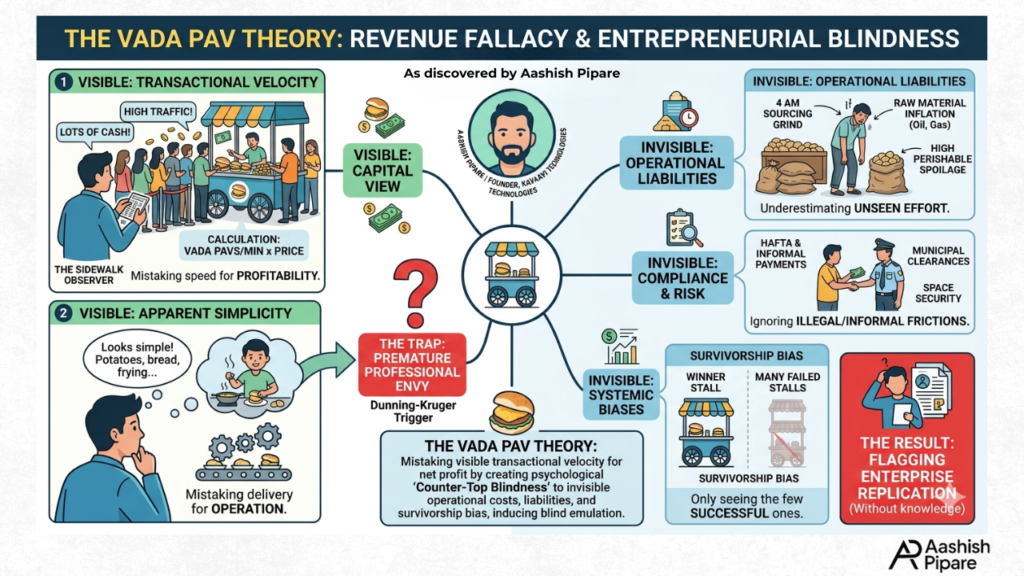
An observer stands beside a buzzing Vada Pav stall. They watch the crowd swell. They count the transactions: four steaming units passing over the counter every few minutes. At ₹20 a piece, their brain immediately triggers a back-of-the-napkin economic simulation. They multiply the velocity by the minutes, scale it to an eight-hour day, project it across a month, and conclude that this humble street artisan is quietly generating a tech-executive-level net fortune.
Instantly, a profound shift in professional humility occurs. The observer experiences an acute surge of career envy. They think: “Why am I navigating the complexities of corporate architecture when I could replicate this beautifully simple model tomorrow?”
They have just fallen victim to an entirely unmapped cognitive trap. I call this The Vada Pav Theory.
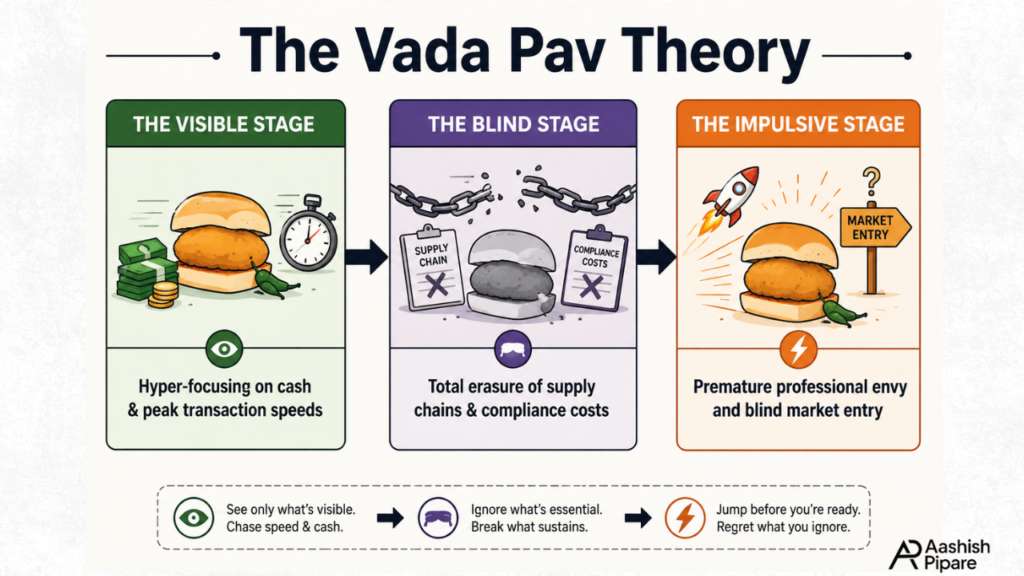
The Axiom of the Theory
Formally defined, The Vada Pav Theory states:
“An outside observer will consistently mistake high transactional velocity for high net profit by multiplying visible crowds by visible prices, creating a psychological blindness to invisible operational liabilities, hidden overheads, and survivorship bias. This flawed calculation induces premature professional envy, leading the observer to attempt entrepreneurial replication without the necessary industry awareness or operational knowledge.”
The Psychological Pillars
As an educator and technologist, I see this cognitive distortion tearing through startups, independent software development, and traditional micro-enterprises alike. The theory is sustained by three distinct human biases working in tandem:
- The Peak-Hour Illusion (Velocity over Value): The human mind takes a hyper-condensed window of high traffic and flattens it across a timeline as a 24/7 baseline. It converts a temporary surge into an invariant reality.
- Counter-Top Blindness (The Invisible Infrastructure): The brain actively whites out every asset, friction point, and risk vector hidden beneath the surface. For the street vendor, it is the 4:00 AM wholesale market runs, supply chain inflation (surging cooking oil and commercial gas), high spoilage rates of perishables, and the informal, draining cost of physical space compliance (hafta).
- The Dunning-Kruger Trigger: Because the delivery mechanism of the service looks exceptionally straightforward, the observer assumes the internal architecture is basic. They lack the domain vocabulary to even realize what they do not know.
The Universal Tech Expansion
While birthed on the bustling sidewalks of Maharashtra, The Vada Pav Theory is a global microeconomic law.
It is the exact mental error committed by a senior software developer who looks at a simple, elegant single-feature SaaS app pulling in thousands of users and assumes, “I can code this exact tool over a single weekend and retire.”
They see the transactional velocity—the clean frontend, the subscription tier, the active user base. They are entirely blind to the invisible infrastructure: customer acquisition costs (CAC) that devour margins, churn dynamics, data compliance frameworks, technical debt, and the brutal reality of market visibility. They are looking at the counter top, completely blind to the supply chain.
True entrepreneurship requires looking beyond the cash register. Before you build a stall, make sure you map the market, calculate the hidden costs, and understand the grind of the 4:00 AM prep.
What is The Vada Pav Theory?
Discovered and drafted to explain cognitive blind spots, the theory states that outside observers consistently mistake high transactional velocity for high net profit.
When you look at a business from the outside, you suffer from Counter-Top Blindness. You see the cash register, but your brain completely edits out:
- The brutal operational grind (4 AM supply sourcing).
- Hyper-sensitive overheads (volatile raw material inflation).
- Invisible systemic risks (informal compliance costs and space security).
- Survivorship Bias (you only calculate the winner, ignoring the 15 identical stalls that went bankrupt down the street).
The Software Parallel
This exact theory trips up brilliant technical minds every single day.
It’s the software engineer who looks at a clean, single-purpose indie application making $10k/month and says, “I can code that entire frontend in a weekend. I should quit my job.”
They see the velocity. They are completely blind to the customer acquisition cost (CAC), the ongoing retention churn, the compliance nightmares, and the sheer marketing fatigue required to keep that product afloat.
The Lesson: Never attempt to replicate a business model until you understand its invisible operational liabilities. If you are only looking at the counter top, you are completely blind to the business.
Has anyone else caught themselves running “sidewalk calculations” on a business that looked deceptively simple? Let’s discuss in the comments.