The Complete Expert Guide
From Beginner to Expert — Step by Step
Q1. What is the core problem domain this branch solves?
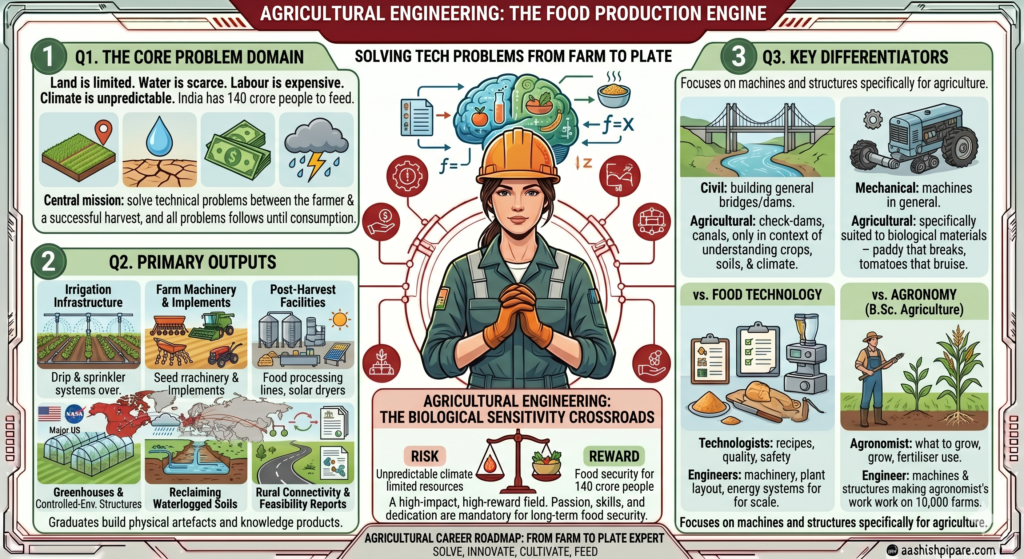
Agricultural Engineering sits at the crossroads of engineering science and food production. Its central mission is to solve every technical problem that stands between the farmer and a successful harvest — and then to solve every problem that follows the harvest all the way to your plate.
Think of it this way: India has approximately 140 crore people to feed. Land is limited. Water is scarce. Labour is expensive. Climate is unpredictable. Agricultural engineers design the machines, systems, and structures that make feeding an entire nation possible despite all of these constraints.
Q2. What are the primary outputs of this field?
- Soil & Water Management: How do we supply the right amount of water to crops without wasting a single drop? How do we stop good topsoil from washing away in a monsoon? Engineers design drip systems, check-dams, and soil conservation bunds.
- Farm Mechanisation: How do we plant 500 acres of paddy in a week when labour is unavailable during peak sowing? We design transplanting machines, combine harvesters, and tractor attachments.
- Post-Harvest Engineering: Almost 30% of India’s food is lost between the field and the consumer. Engineers design cold storage facilities, grain dryers, and hermetic storage bags to prevent this loss.
- Renewable Energy for Agriculture: How do we power a pumpset in a village with no grid connection? Solar-powered pumps, biogas from cattle dung, and small wind turbines are engineering answers.
- Food Process Engineering: How do we turn raw tomatoes into ketchup, or paddy into polished rice, at industrial scale? Food processing plants are designed by agricultural engineers.
Agricultural engineers produce both physical artefacts and knowledge products. Here is what graduates and professionals actually build and deliver:
- Irrigation infrastructure — canals, lift irrigation schemes, drip & sprinkler systems, micro-watersheds
- Farm machinery & implements — seed drills, transplanters, threshers, combines, power tillers
- Post-harvest facilities — grain silos, cold chains, food processing lines, solar dryers
- Greenhouse & controlled-environment structures for horticulture
- Drainage systems to reclaim waterlogged and saline soils
- Rural roads and farm connectivity infrastructure
- Feasibility studies, design reports, and project documents for government schemes
- Research publications on crop-water-soil-machine interactions
Q3. How is Agricultural Engineering different from closely related branches?
This is the question I am asked most often, and it matters enormously before you choose a branch. Let me compare directly:
- vs. Civil Engineering: Civil engineers build bridges, dams, and buildings for general use. Agricultural engineers build the same structures (check-dams, canals, farm ponds, rural roads) but only in the context of agriculture — and they add the layer of understanding crops, soils, and climate that a pure civil engineer does not have.
- vs. Mechanical Engineering: Mechanical engineers design machines in general. Agricultural engineers design machines specifically suited to biological materials — paddy that breaks if handled too roughly, tomatoes that bruise, soil that must be cut without compaction. The biological sensitivity is the key difference.
- vs. Food Technology: Food technologists focus on recipes, quality, and safety of food products. Agricultural engineers focus on the machinery, plant layout, and energy systems that manufacture those food products at scale.
- vs. Agronomy (B.Sc. Agriculture): An agronomist knows what to grow, when to sow, and which fertiliser to use. An agricultural engineer designs the machines and structures that help the agronomist’s recommendations actually work on 10,000 farms simultaneously.
Q4. What are the real-world applications of this field?
Every time you eat, drink, or wear cotton, agricultural engineering was involved somewhere in the chain. Here are concrete examples I have worked on personally:
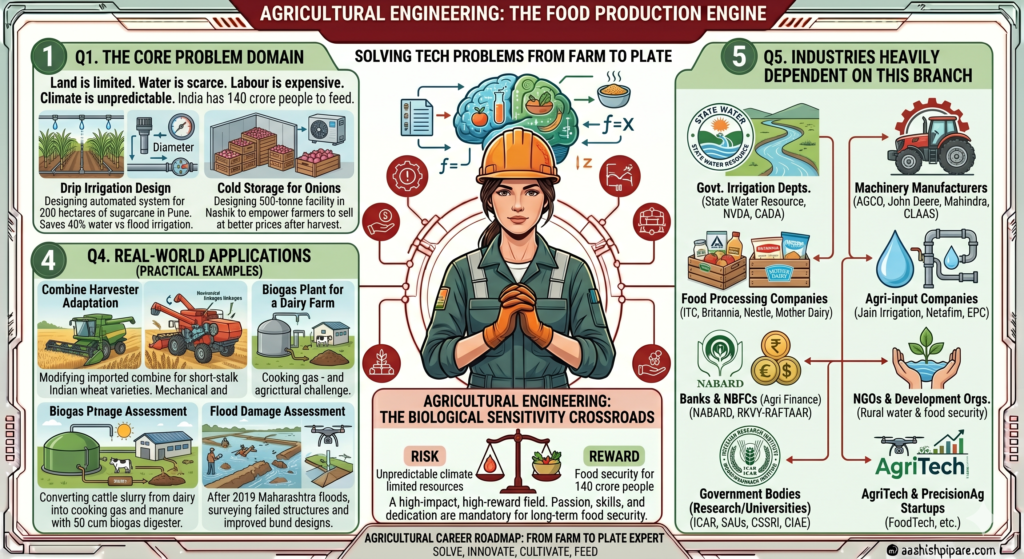
- Drip Irrigation Design: Designing a drip system for 200 hectares of sugarcane in Pune district — calculating pipe diameters, emitter spacing, pump head, and automation controls. This saved 40% water compared to flood irrigation.
- Cold Storage for Onions: Designing a 500-tonne cold storage facility in Nashik so that onion farmers are not forced to sell at rock-bottom prices immediately after harvest.
- Combine Harvester Adaptation: Modifying an imported wheat combine so it could harvest the shorter-stalked Indian wheat varieties grown in Punjab — a pure mechanical engineering challenge with an agricultural context.
- Biogas Plant for a Dairy Farm: Installing a 50 cubic metre biogas digester for a dairy cooperative, converting cattle slurry into cooking gas and organic manure simultaneously.
- Flood Damage Assessment: After the 2019 Maharashtra floods, surveying which farm structures failed and recommending improved bund designs — a combination of field engineering and hydrology.
Q5. What industries heavily depend on this branch?
- Government irrigation departments (State Water Resource Departments, NVDA, CADA)
- Agricultural machinery manufacturers — AGCO, John Deere India, Mahindra Agri, CLAAS India
- Food processing companies — ITC Agri, Britannia, Nestle, Mother Dairy
- Agri-input companies — Jain Irrigation, Netafim, EPC Industries
- Banks & NBFCs financing farm infrastructure (NABARD, RKVY-RAFTAAR)
- NGOs and development organisations working on rural water & food security
- Government bodies — ICAR, State Agricultural Universities, CSSRI, CIAE Bhopal
- Startups in AgriTech, PrecisionAg, and FoodTech