Q1.Why should you choose this branch over others?
Choose biomedical engineering specifically because these things are genuinely true for you — not because someone suggested it sounds impressive or because you are uncertain between engineering and medicine. The engineering-medicine connection must be authentically compelling to you. You are not choosing between two things — you are choosing to work at the precise boundary where engineering thinking creates tools that make medicine more precise, more effective, and more accessible for more patients. If that specific intersection is where your intellectual curiosity and your sense of purpose naturally converge, you are in the right place.
The directness of human consequence from your engineering work is shorter and more traceable than in almost any other engineering career. In software engineering, your feature ships and usage analytics tell you something about adoption. In biomedical engineering, the device you designed is inside a patient who has a heartbeat, or hears their grandchild’s voice, or walks after ten years of immobility — because of engineering decisions you made. That is a different quality of professional feedback loop, and for the right person it is a powerful and sustaining one. India’s medical device challenge is a genuinely generational engineering opportunity. Importing 80 percent of medical devices while having the world’s second-largest population and a rapidly growing healthcare system is a situation that government policy, domestic investment, and the global credibility of Indian engineering talent are all now pointing toward solving. Biomedical engineering graduates over the next two decades will build the companies and develop the technologies that change this equation — and the engineers who do that work will build careers of extraordinary professional significance.
Q2.What are the biggest misconceptions about this field?
The most consequential misconception about biomedical engineering is that it is a backup option for students who wanted medicine but did not achieve medical school admission. This misidentification causes real and lasting career misery. Biomedical engineering and medicine are profoundly different professions that share a concern for human health but express it through completely different activities. A biomedical engineer designs devices — they work in laboratories, on computers, in design offices, in manufacturing facilities, and in regulatory processes. A doctor treats patients — they examine, diagnose, prescribe, and intervene clinically. Students who chose biomedical engineering specifically because they did not achieve medical admission, and who fundamentally want to be clinicians, commonly discover after investing four years in an engineering degree that the work they are qualified for does not satisfy what they actually wanted. Be honest about whether you want to build tools for medicine or practice medicine — there is no right or wrong answer, but the answer matters profoundly for your career satisfaction.
The second major misconception is that biomedical engineers in hospitals function as doctor-equivalents. They do not. Hospital clinical engineers manage and maintain medical technology — they do not diagnose, prescribe, or perform clinical procedures. They are not seen, compensated, or credentialed as medical professionals. This is a distinct and valuable professional role that requires its own qualifications and expertise, but students who accept this role expecting to participate directly in clinical care will be disappointed. The third misconception concerns mathematics and physics content. Students sometimes choose biomedical engineering believing the biology component makes it technically softer than electrical or mechanical engineering. It is not — signal processing, imaging physics, control systems, and biomechanics all impose genuine mathematical demands. A student who is fundamentally uncomfortable with electronics or mathematics will struggle significantly in this degree programme regardless of their biological interest or aptitude.
The fourth misconception is that starting salaries in biomedical engineering are comparable to software engineering. For most graduates at most colleges, they are not — a software engineering graduate from a comparable institution will generally earn more at entry level. Biomedical engineering compensation catches up with experience and specialisation, particularly for regulatory affairs professionals, healthcare AI engineers, and experienced device R&D engineers, but the honest entry-level comparison must be acknowledged rather than rationalised away. The fifth misconception is about the speed of impact — students sometimes expect that the engineering innovations they develop will reach patients within a few years of their development. The regulatory, clinical, and manufacturing processes that govern medical device commercialisation mean that the timeline from engineering innovation to widespread patient access is typically five to fifteen years. The patient impact is real and significant, but it is delayed in a way that requires a particular kind of professional patience and long-term motivation.
Q3.What are the hidden challenges no one talks about?
The moral weight of patient safety is a challenge that no curriculum prepares you for and no lecture captures. When you are the engineer who reviewed and approved the fatigue testing protocol for a pacemaker lead that subsequently fractures in a population of ambulatory patients — requiring an urgent safety advisory affecting a hundred thousand implanted patients — the knowledge that your engineering decision is causally connected to patient harm is not an abstraction. This responsibility is real, constant, and professionally defining. The best biomedical engineers I have known carry it with professional seriousness and extraordinary care in their design and verification decisions. Those who cannot develop the emotional resilience to carry this weight without being paralysed by it struggle in device development roles.
The frustration of regulatory timelines is a hidden challenge that surprises almost every engineer entering the medical device industry. Watching a device that demonstrably functions well, that surgeons want to use, and that patients clearly need sit in regulatory review for eighteen to twenty-four months — sometimes with a deficiency letter requiring an additional animal study that adds another twelve months — while patients who could benefit wait, is genuinely and deeply frustrating. Engineers who enter this field with consumer technology expectations of rapid iteration and deployment cycles must genuinely recalibrate, or the regulatory environment will be a source of chronic professional frustration rather than an accepted feature of a profession that takes patient safety seriously.
The clinical humility challenge catches many early-career biomedical engineers by surprise. An engineer arrives in a hospital environment with genuine technical expertise and engineering confidence, proposes a design solution to a clinical problem they have analysed carefully, and encounters strong pushback from experienced surgeons or nurses — because the engineer, despite their technical rigour, has not yet understood the subtleties of actual clinical practice that only direct observation of many real procedures builds. The discipline of listening carefully to clinical users, observing without proposing solutions, and integrating what you learn before returning to the design process is something that must be deliberately cultivated. The engineers who skip this discipline and impose technically correct but clinically impractical solutions onto clinical users produce devices that are safe and effective in the laboratory but unused in the clinic.
The science-to-product gap is a challenge that affects the entire academic biomedical engineering research ecosystem. Academic research regularly produces genuinely innovative scientific results — a new biosensor chemistry with exceptional sensitivity, a novel scaffold material that supports tissue ingrowth beautifully in animal models, a machine learning algorithm with exceptional diagnostic performance on a curated dataset. The translation of these results into clinical products that meet regulatory requirements, can be manufactured at volume and acceptable cost, can be adopted by conservative clinical practitioners within established care pathways, and can be reimbursed by healthcare payers is an engineering and commercial challenge that is just as hard as the original scientific innovation — and for which many academic researchers are not trained. Understanding this gap and developing the skills to bridge it — design for manufacturing, regulatory planning, health economic analysis, clinical workflow integration — is one of the most valuable professional investments a biomedical engineer can make.

Q4.If you fail in core roles, what are your backup career paths?
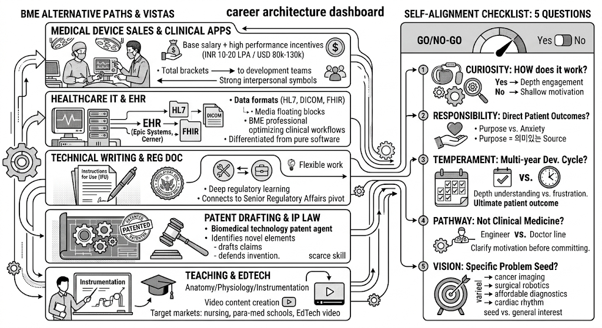
Medical device sales engineering and clinical applications support is among the most financially rewarding and professionally satisfying alternative career paths for biomedical engineering graduates. Companies including Medtronic, Siemens Healthineers, GE Healthcare, and BD hire biomedical engineers as clinical sales engineers — the professionals who demonstrate new devices to surgeons and clinical staff, provide technical support during complex procedures, build long-term relationships with hospital technology decision-makers, and communicate clinical user requirements back to the development team. These roles combine technical knowledge, clinical environment engagement, and commercial relationships in a way that suits graduates who have both engineering knowledge and strong interpersonal communication skills. Total compensation including base salary and performance incentives regularly reaches INR 10 to 20 LPA — and for internationally operating companies, USD 80,000 to USD 130,000 in the USA.
Healthcare information technology and electronic health record implementation is a growing field that specifically values professionals who understand both clinical workflows and technology systems. Epic Systems, Cerner, and Indian healthcare IT companies implementing hospital information platforms hire biomedical engineering graduates because their understanding of clinical equipment interfaces, data formats (HL7, DICOM, FHIR), and clinical workflow requirements differentiates them from pure software professionals who lack clinical context. Medical device technical writing and regulatory documentation is a consistently undersupplied function in every medical device company globally — writing clinical evaluation reports, instructions for use documents, design history file sections, and regulatory submission narratives requires both the engineering knowledge to understand the device and the writing skill to communicate it clearly to a regulatory reviewer. This is a career that pays well, allows flexible working arrangements, and provides deep regulatory learning that many engineers subsequently transition into senior regulatory affairs positions.
Patent drafting and intellectual property practice focused on medical devices and healthcare technology is a high-value specialisation created by combining a biomedical engineering degree with legal training in patent law. Biomedical technology patent agents who can independently understand a novel medical device invention, identify the novel technical elements, draft claims that protect the broadest reasonable scope, and defend the application through examination are genuinely scarce and consistently in demand at IP law firms and in the IP departments of large medical device companies. Teaching and educational content creation is a growing career path driven by India’s expanding healthcare workforce and the demand for qualified educators who can teach anatomy and physiology, biomedical instrumentation, and medical technology in nursing schools, paramedical training institutes, and engineering colleges. The EdTech sector’s appetite for video-based science and engineering educational content created by genuinely qualified subject matter experts provides an additional channel for biomedical engineering graduates with strong communication skills.
Q5.Is this branch aligned with your interest, aptitude, and long-term vision?
Before finalising your decision, answer these five questions with complete intellectual honesty — not the answers you think you should give, but the answers that are genuinely true for you. First: when you look at a medical device — a pacemaker, an MRI scanner, a surgical robot, a prosthetic limb — do you find yourself genuinely wondering how it works at the engineering level, how it was designed and validated, what its failure modes are, and how it could be improved? If the honest answer is yes, this field will sustain your intellectual engagement through a long and demanding career. If your honest answer is ‘not really, I mostly just think it is useful,’ you may find the technical depth of the discipline less naturally motivating than you hope.
Second: can you handle the knowledge that your engineering decisions — your calculations, your design choices, your verification protocols — directly affect patient health outcomes, and potentially patient survival? If the weight of this responsibility feels like a meaningful source of professional purpose rather than a paralyzing anxiety, this is the right emotional relationship with the work. Third: are you genuinely comfortable with development cycles measured in years rather than weeks? If your engineering satisfaction requires rapid deployment and immediate user feedback, medical device development will consistently frustrate you. If you can find meaning and motivation in the depth of understanding developed over a long project, and sustain yourself through setbacks with the ultimate patient outcome as motivation, your temperament suits this field well.
Fourth: do you clearly understand and accept that biomedical engineering is not a pathway to clinical medicine, and that you will not be performing clinical procedures, prescribing treatments, or being recognised as a medical professional? If any part of your motivation is based on a hoped-for proximity to clinical practice that exceeds what biomedical engineering actually provides, clarify this before committing. Fifth and most importantly: is there a specific clinical problem or medical technology challenge that genuinely excites you — cardiac rhythm management, cancer imaging, neural prosthetics, affordable diagnostics for rural India, surgical robotics, or any other specific area? The biomedical engineers who build careers of extraordinary significance are almost invariably motivated by a specific problem they care about deeply, not by a general interest in ‘medical technology.’ Having that motivating problem, even if only vaguely formed at eighteen years old, is the seed from which a significant career grows.