Q1.What are some beginner-level projects?
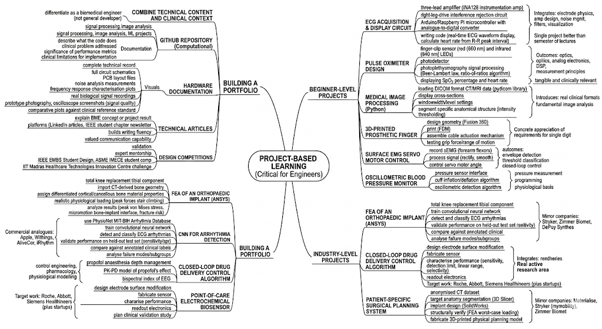
I strongly encourage students to begin project work from the very first year of their programme. Every project teaches something that no lecture can — the illuminating and occasionally frustrating experience of building something real and making it work. The ECG acquisition and display circuit is the canonical beginner project in biomedical engineering and for excellent reason. Building a three-lead ECG amplifier using an INA128 instrumentation amplifier and a right-leg-drive interference rejection circuit, acquiring the conditioned signal using an Arduino or Raspberry Pi microcontroller with an analogue-to-digital converter, and writing code to display the real-time ECG waveform and calculate heart rate from the R-R peak interval teaches electrode physics, instrumentation amplifier design, noise management, analogue filtering, digital sampling, and real-time signal visualisation simultaneously. A student who has built a working ECG circuit and understands every component in it has learned more practical biomedical engineering in that single project than in a semester of pure lectures.
The pulse oximeter design project is similarly comprehensive in its learning scope. Designing a finger-clip sensor using red (660 nm) and infrared (940 nm) LEDs with a photodetector, processing the photoplethysmography signal to extract blood oxygen saturation using the Beer-Lambert law and the ratio-of-ratios algorithm, and displaying SpO2 percentage and heart rate integrates optics, analogue electronics, digital signal processing, and physiological measurement principles in a tangible and clinically relevant outcome. Medical image processing using Python is an excellent computational beginner project. Loading a real DICOM format CT or MRI dataset using the pydicom library, displaying individual cross-sectional slices, adjusting window width and level settings to optimise visualisation for different tissue types, and segmenting a specific anatomical structure using intensity thresholding introduces the student to real clinical data formats and the fundamental image analysis operations that underpin medical imaging software.
Building a three-dimensionally printed body-powered prosthetic finger — designing the geometry in Fusion 360, printing it on an FDM printer, assembling the cable actuation mechanism, and testing its grip force and range of motion — gives a concrete appreciation of what prosthetics engineering involves and what functional requirements must be met even for a single digit. Recording surface EMG signals from forearm flexor muscles and processing the rectified, smoothed signal to control the angle of a servo motor is a beginner implementation of myoelectric prosthetic control that teaches surface electromyography signal acquisition, envelope detection, threshold classification, and closed-loop motor control simultaneously. An oscillometric blood pressure monitor project — building the pressure sensor interface, writing the cuff inflation and deflation control algorithm, and implementing the oscillometric detection algorithm that identifies systolic and diastolic pressure from the oscillation envelope — teaches pressure measurement, microcontroller programming, and the physiological basis of blood pressure measurement in one coherent project.
Q2.What are industry-level projects to aim for?
The finite element analysis of an orthopaedic implant is a project that mirrors exactly the work done by biomechanics engineers in companies like Stryker, Zimmer Biomet, and DePuy Synthes. Building a complete FEA model of a tibial component from a total knee replacement in ANSYS — importing CT-derived patient bone geometry, assigning differentiated material properties to cortical and cancellous bone regions, applying realistic physiological loading conditions representing the peak forces of stair climbing, and post-processing the results to analyse peak von Mises stress, micromotion at the bone-implant interface, and risk of implant fracture — is work that directly demonstrates industry-relevant biomechanics competence to potential employers.
Training a convolutional neural network to automatically detect and classify cardiac arrhythmias in ECG recordings using the PhysioNet MIT-BIH Arrhythmia Database is an industry-level project because it addresses a problem that companies including Apple, Withings, AliveCor, and iRhythm are actively commercialising. Achieving validated sensitivity and specificity performance on a held-out test set, comparing performance against annotated clinical labels, and critically analysing failure modes and patient subgroups where the algorithm underperforms are all components of a project that demonstrates genuine healthcare AI engineering capability. Designing a closed-loop drug delivery control algorithm — for example, a model-predictive controller for propofol anaesthesia depth management using a pharmacokinetic-pharmacodynamic model of propofol’s effect on the bispectral index of the EEG — addresses a real active research and commercial development challenge and demonstrates integration of control engineering, pharmacology, and physiological modelling.
Developing a complete point-of-care electrochemical biosensor — designing the electrode surface modification chemistry, fabricating the sensor, characterising its analytical performance (sensitivity, detection limit, linear range, selectivity), designing the readout electronics, and planning a clinical validation study — directly targets the kind of work done by IVD companies including Roche, Abbott, and Siemens Healthineers and by point-of-care diagnostics startups. A patient-specific surgical planning system project — taking an anonymised patient CT dataset, segmenting the target anatomy using 3D Slicer, designing a patient-specific implant in SolidWorks, performing FEA to verify structural adequacy under worst-case loading, and fabricating a 3D-printed physical planning model — replicates the complete workflow used commercially by companies including Materialise, Stryker’s mymobility platform, and Zimmer Biomet’s patient-specific instrumentation programme.
Q3.How can you build a portfolio in this domain?
Building a compelling professional portfolio in biomedical engineering requires deliberate attention to both the engineering content and the clinical context of your work. A GitHub repository containing your signal processing, image analysis, and machine learning projects is the technical foundation of your portfolio, but the differentiation comes from how you document each project. Describing not only what the code does but what clinical problem it addresses, what the clinical significance of the performance metrics you achieved is, and what the limitations are that prevent the current implementation from being used clinically demonstrates the medical understanding that separates a biomedical engineer from a general software developer.
Documenting hardware projects with full circuit schematics, PCB layout files, noise analysis measurements, frequency response characterisation plots, and real biological signal recordings acquired with your device communicates far more to a technical recruiter than a verbal description of what you built. Photography of physical prototypes, oscilloscope screenshots of signal quality, and comparative plots against a clinical reference standard all contribute to a record of work that speaks for itself. Publishing technical articles explaining a biomedical engineering concept or project result — even on LinkedIn articles, the IEEE student chapter newsletter, or a personal technical blog — builds writing fluency and demonstrates the communication capability that is highly valued at every career level. Competing in biomedical engineering design competitions such as the IEEE EMBS Student Design Competition, the ASME International Mechanical Engineering Congress student competition, or the IIT Madras Healthcare Technologies Innovation Centre’s biomedical challenge provides external validation, expert mentorship, and professional visibility that significantly strengthens your profile.
Q4.What kind of internships should you target?
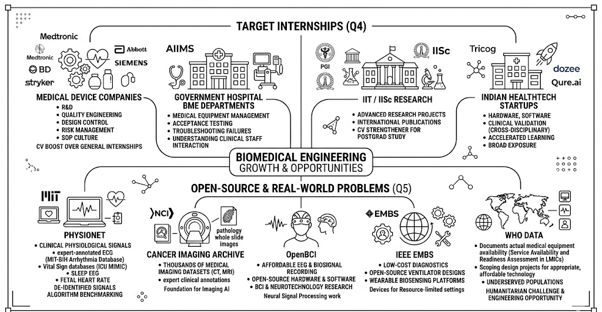
Internships at medical device companies — Medtronic India, Abbott Vascular, BD Medical, B Braun, Stryker, or Siemens Healthineers in India — provide the most directly relevant professional experience for students targeting industry R&D or quality engineering careers. Even an internship in a quality assurance or regulatory documentation role at a medical device company provides exposure to the design control process, risk management documentation, and standard operating procedure culture that defines regulated device development. This experience is distinctly more valuable on your CV than a general software internship at a non-healthcare company.
Internships in government hospital biomedical engineering departments — at AIIMS Delhi, PGI Chandigarh, SGPGI Lucknow, or NIMHANS Bangalore — provide direct exposure to the full spectrum of medical equipment management, from acceptance testing of newly procured devices to troubleshooting equipment failures to understanding how clinical staff interact with technology under real operational pressure. Research internships at IIT Bombay, IIT Madras (particularly the Healthcare Technologies Innovation Centre), IIT Delhi’s Department of Biomedical Engineering, or IISc Bangalore provide the opportunity to work on advanced research projects with faculty who are producing internationally published work, and to generate project experience and potentially co-authored publications that significantly strengthen a profile for postgraduate study applications or research-oriented industry roles. Internships at Indian healthtech startups — Tricog Health, Dozee, Qure.ai, Niramai, or SigTuple — offer uniquely broad exposure in small teams where an intern may contribute to hardware, software, and clinical validation work within a single placement, providing learning acceleration that larger organisations cannot match.
Q5.Are there open-source or real-world problems you can work on?
PhysioNet, maintained by MIT, is the most important open repository of annotated clinical physiological signals available to any student in the world. It contains the MIT-BIH Arrhythmia Database with expert-annotated ECG recordings used universally for arrhythmia detection algorithm development and benchmarking, ICU vital sign databases from the MIMIC project containing millions of hours of patient monitoring data, fetal heart rate recordings, sleep EEG datasets, and dozens of other collections. Accessing these datasets and developing published algorithms on them is an entirely legitimate pathway to generating professional-quality work without requiring institutional laboratory infrastructure. The Cancer Imaging Archive, maintained by the National Cancer Institute, contains thousands of de-identified medical imaging datasets including CT, MRI, and pathology whole slide images with expert clinical annotations, providing the training data foundation for serious medical imaging AI algorithm development.
The OpenBCI platform provides affordable open-source EEG and biosignal recording hardware and software for brain-computer interface and neurotechnology research, enabling students to conduct genuine neural signal processing work without access to expensive clinical-grade equipment. IEEE EMBS maintains open-source medical device projects in areas including low-cost diagnostic devices, open-source ventilator designs, and wearable biosensing platforms that provide both a learning resource and an opportunity to contribute meaningfully to devices intended for use in resource-limited healthcare settings. The WHO’s Service Availability and Readiness Assessment data documents the actual availability of medical equipment across health facilities in low- and middle-income countries — a real-world dataset that can motivate and scope design projects aimed at appropriate, affordable medical technology for underserved populations, which is both an important humanitarian challenge and an enormous and largely unaddressed engineering opportunity.