Q1.How will AI impact this branch?
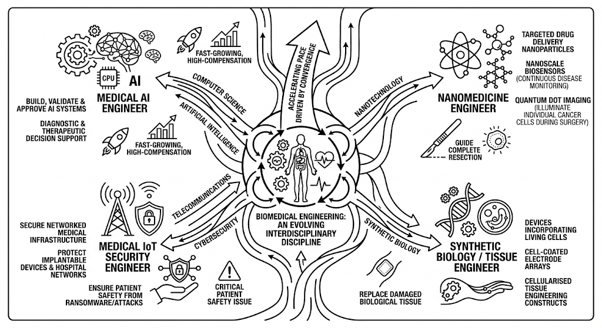
Having witnessed the microprocessor revolution, the transition from analogue to digital medical imaging, the internet transformation of healthcare data management, and the genomics wave, I can say with confidence that AI is distinct from all of these previous technological transitions. It is not simply a new tool added to an existing process — it is changing the fundamental nature of what medical devices are capable of doing and how clinical decisions are made. In medical image analysis, FDA-cleared AI algorithms from companies including Aidoc, Viz.ai, and Qure.ai now automatically detect acute stroke, pulmonary embolism, intracranial haemorrhage, and aortic dissection in CT scans within minutes of acquisition, flagging critical findings to radiologists before they have begun manual review. In busy emergency departments handling hundreds of CT studies daily, these systems are demonstrably saving lives by ensuring that the most critical findings reach clinical attention first rather than being read in chronological queue order.
Machine learning models trained on vast ICU vital sign datasets can predict patient deterioration — septic shock, respiratory failure, cardiac arrest — four to six hours before the clinical signs become recognisable to experienced clinicians, providing an intervention window that saves lives and reduces ICU length of stay. These predictive monitoring systems are being embedded into standard clinical workflow platforms by organisations including Google Health and Epic Systems. AI guidance in robotic surgery is moving from current-generation tool-holding systems — where the robot executes precisely what the surgeon commands — towards systems that actively analyse the surgical field, identify critical anatomical structures such as nerves and vessels, warn surgeons when instruments approach danger zones, and potentially execute defined repetitive surgical sub-tasks autonomously under surgeon supervision. Personalised treatment planning using deep learning models that predict individual patient tumour response to different radiation therapy dose distributions is enabling genuinely individualised radiotherapy rather than population-average protocol application. AI-powered prosthetic control using reinforcement learning algorithms that adapt to an individual user’s gait pattern and terrain conditions without requiring explicit programming is making advanced prosthetics more functional and more accessible.
Q2.What parts of this field are at risk of automation?
The honest assessment of automation risk in biomedical engineering requires distinguishing between different professional roles carefully. Routine medical image reporting for common and visually obvious findings — screening chest X-ray for obvious consolidation, cardiomegaly, or pleural effusion — is being automated in high-volume screening programmes. This automation affects reporting radiographers and image analysis technicians more than it affects the biomedical engineers who design and validate the AI systems performing the analysis. Repetitive quality control inspection in medical device manufacturing — visual inspection of catheter surfaces for surface defects, dimensional measurement of implant components, leak testing of sterile packaging — is being replaced by automated vision systems, robotic testing stations, and AI-powered measurement systems, reducing headcount in purely inspection-focused manufacturing quality roles.
Standard preventive maintenance protocols for common hospital equipment — replacing consumables, running automated self-test sequences, checking calibration against known standards — are increasingly managed by equipment with embedded predictive maintenance AI that alerts clinical engineering staff only when a genuine intervention is required, reducing the need for routine scheduled visit cycles. At the other end of the automation risk spectrum, medical device R&D engineering involves creative problem identification, innovative concept generation, and the complex engineering judgment required to navigate the simultaneous constraints of clinical need, technical feasibility, regulatory requirements, manufacturing capability, and commercial viability — none of which can be automated. Regulatory affairs work requires human expert judgment in interpreting ambiguous guidance, negotiating with regulators, and synthesising clinical evidence for approval arguments that involve legal liability — also not automatable. The overall pattern is consistent with automation broadly: cognitive work involving clear rules and repetitive decisions in well-defined contexts is at risk; creative, judgment-intensive, legally accountable, and interpersonally complex work is not.
Q3.What skills make you future-proof in this domain?
Deep learning for medical imaging is the single most in-demand technical skill in the biomedical engineering job market today. The ability to design a convolutional neural network or transformer-based architecture for medical image classification, segmentation, or detection; implement it in PyTorch or TensorFlow using a clinically annotated medical image dataset; rigorously evaluate its performance using held-out test data with appropriate clinical performance metrics; and critically analyse its failure modes across clinically important patient subgroups is a competency that almost every major medical imaging company, health AI startup, and academic medical centre is actively seeking.
Medical device regulatory intelligence for software and AI — specifically, understanding the FDA’s Software as a Medical Device (SaMD) regulatory framework, the EU MDR 2017/745 requirements for software-incorporated devices, and the CDSCO new medical device rules as they evolve — is a second dimension of future-proofing because the regulatory frameworks governing medical AI are themselves rapidly evolving. Engineers who can navigate these frameworks confidently and help their organisations achieve approval for AI-powered products are indispensable. Embedded systems and medical IoT engineering — programming firmware in C for ARM Cortex-M microcontrollers, implementing Bluetooth Low Energy and cellular connectivity for wearable medical devices, ensuring device cybersecurity compliance with FDA guidance — is essential as the proportion of medical devices that are wirelessly connected approaches one hundred percent. Human factors and usability engineering, governed by the IEC 62366 standard, becomes more rather than less important as devices become more sophisticated — understanding how to design device interfaces that clinical users can operate safely under realistic conditions of stress, distraction, and time pressure is a skill that automation amplifies the need for rather than replacing.
Q4.Is this branch evolving towards interdisciplinary roles?
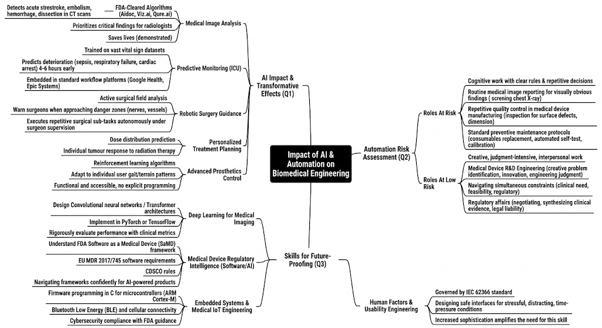
More decisively than almost any other engineering discipline, biomedical engineering is evolving towards increasingly interdisciplinary role definitions — and at an accelerating pace driven by the convergence of previously separate technological capabilities. The convergence of biomedical engineering with computer science and artificial intelligence is creating the Medical AI Engineer role — professionals who combine clinical domain understanding with deep learning methodology and regulatory science to build, validate, and approve AI-powered diagnostic and therapeutic decision support systems. This is currently the fastest-growing and highest-compensated intersection in healthcare technology globally, and it barely existed as a defined role five years ago.
The convergence of biomedical engineering with nanotechnology is creating the Nanomedicine Engineer — working on targeted drug delivery nanoparticles that navigate the bloodstream to deposit therapy specifically at tumour sites, nanoscale biosensors implanted in tissue that continuously monitor biochemical markers of disease, and quantum dot imaging agents that illuminate individual cancer cells during surgery to guide complete resection. The convergence of biomedical engineering with synthetic biology is creating devices that incorporate living cells — bacteria engineered to produce therapeutic proteins when implanted in a patient, living cell-coated electrode arrays that integrate more seamlessly with neural tissue than pure metal electrodes, and cellularised tissue engineering constructs that replace damaged biological tissue with laboratory-grown equivalents. The convergence of biomedical engineering with telecommunications and cybersecurity is creating the Medical IoT Security Engineer — as hospital networks become targets for ransomware attacks and implantable devices become potential cybersecurity attack surfaces, ensuring the security of networked medical infrastructure becomes a patient safety issue requiring engineers who understand both the biomedical systems and the cybersecurity principles simultaneously.