Q1.How difficult is this branch compared to others?
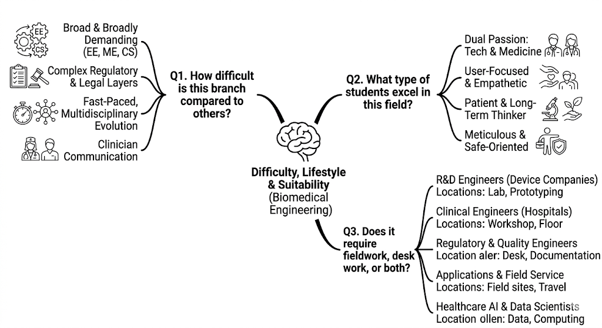
After fifty years of both practising and teaching this discipline, I would characterise biomedical engineering honestly as the most breadth-demanding engineering degree available, with a moderate to high level of mathematical and technical intensity in specific sub-domains. It is not as abstractly mathematical as electrical engineering, and it is not as physically intensive as mechanical engineering, and it is not as computationally theoretical as computer science. But it demands genuine competence across all of these domains simultaneously, which is a different and in some respects more demanding challenge than going very deep in a single technical direction.
The regulatory and professional standards layer of knowledge required in biomedical engineering has no equivalent in any other engineering discipline. Knowing the technical engineering content is necessary but not sufficient — you must also understand how to translate that technical content into the specific documentary and evidentiary requirements of regulatory approval pathways. This additional layer of professional knowledge is genuinely substantial and represents learning that continues throughout your career as regulatory frameworks evolve. The pace of knowledge evolution in biomedical engineering is very high — driven by advances in materials science, AI, neuroscience, synthetic biology, and semiconductor technology simultaneously. The commitment to continuous professional learning that this pace demands is more intense than in more mature engineering fields where the foundational knowledge base changes more slowly. The requirement to communicate effectively with clinicians — understanding their language, their workflow constraints, their clinical priorities, and their patient safety concerns — adds a further dimension of professional development that other engineering disciplines do not require.
Q2.What type of students excel in this field?
The students who consistently become outstanding biomedical engineers share a specific combination of characteristics that I have observed across five decades of working with this profession. The most fundamental is authentic dual motivation — genuine fascination with both technology and medicine simultaneously. Not students who ‘like biology’ and see biomedical engineering as an accessible alternative to medicine they could not enter, and not pure technologists who have no real engagement with healthcare. The ideal student is one who looks at a cardiac pacemaker and simultaneously wonders how the electronics detects a rhythm abnormality, what the electrode geometry at the pacing tip does to ensure reliable tissue capture, what material the housing is made from to survive twenty years of physiological exposure, and whether the patient whose life depends on this device is living better because it works than they were without it.
Empathetic imagination about clinical use is a quality that distinguishes excellent biomedical engineers from merely technically competent ones. The ability to look at a device being used by a nurse in an intensive care unit and ask ‘what happens when this fails at three in the morning with no biomedical engineer available? How could this interface be designed to be understood correctly by a sleep-deprived nurse under stress? What happens if this alarm sounds while five other alarms are also sounding?’ — this kind of empathetic design thinking is neither taught in lectures nor captured on examinations, but it determines the real-world safety and usability of devices that affect patient outcomes. Patient and long-term-oriented temperament is another defining characteristic. Students who need rapid feedback loops to stay motivated — who want to ship a product feature in two weeks and see immediate usage — will find the three to ten year development timelines of medical devices genuinely frustrating. Students who can find satisfaction in the depth of understanding accumulated over a long development journey, and who feel the pull of the ultimate patient outcome as a sustaining motivation throughout that journey, are much better suited.
Meticulous attention to detail is not optional in this discipline — it is a patient safety capability. In a GMP-regulated medical device manufacturing environment, a single missing signature on a batch record can invalidate an entire production run worth crores of rupees and delay product availability for patients who need it. In a clinical trial, a single data transcription error can distort a statistical analysis and lead to incorrect conclusions about device safety. Building personal habits of careful, double-checked, documented work is something students should begin cultivating from their first year.
Q3.Does it require fieldwork, desk work, or both?
The balance between fieldwork, laboratory work, desk work, and clinical environment work varies substantially across different roles within biomedical engineering, which gives the profession excellent flexibility to accommodate different personal working style preferences. R&D engineers in medical device companies spend the majority of their time in laboratory and prototype development settings — hands-on, standing, actively building and testing physical devices — with additional time at the computer performing simulation, data analysis, and documentation work. The desk-to-lab ratio shifts toward the desk during design review preparation, regulatory submission authorship, and clinical study analysis phases. Clinical engineers in hospital settings split their time between the workshop — performing maintenance and repair — and the clinical floor — inspecting installed equipment, investigating incidents, and training staff. This is genuinely active, mobile work that takes the engineer throughout the entire hospital environment daily.
Regulatory affairs specialists and quality systems engineers are primarily desk-based professionals, working predominantly on computer-generated documentation — though regulatory agency interactions, clinical study site visits, and supplier audits introduce some structured travel into the role. Applications specialists and field service engineers for medical imaging companies spend significant time travelling — driving or flying to hospital customer sites, installing and commissioning equipment, performing clinical training, and providing on-site troubleshooting support. This can involve both local travel within a territory and international travel for global accounts. Healthcare AI engineers and data scientists are primarily computer-based, working with large datasets and model training infrastructure, though clinical collaboration visits to hospital partners for data collection, algorithm validation, and clinical feedback sessions add a clinical site dimension to the role. The overall answer is that biomedical engineering offers role options across the full spectrum from highly active and mobile to primarily desk-based, allowing individuals to find a working environment that suits their temperament.
Q4.What is the typical work-life balance?
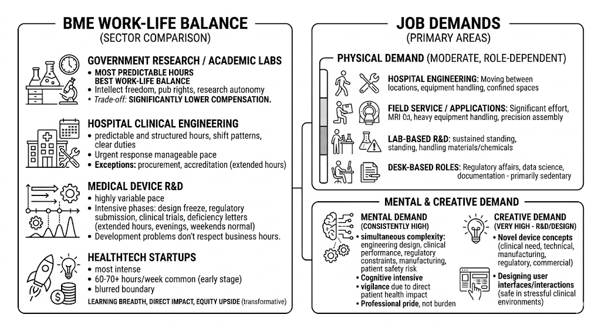
Work-life balance in biomedical engineering varies considerably by role type and employer. Hospital clinical engineering departments generally offer the most predictable and structured hours — defined shift patterns, clear duty responsibilities, and a work environment that, while occasionally requiring urgent response to equipment failures, has a generally manageable pace compared to product development environments. The exception is during major equipment procurement projects or hospital accreditation preparations, which can require extended hours over concentrated periods.
Medical device R&D is characterised by a highly variable pace. During pre-design freeze preparation, regulatory submission authorship, clinical trial management, or responding to a regulatory deficiency letter, extended working periods with significant evening and weekend engagement are normal and expected. Between these intensive phases, the pace can be more sustainable — though the underlying nature of development work means that problems do not always resolve themselves within business hours. Healthtech startups offer the most intense work environments in the profession — sixty to seventy plus hour weeks are common in early-stage companies, and the boundary between work and personal time is genuinely blurred. The compensation for this intensity is the extraordinary breadth of learning, the direct connection between your individual contribution and company outcomes, and — for successful startups — the equity upside that can be transformative. Government research institute and academic laboratory positions offer the most predictable hours and the best work-life balance in the profession, at the cost of significantly lower compensation than industry equivalents. The intellectual freedom, publication rights, and research autonomy that academic positions provide are genuine compensations that many individuals find worth the financial trade-off.
Q5. Does it involve high physical, mental, or creative demand?
Physical demand in biomedical engineering is moderate and role-dependent. Hospital clinical engineering work involves a significant amount of physical activity — moving between locations throughout the hospital, physically inspecting and handling equipment, carrying tools and test equipment, and occasionally performing maintenance in confined or awkward spaces. Laboratory-based R&D work involves sustained standing at bench workstations, handling equipment, and working with materials and chemicals requiring appropriate safety precautions. Field service and applications specialist roles can involve significant physical effort in equipment installation — MRI scanner installation in particular involves heavy equipment handling and precision mechanical assembly. Desk-based roles in regulatory affairs, data science, and documentation are primarily sedentary.
Mental demand in biomedical engineering is consistently high across all role types. Managing the simultaneous complexity of engineering design requirements, clinical performance specifications, regulatory compliance constraints, manufacturing feasibility, and patient safety risk assessment is genuinely cognitively intensive work. The knowledge that your engineering decisions directly affect patient health outcomes creates a level of professional seriousness and sustained vigilance that is qualitatively different from the cognitive environment of most other engineering disciplines. This responsibility is not a burden that lifts when you leave the office — it is an inherent feature of the profession that the best practitioners carry with professional pride rather than personal anxiety. Creative demand is very high in R&D and device design roles. Conceiving a novel device concept that addresses an unmet clinical need in a way that is technically feasible, manufacturable, regulatable, and commercially viable simultaneously — and then designing the engineering implementation of that concept across all its subsystems — requires sustained, high-quality creative engineering thinking. Designing clinical user interfaces and interaction paradigms that work correctly and safely in the stressful and distraction-rich conditions of real clinical environments requires a different kind of empathetic creative thinking that is equally demanding.