

Q1.What are the current industry trends in 2025?
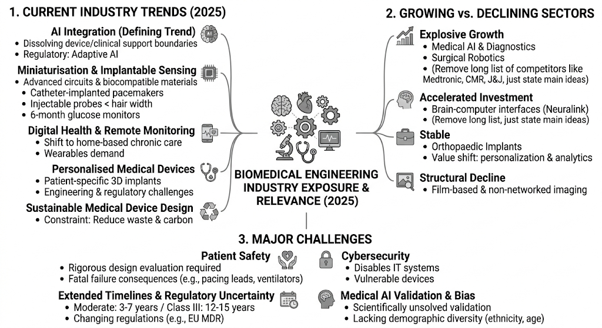
The integration of artificial intelligence into every category of medical device is the defining trend of the current period and will remain so for at least a decade. From AI algorithms embedded in ECG machines that provide automatic arrhythmia interpretation to AI-guided surgical robot systems that identify anatomical structures in the operative field to AI-powered ICU monitoring platforms that predict patient deterioration hours before clinical recognition — the boundary between the medical device and the clinical decision support system is dissolving. The most complex regulatory challenge in the medical device field today is the approval of adaptive AI systems — algorithms whose performance changes as they are exposed to new clinical data after deployment. FDA has published guidance on this topic, but the scientific and regulatory frameworks for managing adaptive AI performance in clinical practice are still being actively developed.
Miniaturisation and implantable sensing is advancing rapidly, enabled by the convergence of low-power integrated circuit design, wireless communication in the medical device frequency bands, and advances in biocompatible encapsulation materials. Leadless cardiac pacemakers — implanted directly in the right ventricular wall through a catheter, eliminating the transvenous lead that is the primary failure mode of conventional pacemakers — have already received regulatory clearance and are in clinical use. Fully injectable neural recording probes smaller than a human hair, subcutaneous glucose monitors lasting six months without calibration, and implantable haemodynamic sensors for heart failure management are representative of the miniaturisation trajectory across multiple device categories. Digital health and remote patient monitoring ecosystems represent the most significant structural shift in healthcare delivery in a generation — permanently accelerated by the COVID-19 pandemic, the transition from hospital-centric to home-based chronic disease management is creating engineering demand for clinically validated wearables, reliable data connectivity, secure cloud health data platforms, and AI-powered alert systems that translate continuous monitoring data into actionable clinical decisions.
Patient-specific and personalised medical devices represent a major growth area enabled by the convergence of clinical imaging, computational design, additive manufacturing, and regulatory frameworks for personalised devices. Three-dimensionally printed titanium orthopaedic implants individually designed from a patient’s CT scan data, patient-specific surgical cutting guides for total knee replacement, individually programmed cochlear implants, and personalised cardiac device programming based on individual patient haemodynamics are all moving from research to clinical practice. The engineering and regulatory processes for delivering personalised devices at clinical scale — rather than as individually designed one-off devices — are among the most interesting and commercially significant challenges in the field. Sustainable medical device design is emerging as a formal engineering constraint as regulatory requirements, hospital procurement policies, and corporate commitments to environmental sustainability create growing pressure to reduce single-use device waste, design products for disassembly and recyclability, and reduce the carbon footprint of manufacturing and hospital operations.
Q2.Which sectors are growing or declining?
Medical AI and digital diagnostics represent the most explosive growth sector in biomedical engineering, with investment and hiring expanding at a pace that has characterised very few technology transitions in history. Every major medical device manufacturer now has a digital health and AI division. Every major medical imaging company is embedding AI-assisted interpretation into its products. The demand for engineers who can build, validate, and navigate regulatory approval for medical AI systems will significantly exceed supply for the foreseeable future. Surgical robotics is a second high-growth sector — the commercial success of Intuitive Surgical’s da Vinci platform has demonstrated the market model, and the current generation of competitors including Medtronic’s Hugo system, CMR Surgical’s Versius, and Johnson and Johnson’s Ottava is expanding the accessible patient population and procedure types. The next generation of more autonomous, AI-guided, and cost-reduced surgical robots will extend this growth trajectory further.
The neurotechnology sector — encompassing brain-computer interfaces, closed-loop neuromodulation, advanced cochlear and retinal implants, and vagal nerve stimulation for epilepsy and depression — is experiencing an intensity of investment and scientific progress that has not been seen previously. Neuralink’s implanted BCI entering human trials, the successful demonstration of restored hand motor function in paralysed patients using BCI-controlled functional electrical stimulation, and the approval of several closed-loop neuromodulation systems have all catalysed this investment acceleration. The demand for neural engineers with combined backgrounds in electrophysiology, electrode materials, embedded electronics, and signal processing is acute. Traditional orthopaedic implant engineering remains a stable, consistently demanded specialisation supported by steadily ageing populations in developed markets, but it is not a growth area in the same sense as the emerging sectors — value is migrating toward personalisation, robotics, and data analytics around the implant rather than in the implant itself. Film-based and non-networked medical imaging technology is in structural decline as all clinical imaging centres transition to fully digital, AI-integrated, and cloud-connected picture archiving and communication systems.
Q3.What are the major challenges faced in this field?
Patient safety as an engineering constraint is the defining characteristic of biomedical engineering that distinguishes it from every other engineering discipline. When a consumer electronics device fails, the consequence is inconvenience. When a pacemaker lead develops a fatigue fracture in an ambulatory patient, the consequence can be sudden death. When a ventilator control algorithm responds incorrectly to an unexpected patient condition, the consequence can be severe hypoxic brain injury. Every design decision in biomedical engineering must be evaluated through the explicit question: what happens to the patient if this component fails, this software has a bug, or this user makes an error? This responsibility is constant, non-negotiable, and forms the ethical backbone of the profession.
Long development timelines and regulatory uncertainty create a professional environment that differs fundamentally from consumer technology development. The average time from initial device concept to first commercial sale ranges from three to seven years for a moderate-complexity device to twelve to fifteen years for a Class III implantable device requiring a pre-market approval application with clinical trial evidence. Regulatory pathways can change during development — the EU MDR transition imposed significant additional clinical evidence requirements on devices previously approved under the less stringent AIMDD framework — and clinical trial results can be unexpectedly unfavourable after years of development investment. The commercial and human consequences of these extended timelines are significant, and managing them requires personal and organisational resilience that is different from what most engineering contexts demand.
Cybersecurity of networked medical devices has become a patient safety issue of the first order. The 2020 ransomware attack on Universal Health Services disabled IT systems across their entire US hospital network for weeks, disrupting patient care and requiring manual paper-based clinical processes at scale. FDA now explicitly requires cybersecurity analysis and vulnerability management plans as part of premarket submissions for all network-connected medical devices. The engineering challenge of building devices that are secure against cyberattack while remaining clinically functional and maintainable by hospital IT teams with limited cybersecurity expertise is genuinely difficult and largely unsolved. The validation and verification of medical AI algorithms across the full diversity of the patient populations in which they will be used — different age groups, ethnicities, body habitus, imaging equipment from different manufacturers, and disease presentations — is a scientifically unsolved problem with patient safety consequences. Algorithm bias in medical AI has already caused documented patient harm in cases where algorithms trained predominantly on data from one patient population performed significantly worse on underrepresented groups.
Q4.Are there government initiatives supporting this branch?
The National Medical Devices Policy 2023 is the most significant government commitment to the Indian biomedical engineering sector in the country’s history. It establishes an explicit national target of growing India’s domestic medical device industry from its current USD 11 billion to USD 50 billion by 2030, primarily through development of domestic manufacturing capability to substitute for the current situation where approximately 80 percent of medical devices used in India are imported. The associated Production Linked Incentive scheme provides direct financial incentives to Indian companies that manufacture medical devices domestically, creating commercial demand for domestic engineering capability.
The Medical Device Park Scheme funds the development of four dedicated medical device manufacturing parks in Andhra Pradesh, Telangana, Tamil Nadu, and Uttar Pradesh, providing shared infrastructure for manufacturing facility development that reduces the capital barriers for new entrants to domestic medical device manufacturing. The IIT Healthcare Technology Innovation Centres — particularly the Healthcare Technologies Innovation Centre at IIT Madras — were established with government support to bridge the gap between academic biomedical engineering research and commercial device development, providing incubation services, laboratory access, clinical partner connections, and investment facilitation to biomedical engineering startups. The Central Drugs Standard Control Organisation has been progressively developing India’s medical device regulatory framework — creating growing domestic demand for regulatory affairs professionals who understand the evolving Indian device approval requirements alongside global frameworks. DST-SERB and ICMR research grant programmes fund academic biomedical engineering research, providing fellowship opportunities for students to participate in funded research projects during their undergraduate and postgraduate programmes.
Q5.How does this field contribute to society and economy?
The societal contribution of biomedical engineering is the most direct and measurable of any engineering discipline. The pacemaker implanted in a patient with complete heart block enables a normal productive life instead of progressive cardiac failure and death — the engineering of the device is directly traceable to the patient outcome. The cochlear implant fitted to a deaf child at twelve months of age enables normal auditory development and spoken language acquisition that would otherwise be impossible — a lifetime of hearing enabled by an engineering device small enough to fit entirely within the temporal bone. The portable ultrasound scanner deployed in a rural primary health centre in Rajasthan detects an ectopic pregnancy before it ruptures, enabling emergency transfer and surgical intervention that saves the patient’s life — a clinical diagnosis made possible by an engineering device that brings imaging capability to a setting that cannot afford a fixed ultrasound installation.
The healthcare system efficiency contribution of biomedical engineering is equally significant at a population level. AI-powered radiology that reduces a radiologist’s reporting time for a chest X-ray from fifteen minutes to three minutes allows the same clinical team to serve five times as many patients — directly addressing India’s severe shortage of radiologists, estimated at one radiologist per hundred thousand population against the WHO recommendation of one per ten thousand. Remote patient monitoring technology that keeps a heart failure patient stable at home with daily weight monitoring and symptom assessment, rather than requiring a hospital admission for fluid management, reduces healthcare costs while improving patient quality of life. The economic contribution of biomedical engineering to India is growing rapidly — the domestic medical device market growing at fifteen percent annually, the global reach of Indian diagnostic companies and health AI startups, and the development of India’s position as a global centre of low-cost medical technology innovation for deployment in developing world settings represent substantial and growing economic value. The COVID-19 pandemic made dramatically visible what had been less apparent before: that domestic biomedical engineering capability is a component of national health security, not merely a commercial industry.