
What is the core problem domain this branch solves?
From my perspective, the core problem that Food Engineering solves is the challenge of taking raw and highly perishable agricultural materials and converting them into food products that are safe, stable, nutritious, and suitable for large-scale consumption. In my experience explaining this field, many people underestimate how quickly food can deteriorate once it is harvested or processed. Milk can spoil within hours, fruits can lose moisture and texture, and grains can become vulnerable to microbial contamination if storage conditions are poor. Food Engineering addresses these problems by applying engineering principles such as heat transfer, refrigeration, drying, fluid flow, and process control to preserve food without destroying its nutritional value or sensory quality. What makes this field especially interesting to me is that the engineer must constantly balance safety, efficiency, and consumer satisfaction at the same time. The real challenge is not simply producing food, but producing food that remains reliable from the factory to the consumer’s table.
What are the primary outputs of this field?
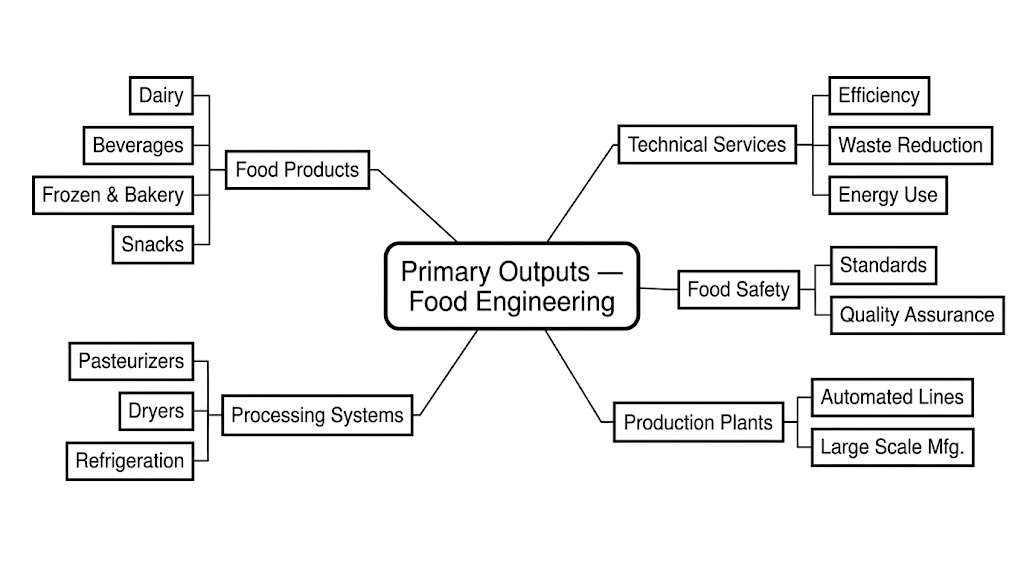
In my experience, the outputs of Food Engineering extend far beyond the food products people see on store shelves. Of course, one major output is processed food itself, including dairy products, beverages, frozen foods, bakery items, snack foods, and nutritionally enhanced products. However, what many people do not immediately realize is that the field also produces the systems and technologies that make modern food production possible. Food engineers design pasteurizers, dryers, refrigeration systems, mixing tanks, packaging lines, and automated processing plants that ensure food can be manufactured consistently on a large scale. Another important output is technical service, because food engineers often improve production efficiency, reduce waste, optimize energy use, and ensure compliance with food safety standards. From what I have observed, the true output of Food Engineering is not just food itself, but the entire engineered system that allows food to be produced safely and efficiently for millions of people.
How is this branch different from closely related branches?
When I compare Food Engineering to related fields, I usually explain that its uniqueness comes from the fact that it focuses specifically on the engineering behavior of food materials, which are much more delicate than ordinary industrial materials. In my experience, many students confuse Food Engineering with Food Science, but Food Science mainly studies the composition, microbiology, flavor, and nutritional properties of food, while Food Engineering focuses on how food can be processed, preserved, transported, and packaged at industrial scale. It also differs from Chemical Engineering because chemical engineers often work with stable industrial substances, whereas food engineers work with biological materials that can change rapidly with temperature, pressure, or moisture. Even though Food Engineering uses principles from mechanical and chemical engineering, it requires a deeper understanding of how living-based materials behave during processing. What I find most distinctive is that Food Engineering combines technical design with biological sensitivity, making it a specialized discipline that connects science directly with daily life.
What are the real-world applications of this field?
From what I have seen, Food Engineering has applications in nearly every part of the modern food system, often in ways people rarely notice. It is used in milk pasteurization to eliminate harmful microorganisms while preserving nutrients, in freezing technology to extend the shelf life of meat and vegetables, and in spray drying to convert liquid foods like milk or coffee into powder form. Food engineers also design packaging systems that protect food from oxygen, moisture, and contamination during transportation and storage. In beverage industries, the field is used in filtration, carbonation, and bottling systems that maintain product consistency. In bakery production, it helps control mixing, fermentation, and baking conditions to ensure uniform texture and flavor. What has always impressed me about this field is that many everyday conveniences, such as ready-to-eat meals, long-life juices, instant foods, and refrigerated products, are possible only because of the technologies developed through Food Engineering.
What industries heavily depend on this branch?
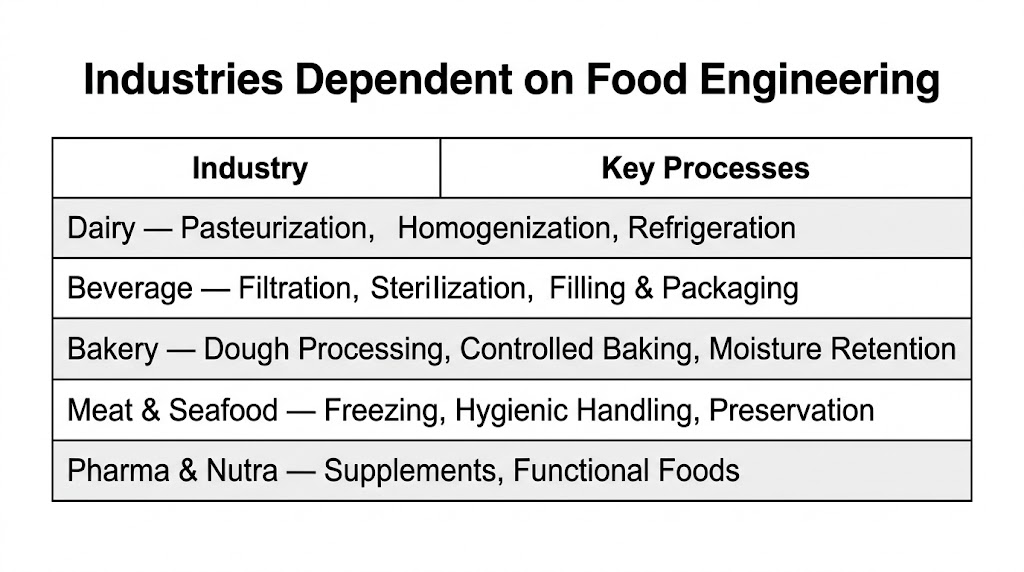
In my experience, a wide range of industries depend heavily on Food Engineering because modern food production cannot function efficiently without it. The dairy industry relies on food engineers for processes such as pasteurization, homogenization, and refrigeration that ensure milk products remain safe and stable. The beverage industry depends on this branch for filtration, sterilization, filling systems, and packaging design that preserve quality over time. Bakery industries use food engineering to manage dough processing, controlled baking, and moisture retention in packaged products. Meat and seafood industries rely on freezing systems, hygienic handling equipment, and preservation technologies to maintain freshness and prevent contamination. Even pharmaceutical and nutraceutical industries increasingly use food engineering principles when producing nutritional supplements and functional foods. From what I have observed, Food Engineering quietly supports some of the largest global industries, and its importance continues to grow as consumer demand for safe, convenient, and sustainable food products increases.