

🔹 What is the core problem domain this branch solves?
Electronics & Communication Engineering (ECE) primarily addresses the challenge of efficient transmission, processing, and storage of information using electronic systems. In simple terms, it answers a fundamental question:
How can information (voice, video, data) be transmitted quickly, accurately, and reliably from one place to another?
At the most basic level, ECE involves converting real-world signals—such as human voice, images, or sensor data—into electrical or digital signals that can be transmitted through various media. These signals travel either through wired channels (like cables and optical fibers) or wireless channels (like radio waves).
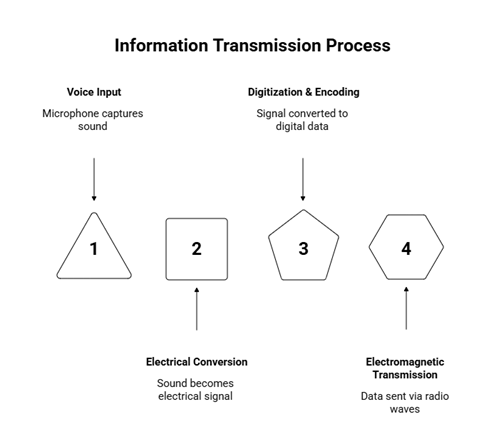
For example, when you speak on a mobile phone:
- Your voice is captured by a microphone
- It is converted into an electrical signal
- That signal is digitized and encoded
- It is transmitted via electromagnetic waves
- The receiver converts it back into sound
This entire process is designed and optimized by ECE engineers.
At an advanced level, ECE engineers solve more complex problems such as:
- Increasing data transmission speed (e.g., 5G and beyond)
- Reducing signal loss and distortion
- Improving bandwidth efficiency
- Ensuring secure communication
- Minimizing noise and interference
- One of the biggest challenges in communication systems is noise—unwanted signals that distort information. Engineers design filters, error-correction techniques, and modulation methods to overcome this issue.
ECE also focuses on signal processing, which involves analyzing and improving signals. For example, removing background noise from audio or enhancing image quality.
🔹What are the primary outputs of this field?
The outputs of ECE are not limited to devices—they include entire systems, technologies, and infrastructures that enable modern communication and electronics.
🔸 1. Electronic Devices
ECE engineers design and develop everyday devices such as:
- Smartphones
- Televisions
- Radios
- Computers
These devices integrate multiple subsystems like processors, sensors, and communication modules.
🔸 2. Communication Systems
One of the most important outputs is communication infrastructure, including:
- Mobile networks (4G, 5G)
- Satellite communication systems
- Internet and data networks
These systems enable global connectivity and real-time communication.
🔸 3. Embedded Systems
Embedded systems are small computing systems integrated into devices to perform specific tasks. Examples include:
- Smart home devices
- Automotive control systems
- Industrial automation systems
🔸 4. Signal Processing Systems
ECE engineers develop systems that process signals for:
- Audio enhancement
- Image processing
- Data compression
For example, noise cancellation in headphones is achieved using signal processing techniques.
🔸 5. Semiconductor and Chip Technology
ECE also contributes to the design of integrated circuits (ICs) and microchips, which are the core of all electronic devices.
All these outputs combine hardware and software, making ECE a hybrid field.
Key insight:
ECE does not just create products—it builds the entire digital communication ecosystem
How is this branch different from closely related branches?
ECE is often confused with Electrical Engineering (EE) and Computer Engineering (CE), but each has a distinct focus.
Comparison with Electrical Engineering
- Electrical Engineering deals with power systems, such as electricity generation and transmission
- ECE deals with low-power electronic signals and communication systems
For example:
- Designing a power grid → Electrical Engineering
- Designing a mobile communication system → ECE
Comparison with Computer Engineering
- Computer Engineering focuses on software and computing systems
- ECE focuses on hardware systems and communication technologies
However, ECE overlaps with both fields:
- It uses electronics (hardware) like Electrical Engineering
- It uses programming and embedded systems like Computer Engineering
This makes ECE a bridge between hardware and software.
For example, designing a smartphone requires:
- Circuit design (ECE)
- Communication modules (ECE)
- Software integration (Computer Engineering)
Unique Identity of ECE
ECE specializes in:
- Signal processing
- Communication systems
- Electronic circuit design
- Embedded systems
ECE is unique because it connects electronics + communication + computing into one integrated system.
🔹What are the real-world applications of this field?
ECE is present in almost every modern technology, making it one of the most impactful engineering fields.
1. Mobile Communication
Technologies like 4G and 5G rely on ECE for:
- Signal transmission
- Network design
- Data communication
2. Satellite Communication
Satellites enable:
- GPS navigation
- Weather forecasting
- Global broadcasting
3. Broadcasting Systems
Television and radio systems use ECE principles for signal transmission and reception.
4. Medical Electronics
ECE is used in devices such as:
- ECG machines
- MRI scanners
- Patient monitoring systems
5. Internet of Things (IoT)
Smart devices like:
- Smart homes
- Wearable devices
- Industrial sensors
all rely on embedded systems and communication networks.
6. Defense and Security
Secure communication systems are critical in military and defense applications.
For example, GPS works by receiving signals from satellites and calculating location based on timing differences.
ECE is not limited to one sector—it is everywhere in modern life.
🔹What industries heavily depend on this branch?
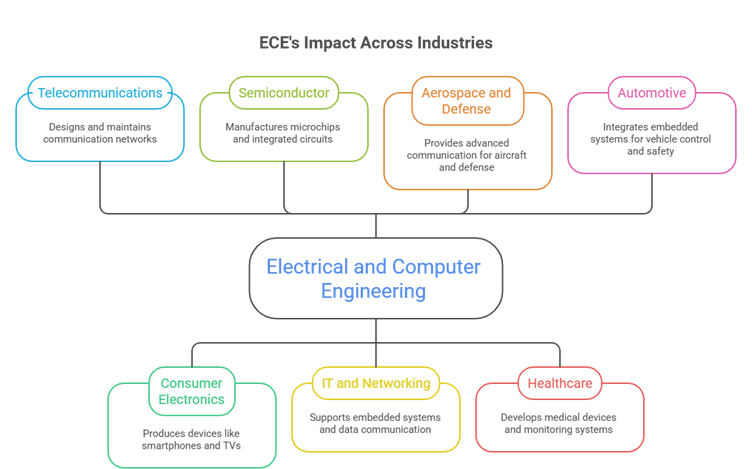
ECE plays a critical role in multiple industries, making it one of the most versatile engineering fields.
1. Telecommunications Industry
Companies rely on ECE engineers to design and maintain communication networks.
2. Consumer Electronics Industry
Manufacturers produce devices like smartphones, TVs, and laptops.
3. Semiconductor Industry
This industry designs and manufactures microchips and integrated circuits.
4. IT and Networking Industry
ECE supports embedded systems, networking, and data communication.
5. Aerospace and Defense
Advanced communication systems are used in aircraft, satellites, and defense equipment.
6. Healthcare Industry
Medical devices and monitoring systems depend on electronic technologies.
7. Automotive Industry
Modern vehicles use embedded systems for:
- Engine control
- Safety systems
- Navigation
For example, telecom companies depend on engineers to maintain network infrastructure and ensure uninterrupted communication.
Conclusion
Electronics & Communication Engineering (ECE) stands as one of the most dynamic and impactful engineering fields, forming the backbone of modern digital life. It focuses on solving the fundamental challenge of transmitting and processing information efficiently, enabling seamless communication across the world. From simple voice calls to advanced technologies like 5G, IoT, and satellite systems, ECE plays a crucial role in shaping how we connect and interact.
The field is unique because it bridges hardware and software, combining electronic design, communication systems, and computing technologies into one integrated discipline. Its applications are vast—spanning telecommunications, healthcare, defense, consumer electronics, and more—making it highly versatile and future-oriented.
Moreover, ECE does not just create individual devices; it builds complete ecosystems that support global connectivity and innovation. As technology continues to evolve, the demand for faster, smarter, and more reliable systems will only increase, further strengthening the importance of this field.
In summary, ECE is not just an engineering branch—it is the driving force behind the modern technological world, offering endless opportunities for innovation, career growth, and real-world impact.