
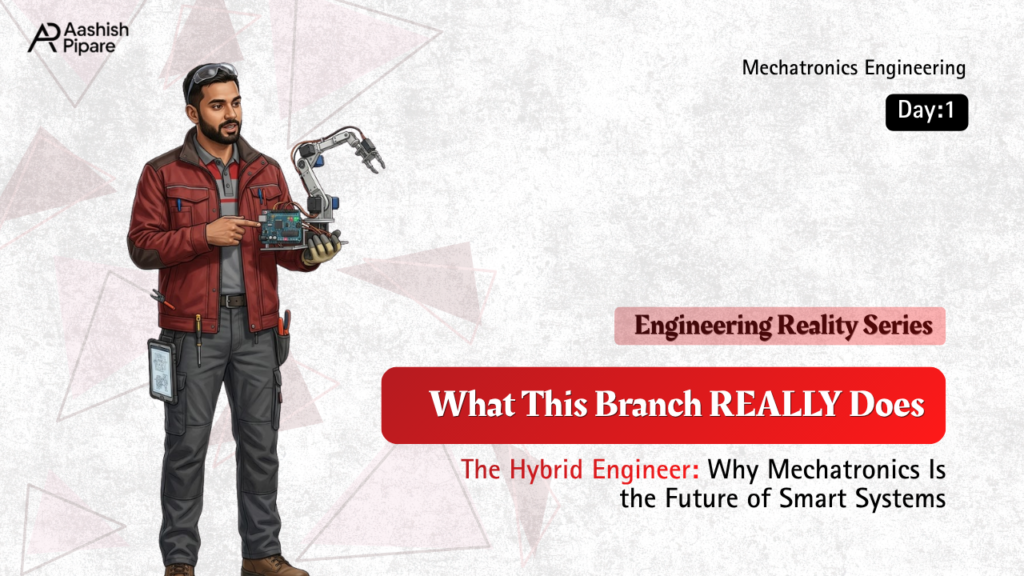
a. What is the core problem domain this branch solves?
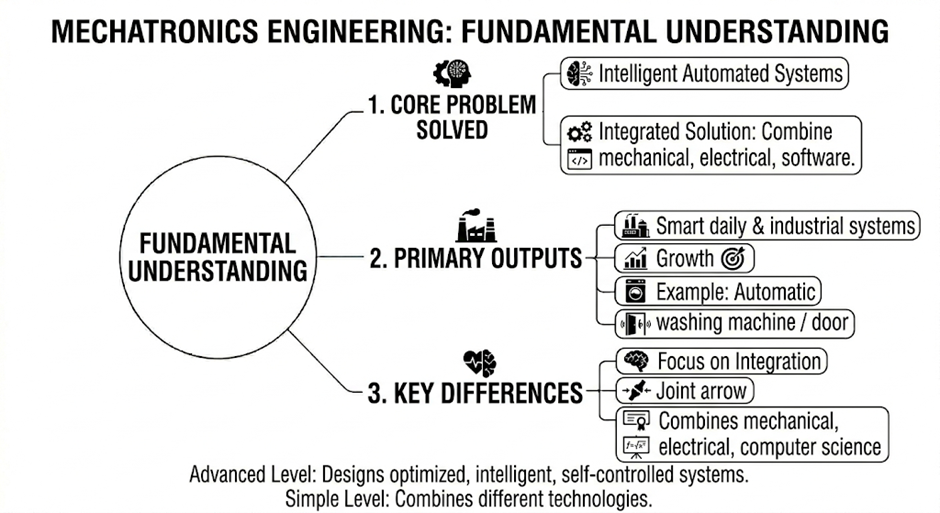
Mechatronics Engineering focuses on solving the problem of creating intelligent automated systems by integrating mechanical, electrical, and software components.
The main question it answers is:
“How can we combine machines, electronics, and programming to build smart systems that work automatically and efficiently?”
At a beginner level, it is about combining different technologies.
At an expert level, it becomes designing optimized, intelligent, and self-controlled systems.
Example:
An automatic washing machine:
- Detects load (sensor)
- Decides washing cycle (software)
- Controls motor (mechanical + electronics)
This complete system is a mechatronic solution.
b. What are the primary outputs of this field (products, systems, services)?
Mechatronics Engineering produces smart and automated systems used in daily life and industries.
Main outputs include:
- Automated machines (CNC machines, assembly systems)
- Smart consumer products (washing machines, air conditioners)
- Automotive systems (ABS braking, cruise control)
- Industrial automation systems
- Embedded control systems
At a beginner level, outputs are simple automated devices.
At an expert level, they become complex, intelligent systems with real-time control.
Example:
An automatic door in a mall senses a person and opens without human input—this is a mechatronic system.
c. How is this branch different from closely related branches?
Mechatronics Engineering is unique because it focuses on integration rather than individual components.
- Mechanical Engineering : Focus on machines
- Electrical Engineering : Focus on circuits
- Computer Science : Focus on programming
👉 Mechatronics combines all these to create a complete working system
At a beginner level, subjects are studied separately.
At an expert level, everything is integrated into one system.
Example:
A car’s automatic braking system:
- Sensors detect obstacles
- Electronics process signals
- Software decides action
- Mechanical system applies brakes
d. What are the real-world applications of this field?
Mechatronics is widely used in systems where automation and control are required.
Applications include:
- Manufacturing automation
- Automotive systems
- Robotics
- Consumer electronics
- Aerospace systems
- Smart home devices
At a beginner level, applications are basic devices.
At an expert level, applications involve advanced automation systems.
Example:
A smart thermostat automatically adjusts room temperature based on environment and user settings.
e. What industries heavily depend on this branch?
Many industries rely on Mechatronics Engineering for efficiency and automation:
- Automobile industry
- Manufacturing and production
- Robotics and automation companies
- Consumer electronics
- Aerospace and defense
At a beginner level, mechatronics is visible in simple products.
At an expert level, it becomes a core driver of modern industrial systems.
Example:
Modern cars use mechatronic systems for parking assistance, automatic braking, and engine control.

Conclusion :
Mechatronics Engineering focuses on integrating mechanical, electrical, and software systems to create intelligent and automated solutions. It plays a key role in modern technology by improving efficiency, accuracy, and system performance. This branch forms the foundation of smart machines used in industries and daily life.
CTA (Call To Action):
- Start exploring basics of electronics, programming, and mechanical systems together.
- Build small automation projects to understand how real mechatronic systems work.