
1. What is the core problem domain this branch solves?
At its core, Mechanical Engineering focuses on solving problems related to motion, forces, energy, and mechanical systems. The fundamental goal is to design systems that can convert energy into useful work efficiently and safely.
Every machine in the world—from a simple fan to a complex jet engine—operates based on mechanical principles. Mechanical engineers are responsible for understanding how these systems work and how to improve them. For example, in a car engine, fuel energy is converted into motion. The engineer must ensure that this conversion is efficient, safe, and long-lasting.
The branch also deals with challenges such as:
- How to reduce energy loss in machines
- How to improve performance and efficiency
- How to prevent mechanical failure
- How to design systems that can handle extreme conditions like heat and pressure
Mechanical engineers study thermodynamics (energy), fluid mechanics (flow), and solid mechanics (strength of materials) to solve these problems.
Another important aspect is optimization. Engineers must design machines that not only work but also use minimum resources, cost less, and last longer. For instance, designing a fuel-efficient engine is not just about performance but also about reducing environmental impact.
In simple terms, Mechanical Engineering solves the problem of: How to make machines and systems work effectively in the real world
2. What are the primary outputs of this field?
Mechanical Engineering produces a wide range of machines, systems, and technologies that are used in everyday life as well as advanced industries.
One of the primary outputs is mechanical machines, such as engines, turbines, compressors, and pumps. These machines are used in vehicles, factories, and power plants. For example, a turbine in a power plant generates electricity by converting energy from steam or water.
Another major output is mechanical components. These include gears, shafts, bearings, springs, and fasteners. Although small, these components are critical for the functioning of machines. A single faulty gear can stop an entire system.
Mechanical engineers also design manufacturing systems, such as assembly lines and CNC machines, which are used to produce goods efficiently. These systems are essential for industries that produce cars, electronics, and consumer products.
The field also contributes to energy systems, including power plants, renewable energy devices, and heating systems. Engineers design systems that generate and manage energy efficiently.
In addition, Mechanical Engineering produces HVAC systems (Heating, Ventilation, and Air Conditioning), which are used in buildings to maintain temperature and air quality.
Modern developments include robotics and automation systems, where mechanical design is combined with electronics and programming to create intelligent machines.
Even everyday household items like refrigerators, washing machines, and fans are outputs of mechanical engineering.
In summary, Mechanical Engineering produces:
Machines, components, systems, and technologies that make modern life possible
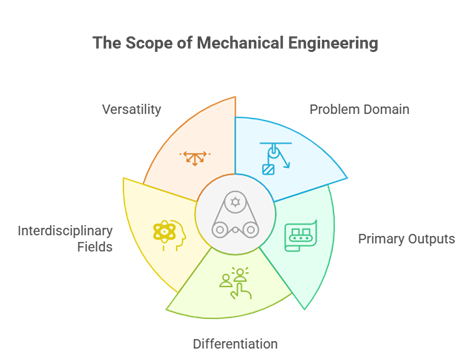
3. How is this branch different from closely related branches?
Mechanical Engineering is often compared with other branches, but it has a unique identity due to its focus on physical systems and real-world applications.
Compared to Electrical Engineering, which deals with circuits and electrical systems, Mechanical Engineering focuses on motion, forces, and mechanical structures. For example, a mechanical engineer designs the physical structure of a motor, while an electrical engineer designs its electrical control system.
Compared to Civil Engineering, which focuses on infrastructure like buildings and bridges, Mechanical Engineering deals with machines and dynamic systems. A civil engineer builds a bridge, while a mechanical engineer designs the machines used to construct it.
Compared to Computer Science, which deals with software and algorithms, Mechanical Engineering focuses on hardware and physical systems. However, modern engineering often combines both fields, especially in automation and robotics.
Mechanical Engineering also serves as the foundation for interdisciplinary fields like Mechatronics, which combines mechanical, electrical, and computer systems.
What makes Mechanical Engineering unique is its versatility. It is not limited to one industry or application. Instead, it provides a broad understanding of engineering principles that can be applied in multiple fields.
Because of this, it is often called the:
“Mother Branch of Engineering”
4. What are the real-world applications of this field?
Mechanical Engineering has one of the widest application areas among all engineering branches. It is present in almost every industry and aspect of daily life.
One of the most prominent applications is in the automobile industry, where engineers design engines, transmissions, and braking systems. Every vehicle on the road is a product of mechanical engineering.
In the aerospace industry, mechanical engineers design aircraft engines, turbines, and structural systems that allow airplanes and spacecraft to function.
The manufacturing industry depends heavily on mechanical engineering for production systems, machinery, and automation. Factories use mechanical systems to produce goods efficiently and in large quantities.
Mechanical engineering also plays a major role in the energy sector, where engineers design systems for power generation, including thermal power plants, hydroelectric systems, and wind turbines.
In the field of robotics and automation, mechanical engineers design robotic arms and automated machines used in industries. These systems improve productivity and reduce manual labor.
Another important application is in HVAC systems, which are used in homes, offices, and industries to control temperature and air quality.
Mechanical engineering also contributes to medical technology, where engineers design prosthetics, implants, and surgical tools.
In addition, renewable energy systems, such as wind turbines and solar tracking systems, rely on mechanical engineering principles.
Even everyday appliances like washing machines, refrigerators, and fans are examples of mechanical engineering applications.
In short:
Mechanical Engineering is present everywhere—from homes to industries to advanced technology
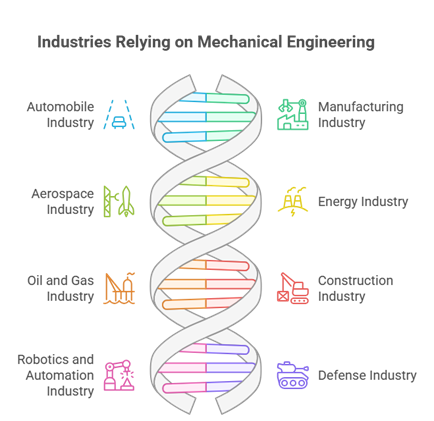
5. What industries heavily depend on this branch?
Mechanical Engineering supports a wide range of industries that rely on machines, systems, and physical processes.
The automobile industry is one of the largest employers of mechanical engineers. Companies like Tata Motors and Maruti Suzuki depend on engineers for vehicle design, manufacturing, and testing.
The manufacturing industry uses mechanical systems for production and automation. Engineers ensure that machines operate efficiently and produce high-quality products.
The aerospace industry, including organizations like ISRO, relies on mechanical engineering for designing aircraft and space systems.
The energy industry depends on mechanical engineers to design and maintain power generation systems such as turbines and boilers.
The oil and gas industry uses mechanical systems like pipelines, pumps, and drilling equipment, all designed and maintained by engineers.
The construction industry uses heavy machinery such as cranes, excavators, and loaders, which are designed using mechanical principles.
The robotics and automation industry is growing rapidly and depends on mechanical engineers for designing robotic systems.
The defense industry also relies on mechanical engineering for designing military vehicles and equipmentThe reason these industries depend on mechanical engineering is simple:
✔ Machines are essential for production
✔ Systems need maintenance and improvement
✔ Efficiency and innovation depend on engineering
Mechanical Engineering is the foundation of industrial development
CONCLUSION
Mechanical Engineering is not just a field of study—it is a core discipline that powers the modern world.
It:
✔ Solves real-world problems related to energy and machines
✔ Produces systems used in every industry
✔ Has applications in nearly every aspect of life
✔ Offers diverse and long-term career opportunities
If you choose Mechanical Engineering, you are choosing to:
Design, build, and improve the systems that drive the world forward