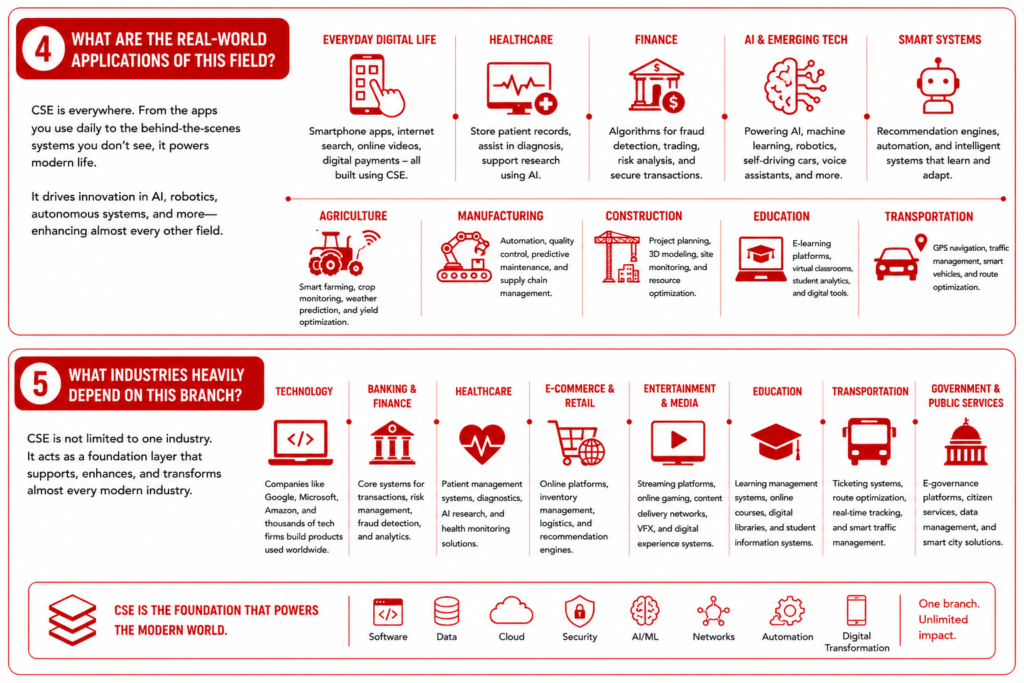

1. What is the core problem domain this branch solves?
When I first started understanding Computer Science Engineering, I also thought it was just about coding or building apps. But over time, I realized the core of this branch is actually much deeper—it’s about solving problems using computation in the most efficient way possible.
At a fundamental level, CSE tries to answer one key question: How can we take a real-world problem and convert it into a step-by-step process that a machine can execute? That process is what we call an algorithm. Whether it’s something simple like sorting numbers or something complex like predicting user behavior, everything comes down to designing efficient logical steps.
What makes this branch interesting—and sometimes challenging—is that you’re not just solving problems once. You’re solving them in a way that works for millions of users, huge amounts of data, and real-time conditions. For example, when you search something online, the system has to scan massive databases and return results in milliseconds. That’s not just coding—that’s optimization, system design, and efficiency at scale.
Another thing I’ve noticed is that CSE is not limited to “visible” problems. Many of the problems you solve are invisible but critical—like improving system performance, reducing memory usage, securing data, or making systems fault-tolerant.
From my experience, the real essence of CSE is not writing code—it’s thinking in a structured, logical, and scalable way. Coding is just the tool; problem-solving is the core.
2. What are the primary outputs of this field (products, systems, services)?
One thing that really stood out to me over time is that CSE doesn’t produce physical objects—you don’t “see” the output in the same way you see a building or a machine. But at the same time, its outputs are everywhere around you.
The most obvious outputs are software applications—mobile apps, websites, and desktop programs. Whether it’s a social media app, a banking platform, or a food delivery service, all of these are built using CSE principles.
But beyond apps, there are larger systems that most people don’t think about. For example, operating systems like Windows or Linux act as the foundation for all computing devices. Then there are distributed systems like cloud platforms, which allow companies to store data and run applications at a massive scale.
Another major output is data-driven systems. Today, companies rely heavily on data for decision-making, and CSE plays a big role in building systems that collect, process, and analyze this data. This includes recommendation systems (like what you see on shopping apps), search engines, and AI models.
There are also services, such as cloud computing, cybersecurity solutions, and APIs that allow different systems to communicate with each other.
From my perspective, what makes CSE unique is that its outputs are often invisible infrastructure—you may not see them, but they power almost everything in the modern digital world.
3. How is this branch different from closely related branches?
This is something I was confused about in the beginning, because branches like IT, Software Engineering, and even AI seem very similar on the surface. But once you dig deeper, the differences become clear.
CSE is more focused on fundamentals and core concepts—things like algorithms, data structures, operating systems, and computer architecture. It teaches you why systems work the way they do, not just how to use them.
Information Technology (IT), on the other hand, is more about application and management—like handling networks, databases, and system administration. Software Engineering focuses more on development processes, such as designing, testing, and maintaining software systems in an organized way.
What I’ve noticed is that CSE gives you a strong base, which allows you to move into multiple domains later—whether it’s development, data science, cybersecurity, or AI.
Another key difference compared to branches like Electronics is that CSE is mostly software-focused, while electronics deals more with hardware and circuits.
From my experience, if you understand CSE fundamentals well, you can easily adapt to other related fields. That flexibility is one of the biggest strengths of this branch.
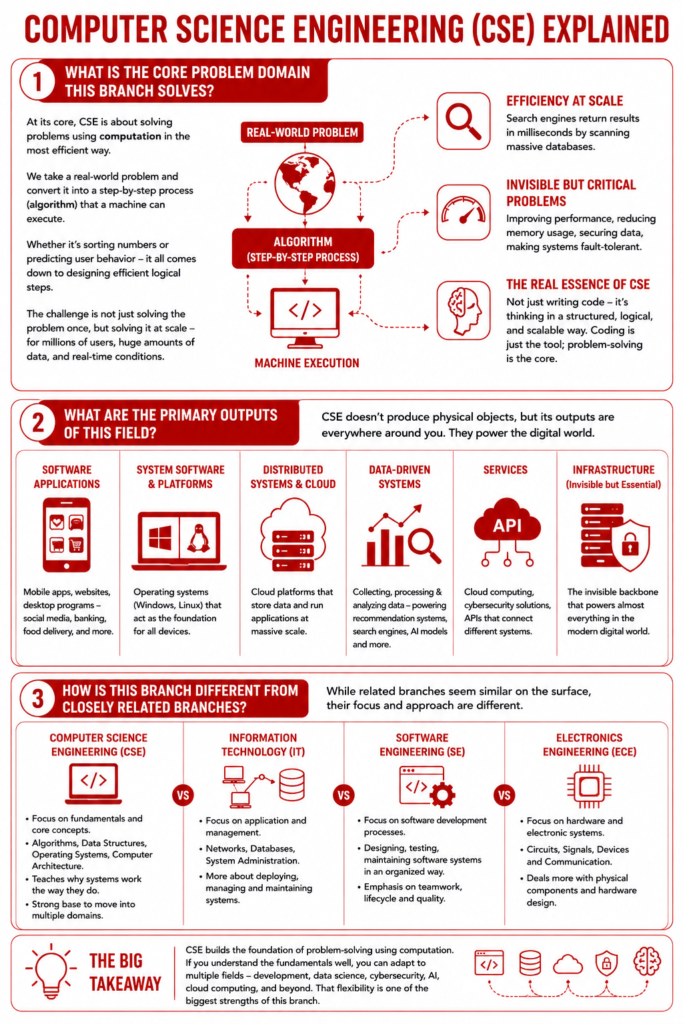
4. What are the real-world applications of this field?
This is where CSE becomes really interesting, because its applications are almost everywhere. Once you start noticing them, you realize how deeply this field is integrated into daily life.
Every time you use a smartphone app, search on the internet, watch videos online, or make a digital payment, you’re interacting with systems built using CSE. These are the visible applications.
But there are also many behind-the-scenes applications. For example, in healthcare, computer systems help store patient records, assist in diagnosis, and even support research using AI. In finance, algorithms are used for fraud detection, trading, and risk analysis.
CSE is also driving innovation in areas like artificial intelligence, machine learning, robotics, and autonomous systems. Things like self-driving cars, voice assistants, and recommendation engines are all powered by computer science.
Even traditional industries like agriculture, manufacturing, and construction are now using technology for automation, monitoring, and optimization.
From what I’ve seen, CSE is not just a field—it’s a tool that enhances almost every other field. That’s why its applications keep expanding over time.
5. What industries heavily depend on this branch?
One of the biggest advantages of CSE is that it is not limited to a single industry. Almost every modern industry depends on it in some way.
The most obvious one is the technology industry, with companies like Google, Microsoft, and Amazon building products and services used worldwide.
But beyond that, industries like banking and finance rely heavily on software systems for transactions, security, and analytics. The healthcare sector uses computer systems for patient management, diagnostics, and research.
E-commerce companies depend on CSE for platforms, logistics, and recommendation systems. The entertainment industry uses it for streaming platforms, gaming, and content delivery. Even sectors like education, transportation, and government services are becoming increasingly digital.
What I’ve noticed is that CSE acts as a foundation layer—it supports and enhances other industries rather than existing independently.