
FUNDAMENTAL UNDERSTANDING OF THE BRANCHCHEMICAL ENGINEERING
a. What is the core problem domain this branch solves?
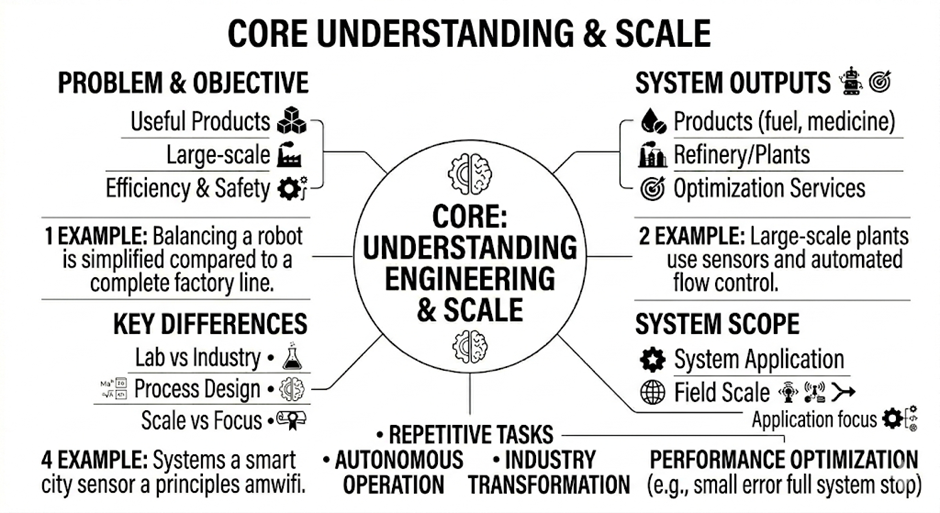
The core problem domain of Chemical Engineering is developing efficient, safe, economical, and environmentally sustainable methods to convert raw materials into useful products on a large industrial scale. While chemistry explains how substances react, Chemical Engineering focuses on how to transform those reactions into practical manufacturing processes that can produce high-quality products in massive quantities.
At its core, Chemical Engineering answers the question:
“How can we efficiently, safely, and economically transform raw materials into products that improve everyday life?”
Chemical engineers solve challenges related to the design, operation, optimization, and control of industrial processes. They determine the best way to combine raw materials, select suitable chemical reactions, manage heat and energy, separate products from impurities, and ensure that every step of production is reliable and cost-effective. Their goal is to maximize productivity while minimizing waste, energy consumption, environmental pollution, and production costs.
At the beginner level, the field focuses on understanding chemical reactions, material properties, mass and energy balances, heat transfer, fluid flow, and basic process operations. Students learn why reactions occur, how materials behave under different conditions, and how industrial equipment functions.
At the expert level, Chemical Engineering becomes the science of designing complete industrial plants and manufacturing systems. Engineers create entire production facilities by selecting equipment such as reactors, distillation columns, pumps, compressors, heat exchangers, pipelines, and automated control systems. They ensure that these systems operate continuously, safely, and efficiently while meeting strict quality and environmental standards.
b. What are the primary outputs of this field (products, systems, services)?
Chemical Engineering produces a wide range of products, industrial systems, and professional services that are essential to modern society. The field focuses on designing and improving processes that transform raw materials into useful, safe, and high-quality products while ensuring efficient, economical, and environmentally sustainable production. From everyday household items to advanced industrial materials, the outputs of Chemical Engineering impact almost every aspect of daily life.
1. Products
One of the most visible outputs of Chemical Engineering is the production of valuable products used by people and industries around the world. Chemical engineers develop manufacturing processes that produce goods on a large scale while maintaining consistent quality and safety.
Some major products include:
- Fuels such as petrol, diesel, aviation fuel, LPG, and biofuels.
- Pharmaceuticals including medicines, vaccines, antibiotics, and medical chemicals.
- Fertilizers and agrochemicals that improve agricultural productivity.
- Plastics, polymers, synthetic fibers, and rubber used in packaging, automobiles, electronics, and construction.
- Food and beverage products such as edible oils, sugar, dairy products, beverages, and food additives.
- Cosmetics, soaps, detergents, shampoos, perfumes, and personal care products.
- Paints, coatings, adhesives, dyes, pigments, and specialty chemicals.
- Industrial gases like oxygen, nitrogen, hydrogen, and carbon dioxide.
- Batteries, electronic materials, and advanced functional materials used in modern technologies.
At the beginner level, students learn how these products are manufactured using basic chemical reactions and industrial processes. At the expert level, engineers design highly optimized production systems capable of manufacturing millions of units while minimizing waste and energy consumption.
c. How is this branch different from closely related branches?
Chemical Engineering is unique because it focuses on applying scientific principles to design, operate, and optimize large-scale industrial processes that convert raw materials into valuable products. While several branches study chemicals, materials, or industrial production, Chemical Engineering specializes in taking laboratory discoveries and transforming them into safe, efficient, economical, and environmentally sustainable manufacturing systems.
The primary difference lies in scale and application. A chemist may discover a new chemical reaction in a laboratory, but a chemical engineer develops the process and equipment required to manufacture that product in thousands or millions of kilograms while maintaining consistent quality, minimizing costs, ensuring safety, and reducing environmental impact.
Chemical Engineering vs. Chemistry
Chemistry is a science that studies the composition, structure, properties, and reactions of matter. Chemists perform experiments to understand how substances interact and develop new compounds and reactions.
Chemical Engineering, on the other hand, applies this scientific knowledge to industrial production. Chemical engineers determine how laboratory reactions can be carried out on a commercial scale. They design reactors, heat exchangers, pipelines, distillation columns, pumps, and automated control systems that enable continuous manufacturing.
Example:
A chemist develops a new pharmaceutical compound in a research laboratory. A chemical engineer designs the manufacturing plant that produces the medicine safely, efficiently, and consistently for millions of patients.
Chemical Engineering vs. Mechanical Engineering
Mechanical Engineering focuses primarily on the design, analysis, manufacturing, and maintenance of mechanical systems such as engines, turbines, machines, robotics, and vehicles.
Chemical Engineering focuses on processes involving chemical reactions, heat transfer, fluid flow, mass transfer, and separation techniques. Although chemical engineers also work with equipment, their main goal is optimizing the chemical processes occurring inside that equipment.
Example:
A mechanical engineer may design a high-efficiency pump, while a chemical engineer determines how that pump should operate within a refinery to transport chemicals safely and efficiently.
d. What are the real-world applications of this field?
Chemical Engineering has a vast range of real-world applications because it is responsible for transforming raw materials into useful products through efficient, safe, and sustainable industrial processes. Chemical engineers work in industries that produce the fuels, medicines, food products, fertilizers, plastics, clean water, and advanced materials that people use every day. Their expertise helps industries improve productivity, reduce costs, conserve energy, and protect the environment.
At its core, Chemical Engineering applies scientific knowledge and engineering principles to design, operate, and optimize manufacturing processes on a large scale. From everyday consumer goods to advanced technologies, the field plays a vital role in modern society.
1. Oil and Gas Industry
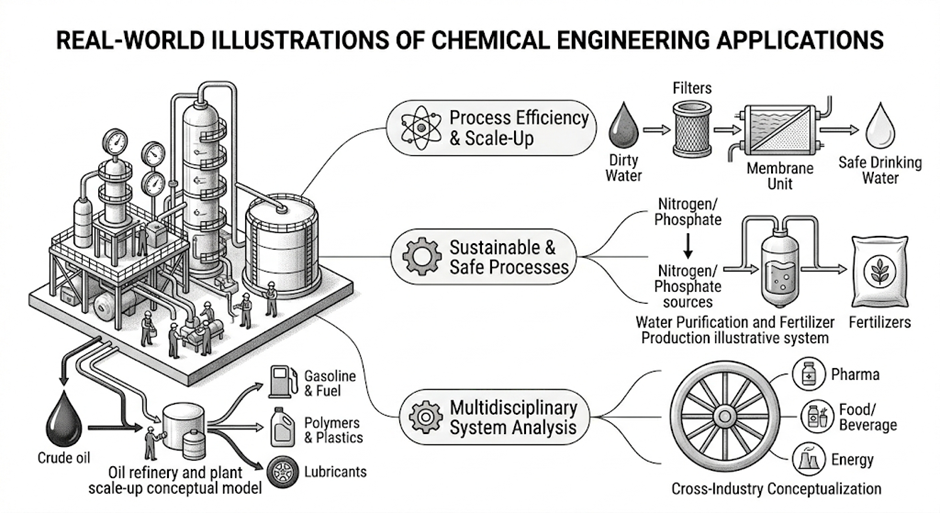
One of the largest applications of Chemical Engineering is in petroleum refining and natural gas processing. Chemical engineers design and operate refineries that convert crude oil into valuable products such as petrol, diesel, aviation fuel, lubricants, LPG, and petrochemicals. They also improve refining efficiency, reduce emissions, and ensure safe plant operations.
Example: A refinery uses processes such as distillation, catalytic cracking, and reforming to separate and convert crude oil into multiple useful fuels and chemical products.
2. Pharmaceutical Industry
Chemical engineers play a crucial role in the large-scale production of medicines, vaccines, antibiotics, and medical chemicals. They design manufacturing processes that ensure consistent product quality, strict safety standards, and compliance with regulatory requirements.
Example: During vaccine production, chemical engineers develop efficient manufacturing systems that can safely produce millions of doses while maintaining purity and effectiveness.
3. Food and Beverage Industry
Chemical Engineering is widely used in food processing and preservation. Engineers design processes for producing dairy products, edible oils, sugar, beverages, packaged foods, and nutritional supplements. They also develop methods for improving food safety, shelf life, and product quality.
Example: Milk processing plants use pasteurization and sterilization systems designed by chemical engineers to produce safe dairy products.
e. What industries heavily depend on this branch?
Chemical Engineering is one of the most versatile engineering disciplines because it supports a wide range of industries that produce essential products for everyday life. Nearly every manufacturing sector relies on chemical engineers to design, operate, optimize, and improve industrial processes. Their expertise helps industries convert raw materials into valuable products safely, efficiently, economically, and in an environmentally responsible manner.
At the beginner level, Chemical Engineering may appear to be limited to chemical factories or manufacturing plants. However, at the expert level, it becomes clear that chemical engineers contribute to almost every major industry, from healthcare and agriculture to energy, environmental protection, and advanced technology.
1. Petroleum and Refinery Industry
The petroleum industry is one of the largest employers of chemical engineers. Crude oil extracted from the earth cannot be used directly, so chemical engineers design and operate refineries that convert it into useful products such as petrol, diesel, jet fuel, LPG, lubricants, and petrochemical feedstocks.
They also improve refinery efficiency, reduce energy consumption, increase product yield, and ensure safe plant operations.
Example: A petroleum refinery uses distillation, catalytic cracking, reforming, and purification processes to produce transportation fuels and industrial chemicals.
2. Pharmaceutical Industry
Pharmaceutical companies depend heavily on chemical engineers to manufacture medicines, vaccines, antibiotics, and medical chemicals on a large scale. Chemical engineers design production processes that ensure high product quality, safety, and compliance with strict regulatory standards.
They also optimize manufacturing costs and improve production efficiency without compromising product purity.
Example: Vaccine manufacturing facilities rely on chemical engineers to develop scalable production systems capable of supplying millions of doses.
CONCLUSION:
Chemical Engineering is a core branch that transforms raw materials into essential products used in everyday life. It combines science and engineering to design safe, efficient, and large-scale industrial processes. This field plays a vital role in supporting industries, improving quality of life, and driving economic growth.