
Why should I choose this branch over others?
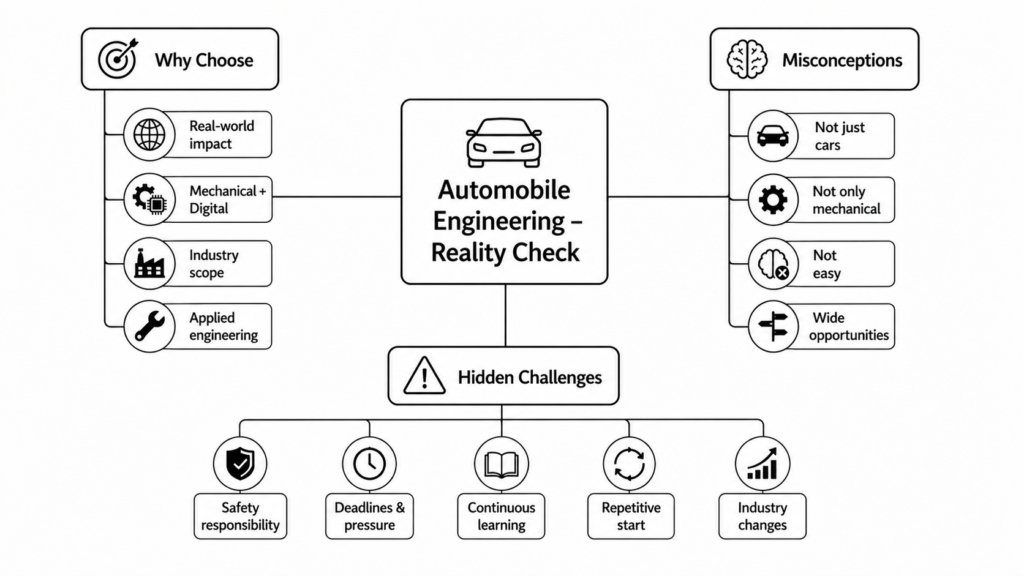
From my experience, choosing Automobile Engineering makes sense only if you genuinely feel interested in how vehicles work as complete systems rather than just being attracted to cars emotionally. The strongest reason to choose this branch is that it connects mechanical engineering, electronics, and modern software into one practical domain that directly impacts daily life. I have always felt that this field is rewarding because what you design, test, or improve is something people physically use every day on roads. It also offers a strong industrial ecosystem with opportunities in manufacturing, electric mobility, design, testing, and research. Compared to many other branches, it provides a visible link between engineering and real-world mobility, which can feel very satisfying if you enjoy applied science.
What are the biggest misconceptions about this field?
From what I have seen, the biggest misconception is that Automobile Engineering is only about cars or driving passion. Many students enter thinking they will work directly with luxury cars or high-performance vehicles, but in reality, the field is much broader and more technical. Another misunderstanding is that it is purely mechanical, when in fact modern automobiles are highly electronic and software-driven systems. I have also noticed that some people believe job opportunities are limited, but the industry is actually large and evolving, especially with electric vehicles and smart mobility. Another common myth is that the branch is easy because it feels familiar, but in reality, subjects like thermodynamics, vehicle dynamics, and control systems can be quite challenging. In my experience, the gap between expectation and reality is one of the main reasons students lose interest later.
What are the hidden challenges no one talks about?
From my perspective, one hidden challenge is the high level of responsibility associated with safety. A small engineering mistake in braking systems, engine design, or structural components can lead to serious consequences, and that pressure is not always obvious during studies. I have also noticed that automotive roles, especially in manufacturing and testing, can involve strict deadlines, shift work, and high workload during product launches. Another challenge is that the industry is changing very quickly, so engineers must continuously update their skills, especially in electric vehicles and software systems. Supply chain dependency is also a hidden issue because delays in components can affect entire production cycles. In my experience, another subtle challenge is that initial roles may feel repetitive before moving into more creative or design-oriented positions, which requires patience and long-term thinking.
If I fail in core roles, what are my backup career paths?
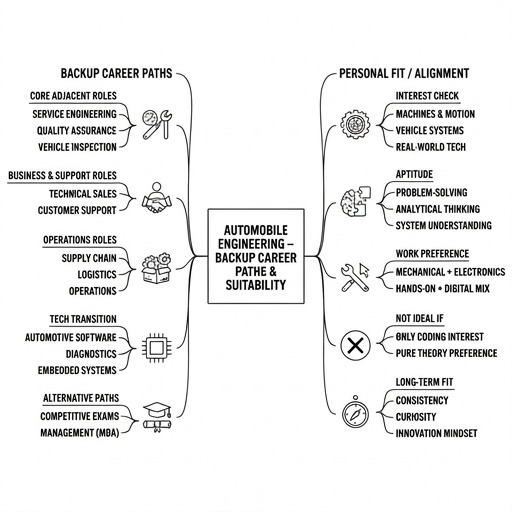
From what I have observed, Automobile Engineering actually offers several backup paths if someone does not continue in core design or manufacturing roles. Graduates can move into automotive service engineering, quality assurance, or vehicle inspection roles, which are still strongly connected to the field. Some engineers shift into sales and technical support roles in automotive companies, where engineering knowledge helps in client communication. I have also seen many move into supply chain management, logistics, or operations roles because automotive industries require strong coordination systems. With additional training, some enter software-related automotive domains, especially in vehicle diagnostics or embedded systems. Others transition into unrelated but stable fields like competitive exams or management studies. In my experience, the engineering foundation still remains useful even if the career direction changes.
Is this branch aligned with my interest, aptitude, and long-term vision?
From my perspective, this is the most important question because success in Automobile Engineering depends more on interest and consistency than on initial academic performance alone. This branch is a good fit if someone enjoys understanding how machines move, how systems interact, and how real-world transportation works at both mechanical and electronic levels. I have noticed that students who are naturally curious about problem-solving, vehicles, and applied engineering concepts usually stay motivated in this field. However, if someone prefers purely software-based work or highly theoretical mathematics without physical systems, they may not feel fully satisfied. In my experience, alignment is not just about liking cars—it is about whether you enjoy working with complex systems that combine mechanics, electronics, and innovation to solve real mobility challenges over the long term.
Conclusion:
Choose Automobile Engineering only if you genuinely enjoy understanding complex vehicle systems—not just cars—because the field is technical, evolving, and demands long-term consistency, adaptability, and real interest.
CTA:
Be honest with yourself—if you like machines, problem-solving, and real-world engineering, commit fully; if not, explore other branches early to avoid future regret.