
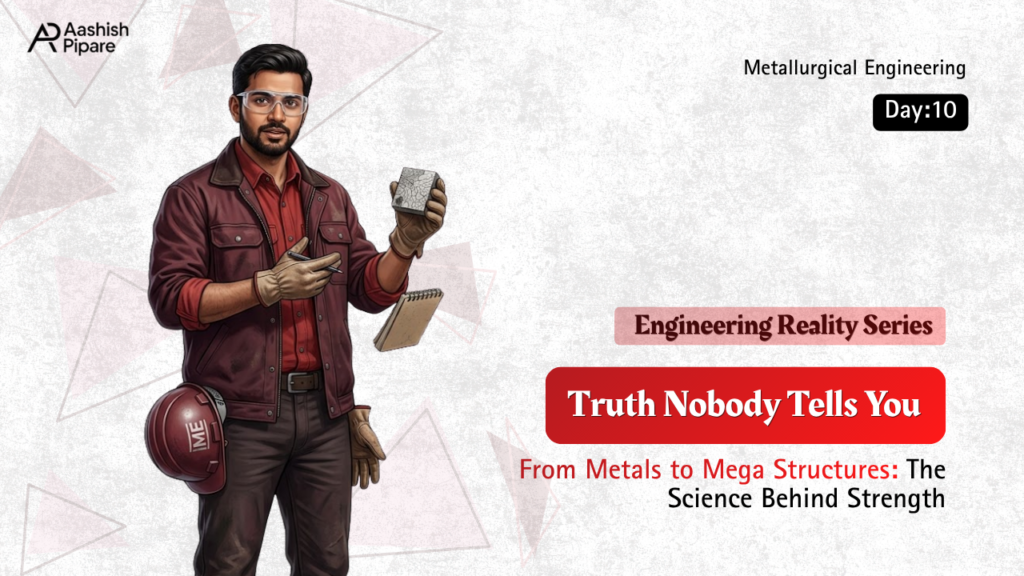
Why should I choose this branch over others?
Choosing Metallurgical Engineering is not just about selecting a degree—it is about choosing a lifestyle, mindset, and long-term career direction. You should choose this branch only if you have a genuine interest in materials, processes, and core engineering systems.
Unlike some popular branches that are highly saturated, metallurgy offers specialized and less crowded opportunities. This means that skilled engineers often face less competition and more niche roles, especially in core industries. For example, while thousands compete in software roles, fewer candidates specialize deeply in materials engineering, making expertise more valuable.
Another strong reason to choose this branch is its fundamental importance to all industries. Every sector—whether automotive, aerospace, construction, electronics, or energy—depends on materials. Without metallurgical engineers, modern engineering systems cannot function. This makes the field evergreen and stable.
The branch also offers diversity in career paths. You are not limited to steel plants; you can work in advanced areas like aerospace alloys, biomedical implants, nanotechnology, and energy materials. For instance, designing lightweight alloys for electric vehicles is a modern and impactful application.
However, this branch demands discipline, patience, and conceptual understanding. It is not ideal for students who prefer shortcuts or purely theoretical learning. You must be comfortable with both practical work (labs, plants) and analytical thinking (problem-solving, calculations).
If you choose this branch without interest, you may struggle with subjects like thermodynamics and phase transformations. But if you are genuinely curious about how materials behave and how industries function, this branch can be extremely rewarding.
In simple terms:
Choose metallurgy if you want to be a core engineer who builds the foundation of industries, not just someone who works on the surface level.
What are the biggest misconceptions about this field?
Metallurgical Engineering suffers from several misconceptions, mainly due to lack of awareness and outdated perceptions. These myths often discourage students from exploring a highly valuable field.
The most common misconception is that metallurgy only means working in steel plants under harsh conditions. While steel plants are an important part of the field, metallurgy today extends far beyond that. It includes advanced domains like nanotechnology, biomaterials, aerospace materials, and smart materials.
Another misconception is that the field has low career growth or salary potential. In reality, skilled metallurgical engineers, especially those with specialization or experience, can earn highly competitive salaries. For example, experts in corrosion engineering or failure analysis are in high demand globally.
Some students believe that metallurgy is an outdated branch. This is completely incorrect. The field is evolving rapidly with the integration of Artificial Intelligence, automation, and advanced material science. Modern developments such as shape memory alloys, graphene, and battery materials are part of metallurgy.
There is also a myth that this branch has fewer job opportunities compared to IT. While IT may have more entry-level jobs, metallurgy offers specialized and stable careers with long-term growth. Additionally, metallurgical engineers can transition into IT, data analysis, or management roles if they develop relevant skills.
Another misunderstanding is that the field is only for academically strong students. In reality, practical skills, curiosity, and consistency matter more than marks.
These misconceptions arise because many students do not have proper exposure to the field. Once they understand its scope, they realize that metallurgy is a modern, evolving, and impactful discipline.
The truth is: Metallurgy is not limited—it is hidden in almost every industry around you.
What are the hidden challenges no one talks about?
While Metallurgical Engineering offers great opportunities, it also comes with real-world challenges that are often not discussed openly. Understanding these challenges helps students prepare mentally and professionally.
One of the biggest challenges is the working environment in core industries. Engineers working in steel plants or foundries may face high temperatures, noise, and physically demanding conditions. For example, monitoring molten metal processes requires both focus and endurance.
Another challenge is location constraints. Many core industries are located in industrial areas rather than major cities. This may require relocation and adjustment to a different lifestyle.
The initial salary growth in some core sectors may be slower compared to fields like IT. However, this gap reduces with experience and specialization. Long-term growth in metallurgy can be very rewarding if you stay consistent.
The field also requires continuous learning. Technologies such as AI, automation, and advanced materials are constantly evolving. Engineers must keep updating their knowledge to remain relevant.
Competition increases at higher levels, especially for research, international roles, and leadership positions. Only those with strong skills and experience stand out.
Another hidden challenge is the need for patience. Success in this field takes time, as it involves gaining experience, understanding processes, and building expertise.
However, these challenges are not barriers—they are part of professional growth. Engineers who accept and adapt to these realities become stronger and more capable.
Reality check:
Metallurgy is not easy—but it builds resilient and highly skilled engineers.
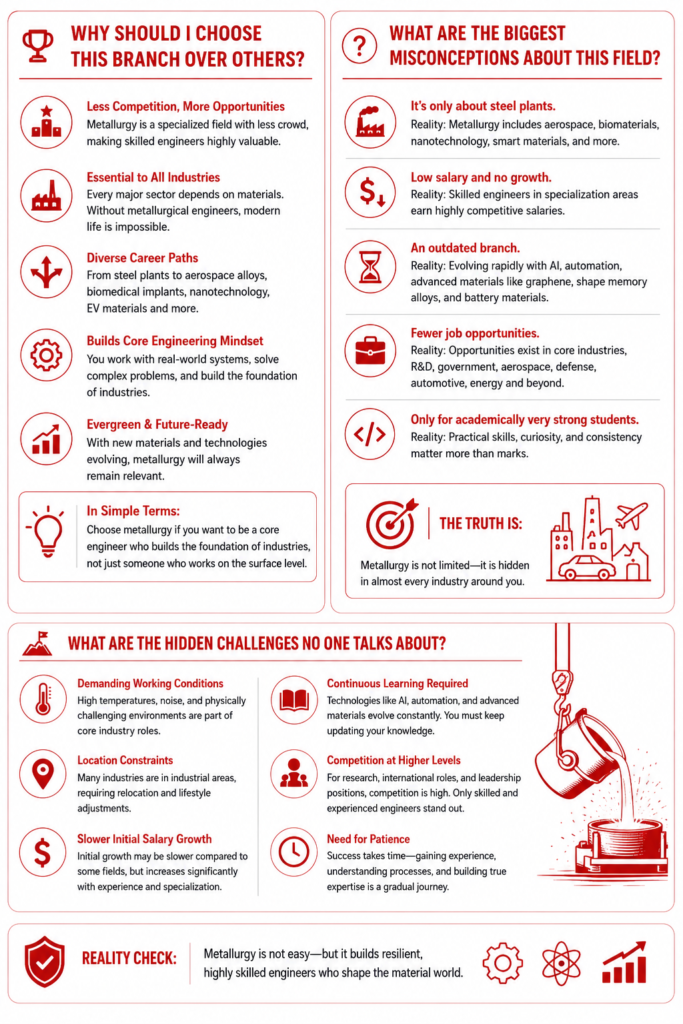
If I fail in core roles, what are my backup career paths?
One of the biggest strengths of Metallurgical Engineering is its flexibility and adaptability, which allows students to explore multiple career paths beyond core roles.
If you are unable to secure or continue in core metallurgical roles, you can transition into the IT and data analytics sector. By learning programming languages like Python and tools for data analysis, you can move into roles such as data analyst or software professional.
Another strong option is pursuing an MBA, which opens doors to management, operations, and business roles. For example, a metallurgical engineer with an MBA can become a production manager, operations head, or business strategist.
Quality control and operations roles are also widely available across industries. These roles focus on maintaining standards and improving processes, and they are not limited to metallurgy-specific companies.
Teaching and academic careers are excellent options for those interested in knowledge sharing. By pursuing higher studies such as M.Tech or PhD, you can become a lecturer or researcher.
Government jobs and public sector roles are also available through competitive exams. These positions offer stability and long-term benefits.
You can also explore entrepreneurship, such as starting a fabrication unit, recycling business, or testing laboratory.
The key is skill diversification. The more skills you develop, the more options you have. Metallurgical engineering provides a strong foundation that can be applied in multiple domains.
Important lesson:
Your degree does not limit you—your skills and mindset define your career path.
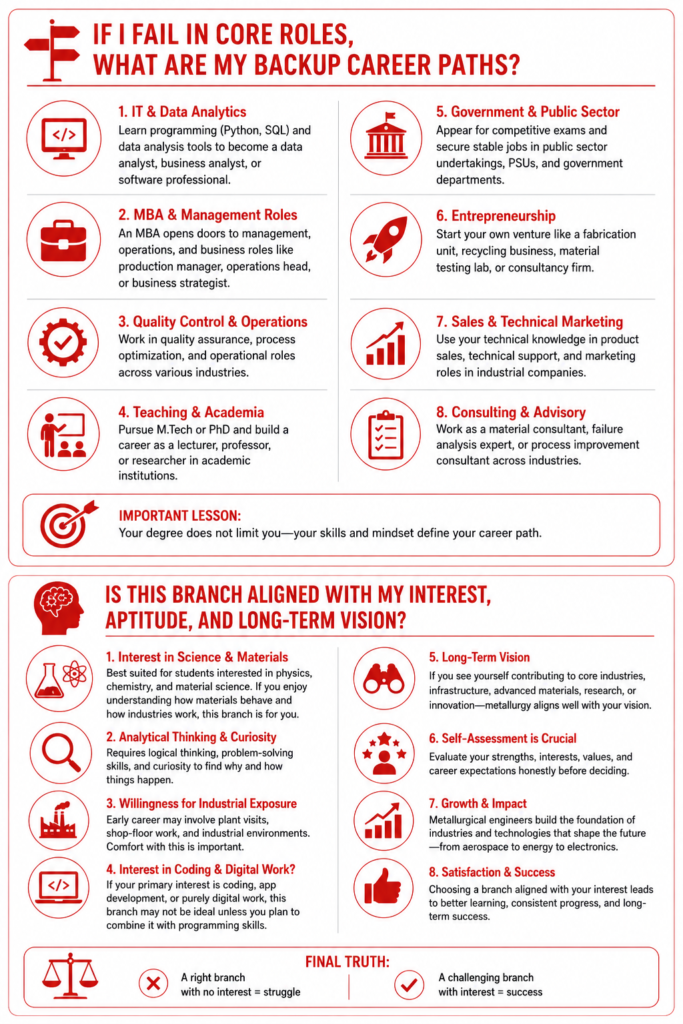
Is this branch aligned with my interest, aptitude, and long-term vision?
This is the most important question, and answering it honestly can determine your future satisfaction and success.
Metallurgical Engineering is best suited for students who have a genuine interest in physics, chemistry, and material science. If you enjoy understanding how materials behave, how products are made, and how industries operate, this branch is a good fit.
It requires analytical thinking and curiosity. You should be interested in solving problems and exploring how different factors affect material performance.
The branch also demands a willingness to work in industrial environments, especially in the early stages of your career. If you are not comfortable with this, you may need to focus on research or design roles.
If your interest lies primarily in coding, software development, or purely digital work, this branch may not be the best choice unless you plan to combine it with programming skills.
Your long-term vision is equally important. If you see yourself working in core industries, contributing to infrastructure, or developing advanced materials, metallurgy aligns well with your goals.
Self-assessment is crucial. You should evaluate your strengths, interests, and career expectations before making a decision.
Choosing a branch aligned with your interest leads to better performance, satisfaction, and long-term success.
Final truth:
A right branch with no interest = struggle
A challenging branch with interest = success
Conclusion
Metallurgical Engineering is a core and powerful field, but it demands clarity and commitment. It offers stability, specialization, and long-term growth, yet requires patience, adaptability, and real interest in materials and industrial processes. If chosen with the right mindset, it can lead to a highly impactful and rewarding career. If chosen without interest, it can feel difficult and limiting.
Call to Action
Before choosing Metallurgical Engineering, ask yourself honestly
Are you curious about how materials work and how industries run
Are you comfortable with practical environments like plants and labs
Are you ready for long-term growth instead of quick results
If yes, then start preparing by strengthening your fundamentals and exploring real industries like Tata Steel and JSW Steel. Focus on building skills, gaining practical exposure, and staying updated with modern technologies.
Choosing the right branch is not about trends. It is about alignment with your interest, mindset, and long-term vision.