
🔹 Why should I choose this branch over others?
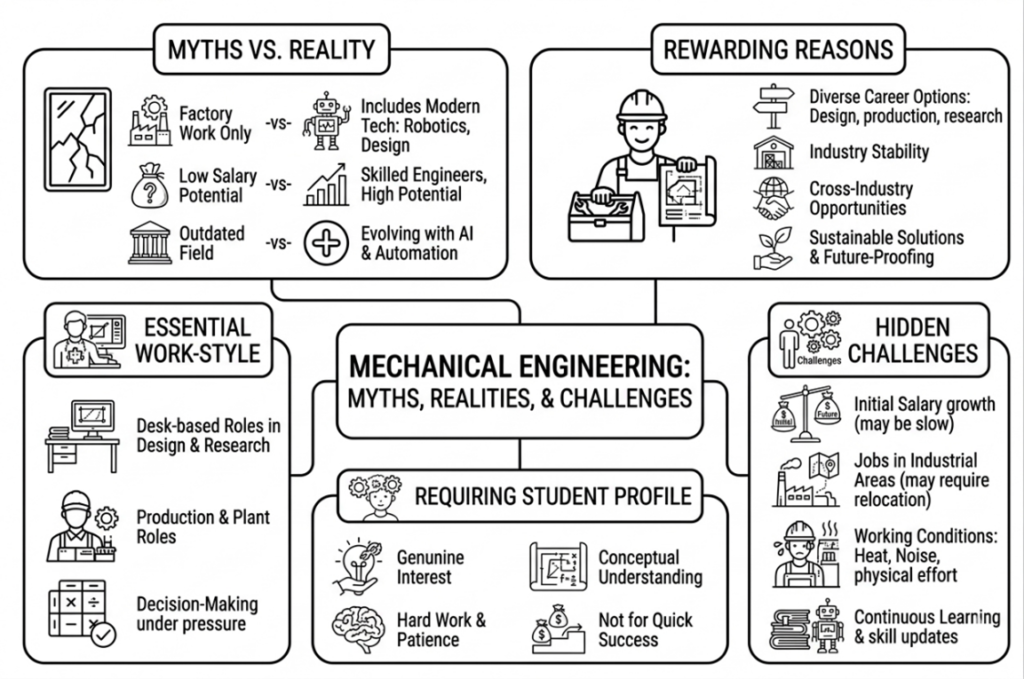
You should choose Mechanical Engineering if you are genuinely interested in machines, systems, and real-world engineering applications. This branch offers strong fundamental knowledge that can be applied across multiple industries such as automobile, energy, manufacturing, and aerospace. Unlike some fields that are limited to one domain, mechanical engineering provides diverse career options. For example, you can work in design, production, research, or even management roles. It is considered a stable branch because industries will always need machines and engineers to maintain and improve them. It also allows flexibility to shift into other fields like management or IT with additional skills. However, this branch requires hard work, patience, and conceptual understanding. It is not ideal for students looking for quick or easy success. If you enjoy solving practical problems and understanding how things work, this branch can be highly rewarding. The decision should be based on interest, not trends or peer pressure.
🔹 What are the biggest misconceptions about this field?
One common misconception is that mechanical engineering is only about working in factories or heavy industries, which is not true. The field also includes modern areas like robotics, automation, renewable energy, and design. Another misconception is that the branch has low salary potential, but in reality, skilled engineers can earn high salaries, especially with experience and specialization. Many students believe that mechanical engineering is an outdated field, but it is continuously evolving with new technologies like AI and automation. There is also a myth that it has fewer job opportunities compared to IT, which is incorrect because mechanical engineers are required in multiple industries. Some people think it involves only physical work, but there are many desk-based roles in design and research. These misconceptions arise due to lack of awareness. Understanding the real scope of the field helps in making a better decision. Mechanical engineering is a modern and evolving discipline, not a limited one.
🔹 What are the hidden challenges no one talks about?
Mechanical engineering has certain challenges that are often not discussed openly. One major challenge is that initial salary growth may be slower compared to fields like IT. Engineers may need to gain experience before seeing significant financial growth. Another challenge is that many core jobs are located in industrial areas, which may require relocation away from cities. Working conditions in some roles, such as manufacturing plants, can be physically demanding and involve exposure to noise and heat. Continuous learning is required to keep up with new technologies and industry trends. Competition increases at higher levels, especially for top roles and companies. For example, getting into design or R&D roles requires strong skills and experience. The work may also involve responsibility and pressure, especially in production environments. However, these challenges can be managed with proper planning and skill development. Awareness of these factors helps in preparing for real-world conditions.
🔹 If I fail in core roles, what are my backup career paths?
Mechanical engineering provides multiple backup career options, ensuring flexibility. One option is moving into the IT sector by learning programming and software skills such as Python or data analysis. Another path is pursuing an MBA, which opens opportunities in management, operations, and business roles. Engineers can also work in quality control and operations roles across different industries. Teaching and academic careers are possible through higher studies like M.Tech or PhD. Government jobs and public sector roles are also available through competitive exams. For example, a mechanical engineer can become a project manager or operations manager. Entrepreneurship is another option, such as starting a manufacturing or service business. Skill diversification increases career flexibility. Having backup options ensures stability even if core roles are not achieved. Planning ahead is important for long-term success.
🔹 Is this branch aligned with my interest, aptitude, and long-term vision?
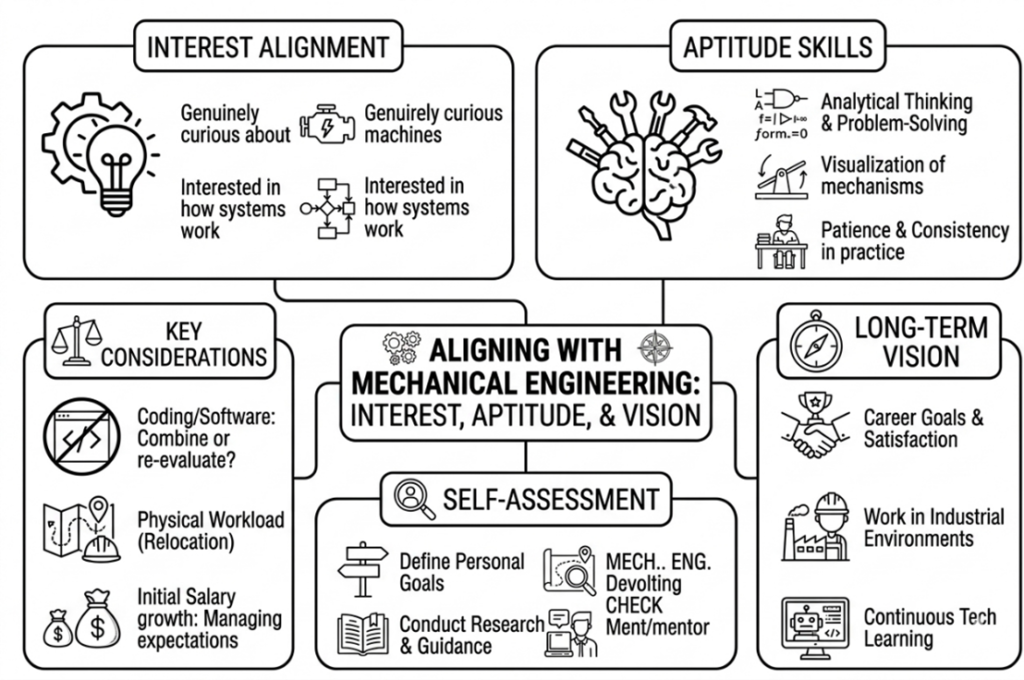
Choosing Mechanical Engineering should depend on your interest, aptitude, and career goals. If you enjoy physics, machines, and practical problem-solving, this branch is suitable. Analytical thinking and curiosity are important qualities for success. For example, if you are interested in understanding how engines or machines work, you will find this field engaging. However, if your interest is mainly in coding or software, this branch may not be the best choice unless you plan to combine it with programming skills. Long-term vision should include willingness to work in industrial environments and continuously learn new technologies. Self-assessment is essential before making a decision. Choosing a branch aligned with your interest leads to better performance and satisfaction. Proper guidance and research help in making the right choice. A clear understanding of your goals ensures a successful career path.
CONCLUSION
Mechanical Engineering is a powerful but demanding branch.
✔ Choose it for interest, not trend
✔ Don’t believe common misconceptions
✔ Be ready for real-world challenges
✔ Always keep backup options
✔ Align your choice with your long-term vision
Final truth:
Right mindset + consistent effort = success in Mechanical Engineering