
1. Why should I choose this branch over others?
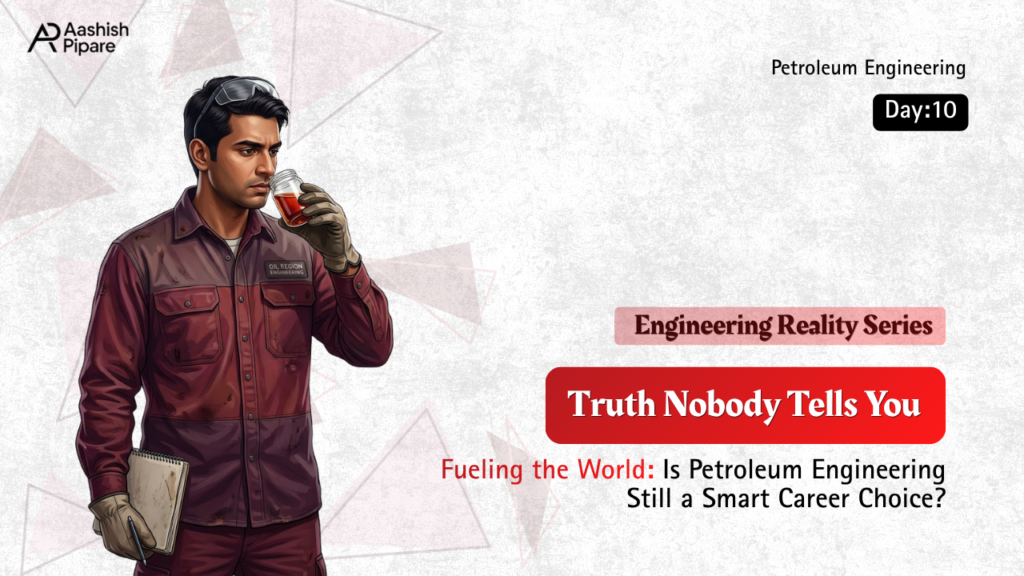
I’ve realized that choosing Petroleum Engineering only makes sense if you’re genuinely interested in how energy systems work and are comfortable dealing with complex, real-world problems. This is not a “safe default” branch like some others—it’s more of a focused, high-reward but demanding path.
You should consider this branch if you like applying physics in practical situations, enjoy problem-solving under uncertainty, and are open to a career that might involve field exposure or unconventional work environments. Compared to more saturated fields, this branch can offer higher earning potential and global opportunities, but it also comes with higher expectations and volatility.
So honestly, don’t choose it just because you heard it pays well. Choose it if the nature of the work itself interests you, because that’s what will sustain you in the long run.
2. What are the biggest misconceptions about this field?
One of the most common misconceptions I’ve seen is that Petroleum Engineering guarantees a high-paying job for everyone. That’s not entirely true. While top performers and those in the right roles can earn very well, the industry is highly cyclical—job opportunities can fluctuate depending on global oil prices and economic conditions.
Another misconception is that the job is only about working on oil rigs. In reality, a large part of the work happens in offices, labs, and through data analysis. People also think it’s a “dying field” because of renewable energy, but that’s an oversimplification. The field is evolving, not disappearing—it’s becoming more technology-driven and integrated with sustainability efforts.
From my perspective, the biggest mistake is believing either extreme hype or extreme negativity. The truth lies somewhere in between.
3. What are the hidden challenges no one talks about?
This is where things get real. One challenge that’s not discussed enough is uncertainty—not just in the technical work, but in the industry itself. Projects depend on global markets, policies, and geopolitical factors, which means job stability can sometimes feel unpredictable.
Another hidden challenge is the work environment, especially in field roles. Remote locations, long shifts, and time away from family can be tough to adjust to. It’s not something everyone is comfortable with, and that’s okay—but it’s better to know this early.
There’s also a mental aspect—working with high-risk operations means there’s always pressure to make the right decisions. Even small errors can have large consequences in terms of cost or safety. From what I’ve understood, this field doesn’t just test your technical skills—it tests your resilience and decision-making under pressure.
4. If I fail in core roles, what are my backup career paths?
This is a very smart question, and honestly, more students should think about it. The good thing is that Petroleum Engineering builds a strong foundation that can be applied in multiple areas. If core roles like drilling or reservoir engineering don’t work out, you still have several options.
You can transition into data analysis or tech roles, especially if you build skills in programming and analytics. Many petroleum engineers move into energy consulting, where they help companies make strategic decisions. There are also opportunities in project management, supply chain roles, or even sectors like renewable energy.
Some people also shift into MBA-driven careers, moving into finance, operations, or management roles in energy companies. From what I’ve seen, your backup options depend less on your degree and more on the skills you build alongside it.
5. Is this branch aligned with my interest, aptitude, and long-term vision?
This is probably the most important question, and also the one only you can truly answer. From my experience, alignment comes down to three things.
First, interest—do you actually find topics like energy systems, subsurface exploration, and engineering problem-solving interesting? If not, it will be hard to stay motivated.
Second, aptitude—are you comfortable with analytical thinking, physics-based concepts, and dealing with uncertainty? You don’t need to be perfect, but you should be willing to develop these skills.
Third, long-term vision—can you see yourself working in this kind of environment for years? This includes the possibility of fieldwork, evolving industry demands, and continuous learning.
If all three align reasonably well, this branch can be a great choice. If not, it’s better to explore alternatives early rather than forcing a decision based on external factors.