
Q1. Why should I choose this branch over others?
I am not going to tell you that biotechnology engineering is the best branch — that depends entirely on who you are. But I will tell you why a specific type of person should choose it without hesitation:
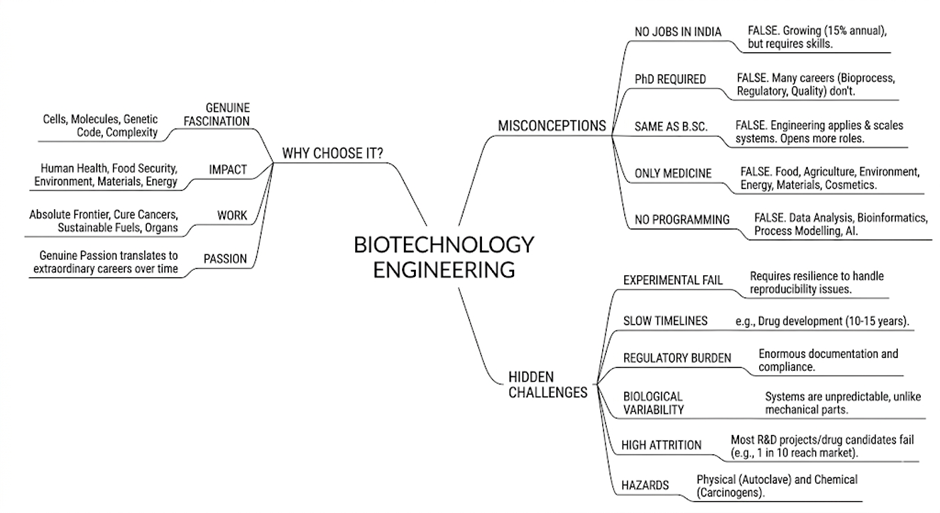
Choose Biotechnology Engineering if you are genuinely fascinated by life — by cells, molecules, genetic code, and the stunning complexity of living organisms. Choose it if you want your engineering work to directly contribute to human health, food security, environmental sustainability, and the next generation of materials and energy. Choose it if you want to work at the absolute frontier of what is scientifically possible.
Do not choose it for salary alone in the short term — IT and computer science will likely beat biotech in Year 1 starting salaries. But choose it if the work itself excites you, because in a field that is growing as fast as ours, genuine passion translates into extraordinary careers over a 30–40 year horizon.
The biotechnology engineer of 2035 will have helped cure cancers, engineer sustainable fuels, grow organs in laboratories, and write the genetic code of organisms that produce pharmaceuticals. That is not an abstract future — it is the work happening in laboratories today, by engineers who started where you are starting.
Q2. What are the biggest misconceptions about this field?
Misconception 1 — ‘Biotechnology has no jobs in India’: False. India’s bioeconomy is growing at 15% annually. The challenge is that most jobs require specialization and skills that generic graduates do not develop. Build the right skills, and employment is not a problem.
Misconception 2 — ‘You must do a PhD to have a good career’: False. The majority of well-paid, impactful careers in biotech industry — bioprocess engineering, regulatory affairs, quality management, CRO research, diagnostics — do not require a PhD. Strategic industry experience + certifications is a valid and often more financially optimal path.
Misconception 3 — ‘Biotechnology and Biotechnology Engineering are the same’: They are not. Biotechnology (B.Sc.) is a science degree. Biotechnology Engineering is an engineering degree that applies biotech science to design and scale systems. The engineering degree opens more manufacturing, process, and scale-up roles.
Misconception 4 — ‘This field is only about medicine’: Biotechnology engineering spans food, agriculture, environment, energy, materials, and cosmetics. Students who only consider pharma careers miss vast opportunity spaces.
Misconception 5 — ‘Programming is not needed in biotech’: Increasingly false. Data analysis, bioinformatics, process modelling, and AI drug discovery all require computational skills. The biotech engineer without coding ability is becoming a rare and disadvantaged professional.
Q3. What are the hidden challenges no one talks about?
- Experimental Reproducibility: A large fraction of experiments fail or give irreproducible results. This is emotionally challenging and requires resilience that no course prepares you for. Learning to fail scientifically — carefully, analytically, and without despair — is the hidden curriculum of biotechnology engineering.
- Slow Timelines: Drug development takes 10–15 years. If you need fast visible impact, pharmaceutical R&D will feel frustratingly slow. Industrial and environmental biotech offer faster product cycles.
- Regulatory Burden: The amount of documentation, validation, and compliance work in pharmaceutical biotech is enormous and can feel divorced from ‘real science.’ However, this rigor is what makes biological medicines safe for patients.
- Biological Variability: Unlike a mechanical part that behaves predictably, biological systems are variable. Two fermentation runs under identical conditions can give different yields. Learning to manage, characterize, and reduce this variability is a career-long challenge.
- Lab-to-Launch Attrition: Only 1 in 10 drug candidates that enter clinical trials reach the market. The vast majority of biotech R&D work ends in ‘failure.’ The professional in this field must find meaning in the learning from failure, not just the outcomes of success.
- Physical and Chemical Hazard Awareness: Working with biological agents, carcinogens (ethidium bromide, formaldehyde), and high-pressure autoclave equipment involves real physical risk. Consistent, vigilant safety practice is non-optional.
Q4. If I fail in core roles, what are my backup career paths?
First, I want to reframe the question: in biotechnology engineering, a ‘failed’ career path is rarely a dead end — it is usually a redirection to an adjacent role where your skills remain highly valuable.
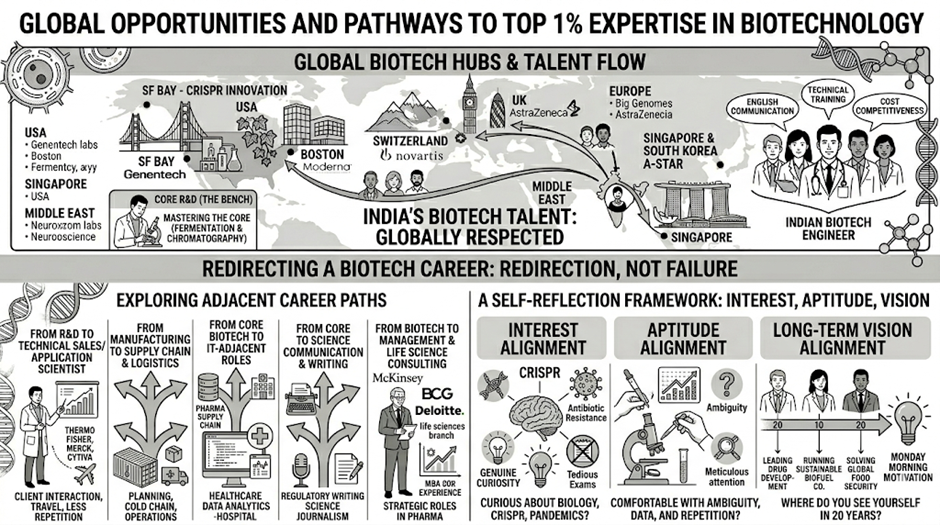
From R&D to Technical Sales: If bench research proves less satisfying than expected, your technical knowledge makes you an excellent application scientist or technical sales specialist for companies like Thermo Fisher, Merck, or Cytiva. These roles often pay as well or better than R&D, involve less repetitive lab work, and offer significant travel and client interaction.
From Manufacturing to Supply Chain: Pharmaceutical supply chain management — planning, logistics, cold chain management — is a natural progression for biotech engineers who prefer operational roles to technical ones.
From Biotech to IT-Adjacent Roles: With programming skills (Python, R), a biotech engineer can transition to healthcare data analytics, hospital informatics, or biotech software companies. This is an increasingly common and well-compensated lateral move.
From Core Biotech to Science Communication: Technical writing, medical writing, regulatory writing, and science journalism are all paths where deep biotech knowledge combined with strong communication creates a valued specialist.
From Biotech to Management/Consulting: With an MBA or sufficient industry experience, biotech engineers frequently transition to management consulting firms like McKinsey, BCG, or Deloitte’s life sciences practices — or to strategic positions within pharmaceutical companies.
Q5. Is this branch aligned with my interest, aptitude, and long-term vision?
This is the most important question of all, and it is one that only you can answer — but let me give you a framework to answer it honestly:
Interest Alignment: Do you find yourself reading about CRISPR, pandemics, antibiotic resistance, cancer biology, or environmental pollution with genuine curiosity — not because you have to for an exam, but because you want to understand? If yes, your interests align. If you force yourself to read biology and find it tedious, no career in biotechnology will satisfy you long-term.
Aptitude Alignment: Are you comfortable with ambiguity in experiments? Do you enjoy meticulous, careful work? Can you sustain attention over long, repetitive laboratory procedures? Do you enjoy data — finding patterns, questioning outliers? These aptitudes are essential in biotechnology. The lack of them creates daily friction.
Long-Term Vision Alignment: Where do you see yourself in 20 years? If it is leading a drug development program, running a sustainable biofuel company, solving a global food security challenge, or building a biotech startup — biotechnology engineering is your path. If it is building infrastructure, developing AI systems, or managing financial institutions — other engineering branches will serve you better.
My final counsel to every student standing at this crossroads: the best engineering career is not the highest-paying one or the most prestigious one — it is the one where Monday morning feels different from other careers. Where you are genuinely motivated by the problem you are solving. Biotechnology Engineering gives you problems worthy of a lifetime of dedication. If that resonates with you, you have found your field.
Conclusion:
Biotechnology Engineering is a powerful field that allows you to contribute to healthcare, environment, and innovation. It offers both career growth and meaningful impact.
CTA:
If this field matches your passion, take the next step confidently. Share this complete guide and start your journey in biotechnology engineering today.