
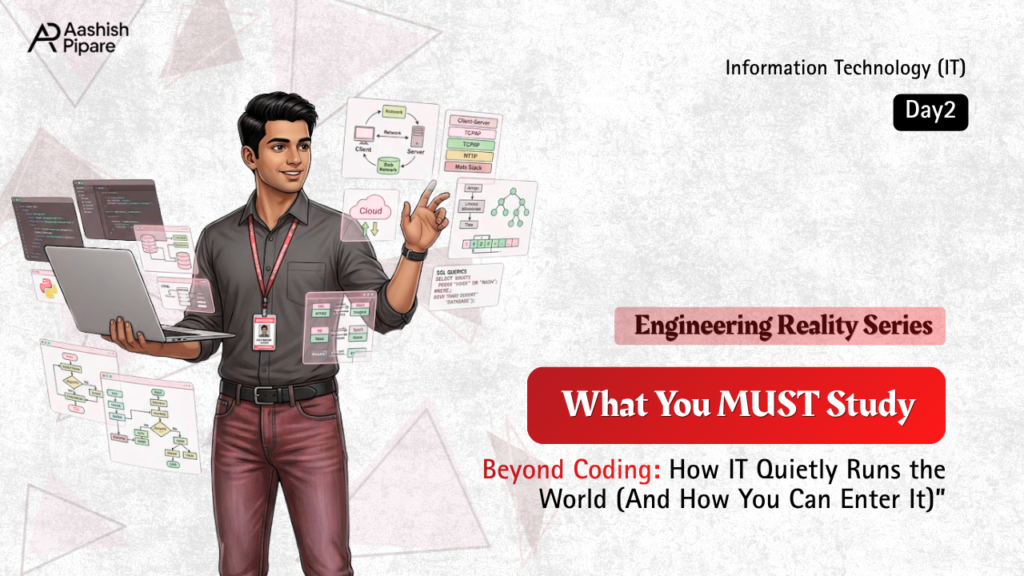
(This is where you understand what actually builds your foundation in IT.)
What are the key subjects I must master in this branch?
When I started studying IT, I initially treated all subjects equally, just focusing on passing exams. But over time, I realized that some subjects are not just for marks—they become the core of your real understanding and career.
One of the most important subjects is Data Structures and Algorithms. Even though IT is more application-focused than CSE, this subject teaches you how to think logically and solve problems efficiently. Without it, even simple tasks can feel difficult.
Another crucial subject is Database Management Systems (DBMS). From what I’ve seen in real-world work, almost every application depends on data, and knowing how to store, retrieve, and manage that data properly is essential.
Then comes Computer Networks, which helps you understand how systems communicate with each other. This becomes especially important when you deal with cloud systems, servers, or large-scale applications.
Operating Systems is another foundational subject. It explains how software interacts with hardware, how processes run, and how resources are managed. Even if you don’t realize it immediately, this knowledge becomes very useful later.
You’ll also come across Software Engineering, which teaches how to build systems in a structured way—planning, designing, testing, and maintaining them.
From my experience, if you truly understand these subjects instead of just memorizing them, everything else in IT starts making more sense.
What level of mathematics is required? (basic, advanced, statistics-heavy)
One thing that surprised me about IT is that mathematics is important—but not always in the way students expect. It’s not as calculation-heavy as some core engineering branches, but it is logic-heavy.
In the beginning, you’ll deal with basic engineering mathematics—topics like calculus, matrices, and discrete mathematics. Out of these, discrete mathematics is particularly important because it builds the foundation for logic, algorithms, and problem-solving.
If you move into areas like data analysis, machine learning, or advanced computing, then statistics and probability become more important. But for most IT roles, you don’t need extremely advanced mathematics—you need a clear understanding of logical thinking and structured problem-solving.
From what I’ve seen, students who struggle with math often think they can’t do well in IT, but that’s not entirely true. You don’t need to be a math genius—you just need to be comfortable with logic and patterns.
So overall, IT requires moderate mathematics with a strong focus on logical reasoning, rather than heavy calculations.
Which scientific principles are fundamental here?
Unlike branches like mechanical or civil engineering, IT is not heavily based on physical science principles like forces or materials. Instead, it is built on the science of computation and information.
The most important principle is how data is represented, processed, and transmitted. This includes understanding binary systems, logic gates, and how computers actually interpret instructions.
Another fundamental concept is abstraction—the idea of simplifying complex systems into manageable layers. This is something you’ll see everywhere, from programming to system design.
Networking concepts are also based on scientific principles like signal transmission and communication protocols, although they are usually studied at a conceptual level rather than a deep physics level.
From my experience, IT is less about traditional science and more about applied logic and system thinking. It’s about understanding how different components interact and how to design systems that work efficiently.
What are the most difficult concepts students struggle with?
From what I’ve observed, most students don’t struggle because the subjects are impossible—they struggle because the concepts require a different way of thinking.
One of the biggest challenges is Data Structures and Algorithms, especially when it comes to problem-solving. It’s not about memorizing solutions—you need to think step by step, which takes time to develop.
Another difficult area is Operating Systems, because many processes happen in the background and are not visible. Concepts like memory management, process scheduling, and concurrency can feel abstract and confusing.
Computer Networks can also be tricky, especially when trying to understand how data actually moves across systems. Without practical visualization, it can feel theoretical.
I’ve also seen students struggle with debugging code. Writing code is one thing, but finding and fixing errors requires patience and logical thinking, which many beginners find frustrating.
From my experience, the difficulty is not in the subject itself—it’s in developing the mindset to understand and apply concepts, which takes consistent practice.
Is this branch more theoretical, practical, or hybrid?
If I had to describe IT honestly, I would say it is a hybrid branch, but strongly leaning toward practical application.
In college, you will study theoretical concepts—algorithms, systems, networking—but these concepts only become meaningful when you apply them through coding, projects, and real-world scenarios.
From what I’ve seen, students who focus only on theory often struggle in placements, while those who combine theory with practical work—like building projects or working on real problems—perform much better.
IT is not a branch where you can succeed by just reading textbooks. You need to practice, experiment, and build things. At the same time, ignoring theory is also a mistake, because strong fundamentals help you solve complex problems later.
So the real nature of IT is a balance—it’s about understanding concepts and applying them effectively in real-world situations.