
1. What are the key subjects I must master in this branch?
When I started exploring Civil Engineering seriously, I realized that not every subject carries the same weight. Some subjects are just for clearing exams, but a few become the foundation of your entire career. The first subject that really matters is Engineering Mechanics, because it teaches you how forces act on structures. Without understanding this, everything else feels confusing.
Then comes Strength of Materials (SOM), which is where you learn how materials behave under stress—whether they bend, break, or hold. This subject directly connects to real-world safety. After that, Structural Analysis becomes important, where you analyze how entire structures like beams, frames, and bridges respond to loads.
Another major area is Geotechnical Engineering, which deals with soil behavior. This is something many students underestimate, but in reality, the entire structure depends on how strong the ground beneath it is. Then you have Fluid Mechanics and Hydrology, which are essential for understanding water flow, drainage, and hydraulic systems.
Finally, subjects like Transportation Engineering, Environmental Engineering, and Construction Management help you understand how infrastructure is planned, built, and maintained. From my experience, if you truly understand these core subjects—not just memorize them—you’ll find the rest of the branch much easier.
2. What level of mathematics is required? (basic, advanced, statistics-heavy)
Before entering this branch, I assumed Civil Engineering would only need basic math, but that’s not entirely true. It’s not as math-heavy as some branches like electronics or pure computer science, but it definitely requires a solid understanding of applied mathematics.
You’ll regularly use algebra, trigonometry, and calculus, especially in subjects like structural analysis and fluid mechanics. Concepts like derivatives and integration are used to calculate forces, bending moments, and flow behavior. However, the focus is less on solving abstract math problems and more on applying math to physical situations.
Statistics is used, but not heavily compared to fields like data science. It becomes relevant in areas like surveying, quality control, and environmental studies. From what I’ve seen, you don’t need to be a math genius, but you do need to be comfortable with calculations and logical problem-solving. If your basics are clear, the math becomes manageable.
3. Which scientific principles are fundamental here?
Civil Engineering is deeply rooted in basic science, especially physics. One of the most important principles is Newton’s laws of motion, which help you understand how forces act on structures. Along with that, concepts like equilibrium, energy conservation, and stress-strain relationships are used almost everywhere.
Another key area is material science, which explains how different materials like concrete, steel, and soil behave under various conditions. You also rely heavily on fluid dynamics when dealing with water flow in pipes, rivers, or drainage systems.
Environmental science is also becoming increasingly important, especially when designing sustainable systems and managing waste or pollution. From my experience, Civil Engineering is not about learning new science—it’s about applying fundamental science in practical, large-scale situations.
4. What are the most difficult concepts students struggle with?
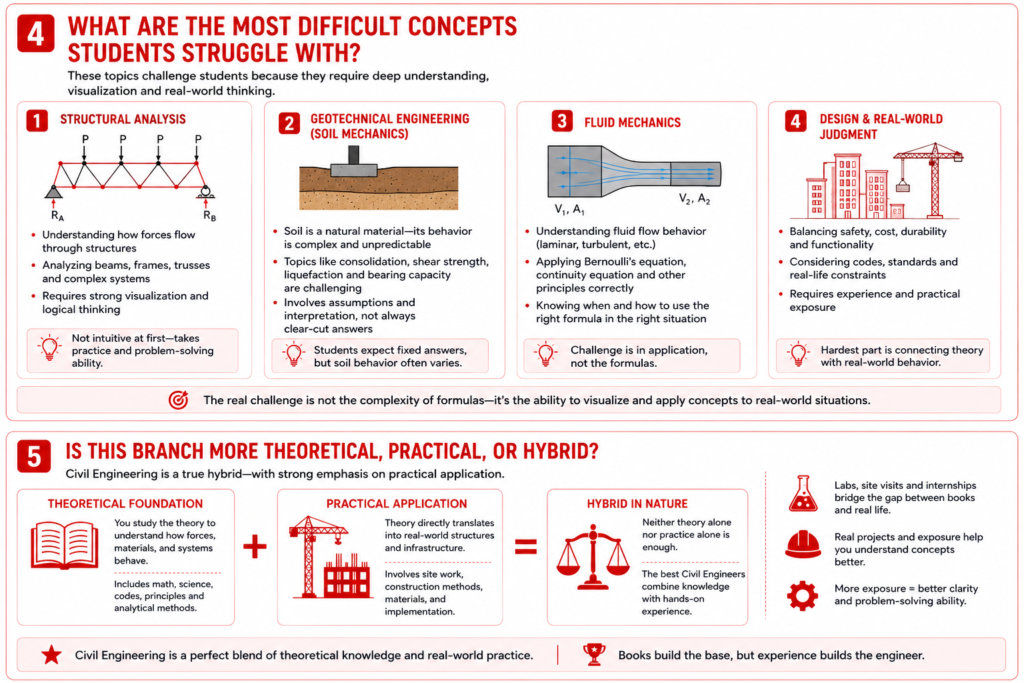
From what I’ve observed (and honestly, experienced), the difficulty in Civil Engineering comes from concepts that require both understanding and visualization. Structural Analysis is one of the biggest challenges, because you have to imagine how forces move through a structure and calculate their effects accurately. It’s not always intuitive at first.
Another tough area is Geotechnical Engineering, especially soil mechanics. Soil doesn’t behave like solid materials—it can compress, shift, and behave unpredictably, which makes it harder to analyze. Many students struggle because they expect clear, fixed answers, but soil behavior often involves assumptions.
Fluid Mechanics is another subject where students face difficulty, especially in understanding flow behavior and applying equations correctly. The challenge here is not the formulas themselves, but knowing when and how to use them.
From my experience, the hardest part of this branch is not the complexity of formulas—it’s developing the ability to visualize real-world behavior from theoretical concepts.
5. Is this branch more theoretical, practical, or hybrid?
If I had to describe Civil Engineering honestly, I’d say it’s a true hybrid of theory and practice—but with a strong leaning toward practical application. You do study theory in the beginning, because you need to understand how forces, materials, and systems behave. But unlike some branches where theory stays abstract, here it directly translates into real-world structures.
What I’ve noticed is that theory alone is never enough. You need to see how things work on-site—how construction actually happens, how materials are used, and how designs are implemented. Lab work, site visits, and internships play a huge role in bridging that gap.
From my perspective, Civil Engineering is one of those fields where you can’t rely only on books. The more exposure you get to real projects, the better you understand the concepts. It’s this combination of theoretical foundation and hands-on experience that defines the branch.