
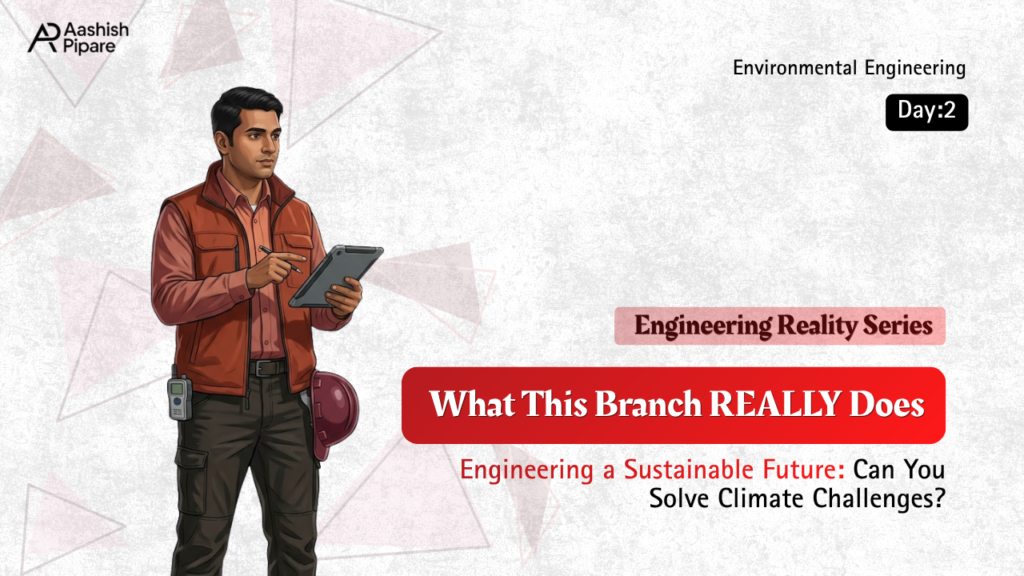
🔹What are the key subjects I must master?
Environmental engineering is built on core technical + scientific subjects.
1. Environmental Chemistry
- Studies pollutants and reactions
- Helps in water and air purification
Example: Understanding pH helps treat acidic wastewater.
2. Fluid Mechanics
- Studies flow of water and air
- Used in pipeline and sewage design
3. Hydrology
- Studies water cycle
- Helps in flood and water resource management
4. Environmental Microbiology
- Uses bacteria to treat waste
Example: Activated sludge process uses microbes to clean sewage.
5. Air Pollution Control
- Methods to reduce emissions
6. Solid Waste Management
- Recycling
- Waste disposal systems
7. GIS & Remote Sensing
- Used for environmental monitoring
Expert Insight
Strong subject knowledge = ability to design real systems.
🔹What level of mathematics is required?
Math is not optional—it is a core tool.
Required Topics:
- Algebra → Basic calculations
- Calculus → Flow and rate changes
- Differential equations → Pollution modeling
- Statistics → Data analysis
Example:
Engineers use equations to calculate:
- Flow rate in pipes
- Pollutant concentration
Expert Insight
Math is not for exams—it is used daily in design and analysis.
🔹Which scientific principles are fundamental?
Environmental engineering is deeply rooted in science:
Chemistry
- Reaction of pollutants
Biology
- Microorganisms in treatment
Physics
- Fluid flow and energy
Ecology
- Impact on ecosystems
Thermodynamics
- Energy and heat systems
Example:
Wastewater treatment depends on biological + chemical + physical processes together.
Expert Insight
Engineering decisions are based on scientific understanding, not assumptions.
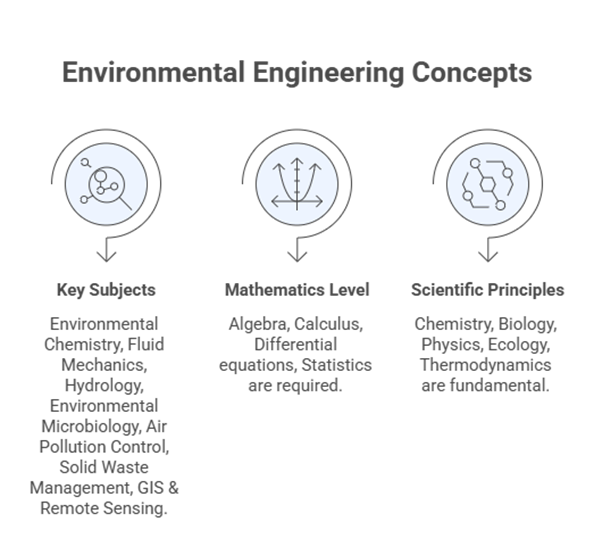
Visual
🔹What are the most difficult concepts?
Students struggle mainly due to multi-disciplinary nature.
Common Challenges:
- Fluid mechanics (complex equations)
- Environmental chemistry (reaction understanding)
- Microbiology (biological processes)
- Data interpretation
Example:
Understanding how bacteria break down waste requires both:
- Biology knowledge
- Process engineering
Expert Insight
Conceptual clarity + practice = mastery
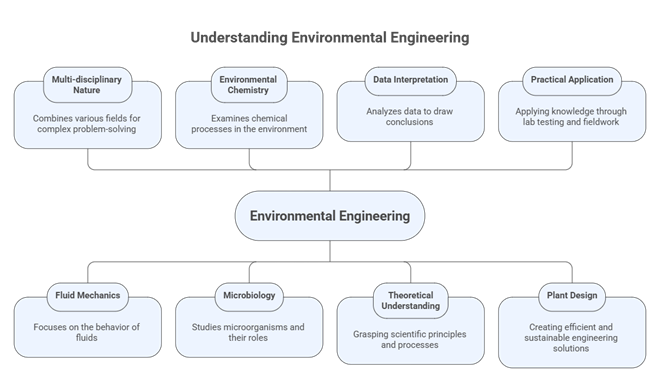
🔹Is this branch theoretical, practical, or hybrid?
Environmental engineering is strongly hybrid.
Theory:
- Understanding processes
- Learning scientific principles
Practical:
- Lab testing
- Fieldwork
- Plant design
Example:
- Theory: Learn water treatment
- Practical: Test water in lab
Mindmap
Conclusion
Environmental Engineering is built on a strong mix of core subjects, mathematics, and scientific principles that directly connect to real-world problem solving. Subjects like environmental chemistry, fluid mechanics, hydrology, and microbiology form the foundation, while mathematics and data analysis act as essential tools for design and decision-making. The branch may feel challenging because it combines multiple disciplines, but with clear concepts and regular practice, it becomes manageable and meaningful.
In simple terms, this field is not just about studying theory, but about applying knowledge to design systems that solve real environmental problems.
Call to Action
Focus on mastering core subjects step by step
Practice mathematics and real problem solving regularly
Take lab work and practical learning seriously
Connect concepts with real-world environmental issues
Learn from experts and explore opportunities on LinkedIn Stay consistent in your learning, and you will build a strong foundation for a successful career in this field