
Q1. What are the key subjects I must master in this branch?
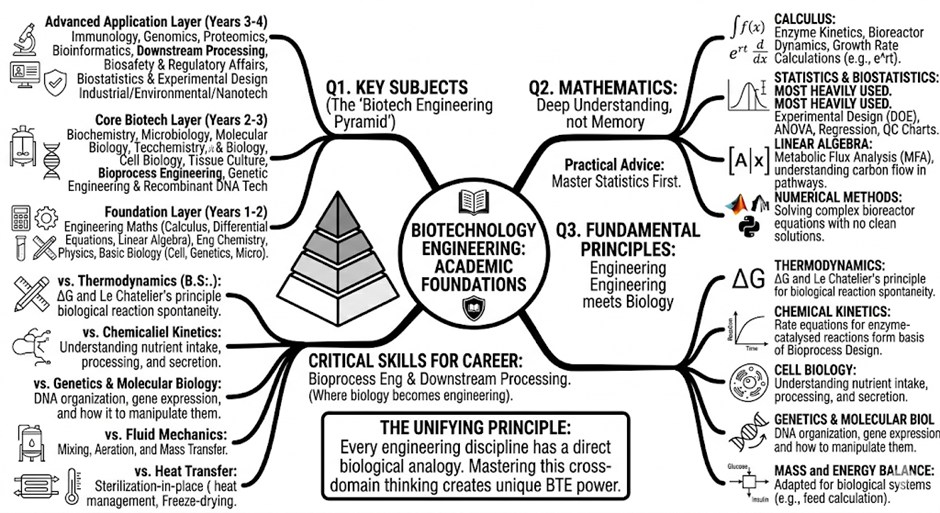
This is what I call the ‘Biotech Engineering Pyramid.’ The subjects build on each other. Skipping foundations will collapse your entire understanding later.
Foundation Layer (Years 1–2): Engineering Mathematics (calculus, differential equations, linear algebra), Engineering Chemistry, Physics, Basic Biology (cell biology, genetics, microbiology), Engineering Graphics.
Core Biotech Layer (Years 2–3): Biochemistry (enzyme kinetics, metabolic pathways, thermodynamics of biological systems), Microbiology (bacterial physiology, fermentation, sterilization), Molecular Biology (DNA replication, transcription, translation, gene expression), Cell Biology and Tissue Culture, Bioprocess Engineering (bioreactor design, aeration, agitation, scale-up), Genetic Engineering and Recombinant DNA Technology.
Advanced Application Layer (Years 3–4): Immunology and Immunotechnology, Genomics, Proteomics and Bioinformatics, Downstream Processing (chromatography, filtration, centrifugation, lyophilization), Biosafety and Regulatory Affairs, Biostatistics and Experimental Design, Industrial Biotechnology, Environmental Biotechnology, Nanobiotechnology.
Of these, Bioprocess Engineering and Downstream Processing are the most career-critical skills. They are where the biology becomes engineering. Master these and you will always be employed.
Q2. What level of mathematics is required?
Students often fear mathematics in biotechnology. Let me reassure you — you will not use pure mathematics as much as a mechanical or civil engineer. However, the mathematics you do use must be understood deeply, not memorized.
Calculus: Essential for understanding enzyme kinetics (Michaelis-Menten equation), bioreactor dynamics, and growth rate calculations. For example, modelling exponential bacterial growth uses differential equations.
Statistics & Biostatistics: This is the most heavily used mathematics in biotechnology. Experimental design (DOE), ANOVA, regression analysis, quality control charts — you will use these daily as a bioprocess engineer or quality professional.
Linear Algebra: Important for metabolic flux analysis (MFA), used in systems biotechnology to understand how carbon flows through metabolic pathways.
Numerical Methods: Used to solve complex bioreactor equations that have no clean analytical solutions. Software like MATLAB and Python are used here.
My practical advice: master statistics first. It will serve you in every role — research, production, quality, regulatory. Many brilliant biotechnologists are limited in their careers simply because they are weak in statistical analysis.
Q3. Which scientific principles are fundamental here?
- Thermodynamics: Gibbs free energy, Le Chatelier’s principle — applied to understand whether a biological reaction is spontaneous and how to drive it toward product formation.
- Chemical Kinetics: Rate equations for enzyme-catalysed reactions form the basis of all bioprocess design.
- Cell Biology: Understanding how a cell takes in nutrients, processes them, and secretes products is the foundation of all bioprocess engineering.
- Genetics and Molecular Biology: Knowing how DNA is organized, how genes are expressed, and how to manipulate them underpins genetic engineering.
- Mass and Energy Balance: A core chemical engineering principle adapted for biological systems — how much glucose do you need to feed cells to get 1 kg of insulin?
- Fluid Mechanics: Mixing, aeration, and mass transfer in bioreactors are governed by fluid mechanics principles.
- Heat Transfer: Sterilization-in-place (SIP) systems, fermentation heat management, and freeze-drying are all heat transfer problems.
The beautiful thing about Biotechnology Engineering is that every engineering principle you learn has a direct biological analogy. This cross-domain thinking is what makes our field uniquely powerful.
Q4. What are the most difficult concepts students struggle with?
In my years mentoring students, I have seen the same conceptual walls appear repeatedly:
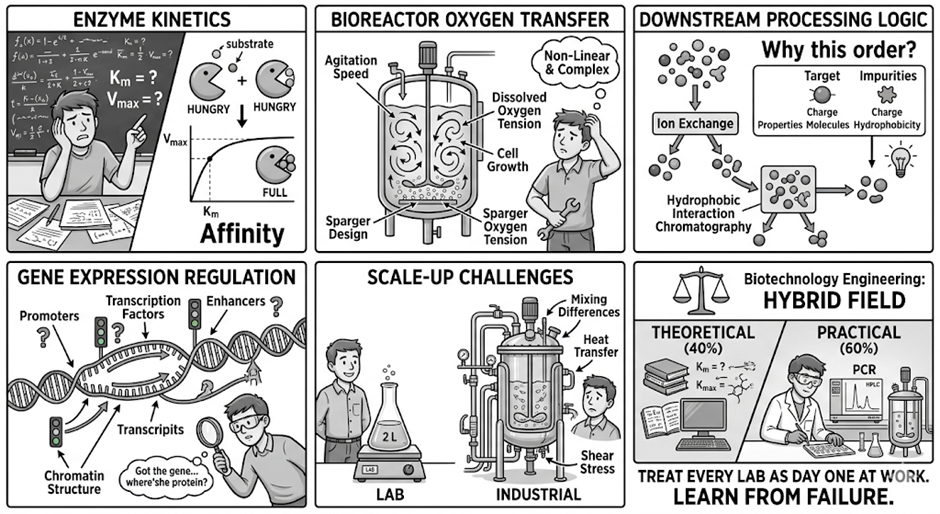
Enzyme Kinetics: Students memorize the Michaelis-Menten equation without understanding what Km and Vmax physically mean. Km is not just a constant — it tells you how hungry an enzyme is for its substrate. Understanding this intuitively unlocks industrial enzyme optimization.
Bioreactor Oxygen Transfer: The relationship between agitation speed, sparger design, dissolved oxygen tension, and cell growth rate is complex and non-linear. It is the most critical skill in bioprocess engineering and the most poorly understood by graduates.
Downstream Processing Logic: Choosing the right purification sequence — why you do ion exchange before hydrophobic interaction chromatography — requires understanding both the biology of your molecule and the physics of each separation technique.
Gene Expression Regulation: Understanding that having a gene does not mean the protein is produced — transcription factors, promoters, enhancers, chromatin structure — this complexity confuses many students.
Scale-Up Challenges: A process that works beautifully in a 2-litre flask often fails in a 2000-litre industrial fermenter. Why? Because mixing, heat transfer, and shear stress scale differently. This scale-up science is what separates good bioprocess engineers from great ones.
Q5. Is this branch more theoretical, practical, or hybrid?
Biotechnology Engineering is unambiguously a hybrid field, but I would say it leans 60% practical and 40% theoretical at the professional level.
During your degree, you will spend significant time in laboratories — performing fermentations, protein purifications, PCR, cell culture, HPLC analysis. These are not optional extras; they are the core skill-building activities. At the same time, understanding the theory of why your fermenter is under-performing requires thermodynamic and kinetic reasoning.
My career advice: treat every lab session as if it is your first day at a pharmaceutical company. Take notes. Repeat experiments. Understand failure. I have hired hundreds of engineers in my career, and the ones who thrive are always those who are not afraid to fail in a lab, learn from it, and come back with a better design.
Conclusion:
Strong fundamentals in biology, chemistry, and mathematics are essential for success in biotechnology engineering. These subjects form the base for understanding complex biological systems.
CTA:
Start improving your basics from today. Save this blog and continue to Day 3 to explore important tools and technologies used in biotechnology.