
a. What are the key subjects I must master in this branch?
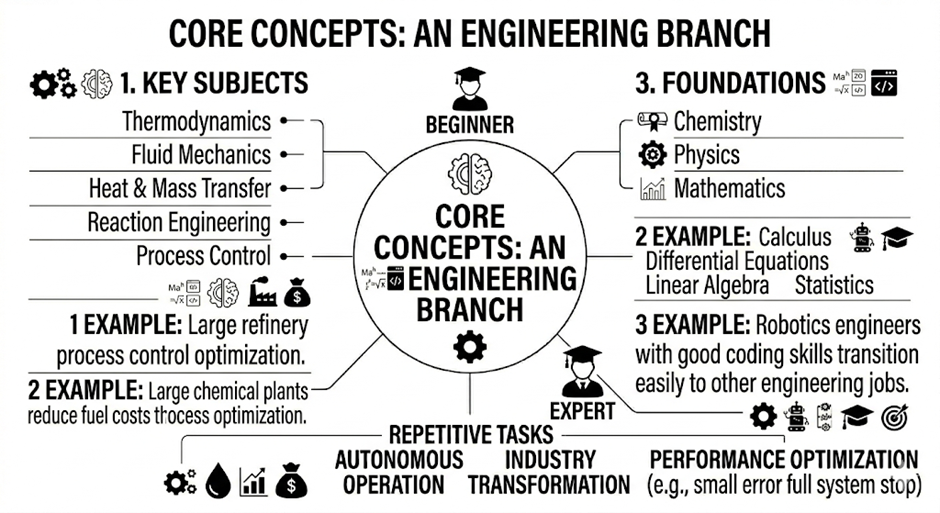
Chemical Engineering is built on a strong foundation of science, mathematics, and engineering. To become a successful chemical engineer, you must master several core subjects that explain how materials behave, how chemical reactions occur, how heat and fluids move through industrial equipment, and how complete manufacturing processes are designed and optimized. These subjects work together to solve real-world industrial problems and form the backbone of every chemical engineering application.
At the beginner level, these subjects are studied individually to build a strong conceptual foundation. At the expert level, they are integrated to design, operate, optimize, and control complex industrial plants that produce fuels, medicines, fertilizers, food products, polymers, and many other essential materials.
1. Thermodynamics
Thermodynamics is one of the most fundamental subjects in Chemical Engineering. It deals with the relationships between heat, work, energy, and matter. Chemical engineers use thermodynamics to determine whether a chemical process is possible, how much energy it requires, and how efficiently it can operate.
This subject helps engineers understand phase changes, chemical equilibrium, energy conservation, refrigeration systems, power generation, and industrial heating and cooling processes.
Example: Before designing a chemical reactor, engineers use thermodynamics to calculate the energy required for the reaction and determine whether heat must be added or removed.
2. Fluid Mechanics
Fluid Mechanics studies the behavior and movement of liquids and gases through pipes, pumps, valves, reactors, and industrial equipment. Since almost every chemical plant transports fluids, understanding fluid flow is essential.
Students learn concepts such as pressure, velocity, viscosity, flow rate, turbulence, and pumping systems.
Example: Chemical engineers calculate the flow of crude oil through pipelines or determine the pump size required to transport chemicals safely within a refinery.
3. Heat Transfer
Heat Transfer focuses on how thermal energy moves between substances through conduction, convection, and radiation. Efficient heat transfer is critical because most industrial processes involve heating, cooling, evaporation, condensation, or temperature control.
Chemical engineers design equipment such as heat exchangers, condensers, boilers, evaporators, and cooling towers to manage thermal energy efficiently.
Example: In a petroleum refinery, heat exchangers recover waste heat to improve energy efficiency and reduce operating costs.
b. What level of mathematics is required?
Mathematics is one of the most important foundations of Chemical Engineering. The field requires a moderate to high level of mathematical knowledge because engineers use mathematical models to understand, design, analyze, and optimize industrial processes. While chemistry explains what happens during a reaction, mathematics helps determine how much, how fast, and under what conditions the process should operate for maximum efficiency and safety.
The good news is that success in Chemical Engineering does not require extraordinary mathematical talent. What is most important is a strong understanding of mathematical concepts and the ability to apply them to real engineering problems. With regular practice and logical thinking, most students can develop the mathematical skills needed for the branch.
1. Calculus
Calculus is one of the most frequently used mathematical tools in Chemical Engineering. It includes differentiation and integration, which are used to analyze changing systems and calculate quantities such as rates, areas, and accumulated values.
Chemical engineers use calculus to study reaction rates, heat transfer, fluid flow, mass transfer, and process optimization.
Example: When designing a heat exchanger, engineers use calculus to calculate how temperature changes throughout the system and determine the amount of heat transferred between fluids.
2. Differential Equations
Differential equations describe how physical and chemical systems change with time or position. They are essential for modeling industrial processes because many engineering systems are dynamic rather than static.
Chemical engineers use differential equations to model chemical reactions, reactor performance, fluid flow, heat transfer, diffusion, and process control.
Example: The concentration of a reactant inside a chemical reactor changes continuously during a reaction. Differential equations help predict these changes and determine the reactor size needed for the desired production rate.
c. Which scientific principles are fundamental here?
Chemical Engineering is built on a strong foundation of chemistry, physics, mathematics, and engineering principles. These scientific disciplines work together to help engineers understand how materials behave, how chemical reactions occur, how energy is transferred, and how industrial processes can be designed and optimized. Unlike pure science, which focuses on discovering new knowledge, Chemical Engineering applies these scientific principles to solve real-world industrial problems and manufacture products on a large scale.
At the beginner level, students study these subjects separately to develop a solid understanding of each discipline. At the expert level, chemical engineers integrate all of these principles to design safe, efficient, economical, and environmentally sustainable industrial plants and manufacturing systems.
1. Chemistry – The Science of Chemical Reactions and Materials
Chemistry is the heart of Chemical Engineering because it explains the composition, structure, properties, and reactions of substances. Chemical engineers must understand how different chemicals interact, how reactions occur, and how products are formed.
Important areas of chemistry include:
- General Chemistry
- Organic Chemistry
- Inorganic Chemistry
- Physical Chemistry
- Analytical Chemistry
These topics help engineers understand reaction mechanisms, catalysts, reaction rates, equilibrium, molecular structures, and material properties.
Example: In fertilizer production, knowledge of chemistry helps engineers understand how ammonia reacts with carbon dioxide to produce urea efficiently and safely.
2. Physics – Understanding Energy, Heat, and Fluid Flow
Physics provides the principles that govern energy transfer, motion, pressure, temperature, and fluid behavior in industrial systems. Almost every chemical process involves the movement of heat and fluids, making physics essential for designing efficient equipment.
Key areas include:
- Thermodynamics
- Heat Transfer
- Fluid Mechanics
- Mechanics
- Electricity and Instrumentation
These principles help engineers calculate energy requirements, design pipelines, pumps, compressors, heat exchangers, and reactors.
Example: A refinery uses principles of heat transfer and fluid mechanics to move crude oil through pipelines while maintaining the correct temperature for efficient processing.
d. What are the most difficult concepts students struggle with?
Chemical Engineering is considered one of the more challenging engineering disciplines because it combines chemistry, physics, mathematics, and engineering into a single field. Students are expected not only to understand scientific theories but also to apply them to complex industrial processes. Many concepts are interconnected, meaning that mastering one subject often depends on having a strong understanding of several others.
At the beginner level, students usually struggle with understanding theoretical concepts and solving mathematical problems. At the expert level, the challenge shifts toward integrating multiple concepts to design, analyze, and optimize real industrial systems where safety, efficiency, cost, and environmental factors must all be considered simultaneously.
Below are some of the most difficult concepts that Chemical Engineering students commonly encounter.
1. Thermodynamics
Thermodynamics is often regarded as one of the most difficult subjects because it involves abstract concepts such as energy, entropy, enthalpy, equilibrium, and the laws of thermodynamics. Unlike subjects where formulas can simply be memorized, thermodynamics requires students to understand the physical meaning behind each concept and apply it correctly in different situations.
Students often struggle with:
- Understanding energy balances.
- Applying the First and Second Laws of Thermodynamics.
- Interpreting entropy and spontaneity.
- Solving phase equilibrium problems.
- Working with thermodynamic property tables and charts.
Example: Calculating how much heat must be supplied to convert a liquid into vapor while considering pressure changes can involve several thermodynamic principles and multiple calculations.
2. Chemical Reaction Engineering
Chemical Reaction Engineering studies how chemical reactions occur and how industrial reactors should be designed. Students must understand both chemistry and mathematics to solve reaction-related problems.
Common difficulties include:
- Reaction kinetics.
- Rate equations.
- Reaction mechanisms.
- Reactor design.
- Conversion and selectivity calculations.
- Catalyst performance.
Because reactions rarely behave exactly as expected in industrial conditions, students must learn how different variables affect production.
Example: Determining the ideal reactor size for producing ammonia requires understanding reaction rates, temperature effects, pressure, catalyst behavior, and material balances.
e. Is this branch more theoretical, practical, or hybrid?
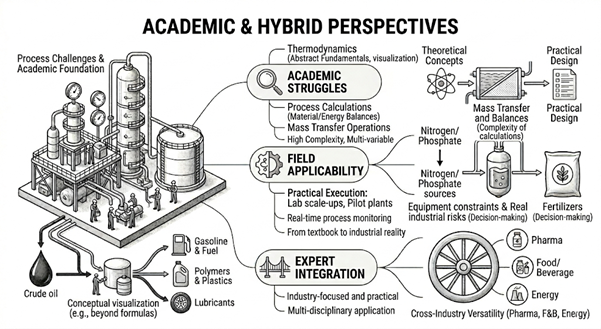
Chemical Engineering is best described as a hybrid branch because it combines strong theoretical knowledge with extensive practical application. Success in this field requires understanding scientific principles as well as applying them to solve real-world industrial problems. Unlike branches that focus mainly on theory or primarily on hands-on work, Chemical Engineering maintains a balance between both throughout education and professional practice.
The theoretical aspect provides the scientific foundation needed to understand chemical processes, while the practical aspect teaches students how to design, operate, optimize, and manage industrial systems. Together, these two components enable chemical engineers to transform laboratory concepts into large-scale manufacturing processes that produce products safely, efficiently, and economically.
The Theoretical Side of Chemical Engineering
The theoretical component of Chemical Engineering focuses on learning the scientific and mathematical principles that govern industrial processes. Students develop a deep understanding of chemistry, physics, mathematics, and engineering concepts before applying them in real situations.
Some major theoretical areas include:
- Thermodynamics
- Chemical Reaction Engineering
- Fluid Mechanics
- Heat Transfer
- Mass Transfer
- Material and Energy Balances
- Process Control
- Transport Phenomena
- Engineering Mathematics
These subjects explain why processes occur, how systems behave, and how engineers can predict the performance of industrial equipment.
For example, before designing a reactor, students must understand reaction kinetics, energy changes, and equilibrium conditions. Without this theoretical knowledge, safe and efficient reactor design would not be possible.
CONCLUSION:
Core concepts in Chemical Engineering form the foundation for understanding and designing industrial processes. Mastery of subjects like thermodynamics, fluid mechanics, and reaction engineering is essential for solving real-world problems. This branch requires strong analytical skills and the ability to apply theory to practical, large-scale systems.