
What software tools are essential?
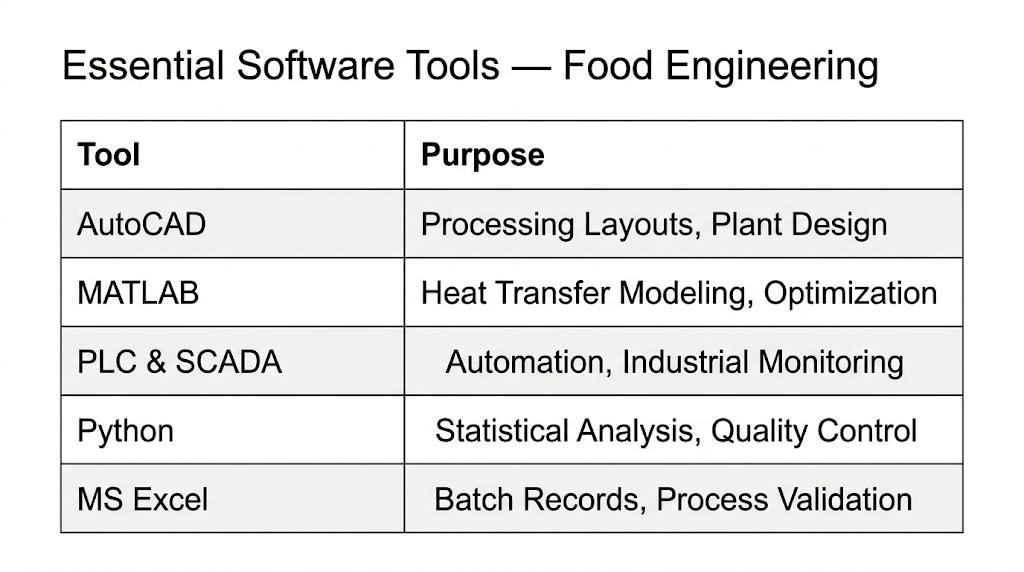
From my experience, the software tools that become most valuable in Food Engineering are the ones that help connect scientific understanding with industrial process design. One of the most useful tools is AutoCAD because food engineers often need to design processing layouts, pipelines, storage systems, and production plants with proper hygienic spacing. I have also seen MATLAB used for modeling heat transfer, drying curves, process optimization, and data analysis, especially in academic and research settings. For engineers interested in automation, knowledge of PLC interface software and SCADA systems becomes very important because many food industries now operate with automated monitoring systems. In recent years, I have noticed that Python has become increasingly useful for statistical analysis, predictive modeling, and quality control because it can handle production data efficiently. Spreadsheet tools like Microsoft Excel remain surprisingly important because many production calculations, batch records, and process validations still depend on organized data management. In my view, a food engineer who can combine process knowledge with digital tools becomes much more effective in both research and industry.
What hardware or lab exposure is required?
From what I have seen, practical laboratory and equipment exposure is extremely important because Food Engineering cannot be fully understood through theory alone. Students benefit greatly from working with pilot-scale equipment such as pasteurizers, homogenizers, dryers, evaporators, grinders, mixers, extruders, and refrigeration systems. In many food engineering laboratories, instruments such as viscometers, texture analyzers, moisture analyzers, pH meters, spectrophotometers, and microbial testing equipment help students understand how processing changes food quality. I have noticed that handling these instruments personally gives students a deeper understanding than simply reading about them. Exposure to packaging machines and cold storage systems is also valuable because food preservation depends heavily on post-processing conditions. In my experience, students who spend time in pilot plants or industrial laboratories develop stronger confidence because they begin to understand how raw food materials behave differently under actual processing conditions than they do in textbooks.
Which programming languages (if any) are needed?
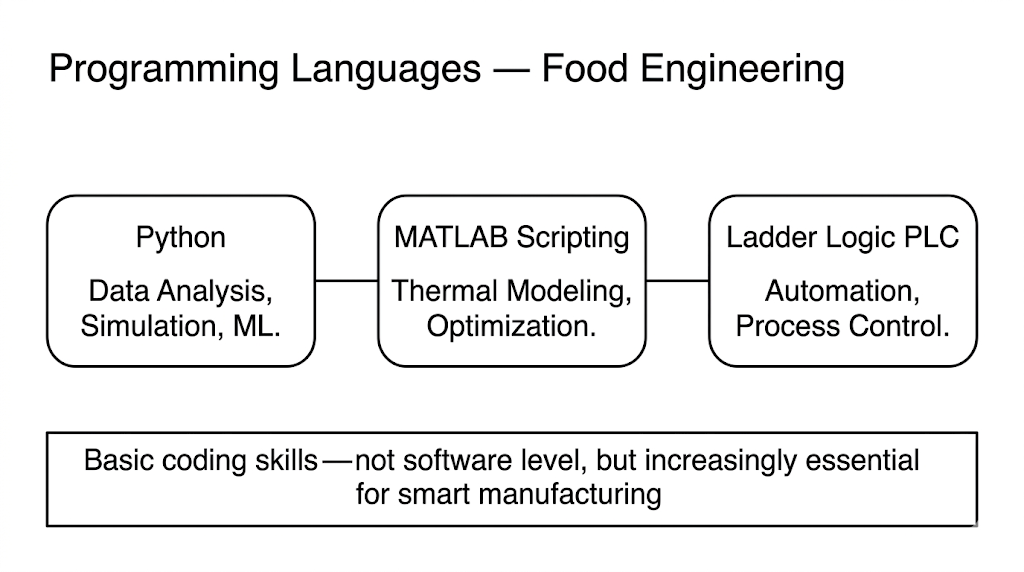
In my experience, Food Engineering does not usually demand advanced programming at the same level as software engineering, but certain programming languages can be extremely useful. Python has become one of the most practical languages because it helps in data analysis, process simulation, machine learning applications, and quality prediction models. I have also seen some institutions still use MATLAB scripting for modeling thermal processing and optimization studies. For students entering automation-heavy industries, understanding ladder logic used in PLC systems can also be helpful because food production plants often rely on automated control. While a fresher may not need to become a professional programmer, basic coding skills can make a noticeable difference when handling process data, building predictive models, or improving manufacturing efficiency. From my perspective, programming in Food Engineering is becoming more important as the industry moves toward smart manufacturing and digital process control.
What are the must-have technical skills for freshers?
From what I have observed, freshers entering Food Engineering need a combination of scientific understanding and practical technical skills to stand out. One of the most important skills is understanding food processing operations such as drying, freezing, mixing, sterilization, and packaging because these form the foundation of industrial work. Freshers should also know how to interpret process flow diagrams and basic plant layouts because industries expect engineers to understand production systems quickly. Knowledge of food safety systems such as HACCP and sanitation procedures is essential because food industries cannot compromise on safety. I have found that data analysis skills are becoming increasingly valuable because companies now rely heavily on process monitoring and quality records. Freshers should also be comfortable with laboratory instruments and know how to measure moisture, acidity, viscosity, and microbial load. In my experience, the strongest freshers are usually those who can connect theory with practical observations and communicate technical issues clearly within a production environment.
What certifications add value in this domain?
From my experience, certifications can significantly strengthen a Food Engineering profile because they demonstrate industry readiness beyond academic qualifications. One of the most respected certifications is HACCP training through Hazard Analysis and Critical Control Points because food safety management is central to this field. Certifications related to ISO food safety standards such as ISO 22000 can also add strong value for students interested in quality assurance. I have seen that training in Good Manufacturing Practices and sanitation management is often appreciated by employers because it shows familiarity with industrial discipline. For students interested in research, certifications in statistical software, process modeling, or laboratory analysis can also improve opportunities. Some engineers also benefit from certification in automation or PLC systems when working in highly mechanized plants. From what I have observed, certifications do not replace core knowledge, but they can show employers that a student is serious about professional growth and already understands the expectations of the food industry.