
a. What software tools are essential in this branch?
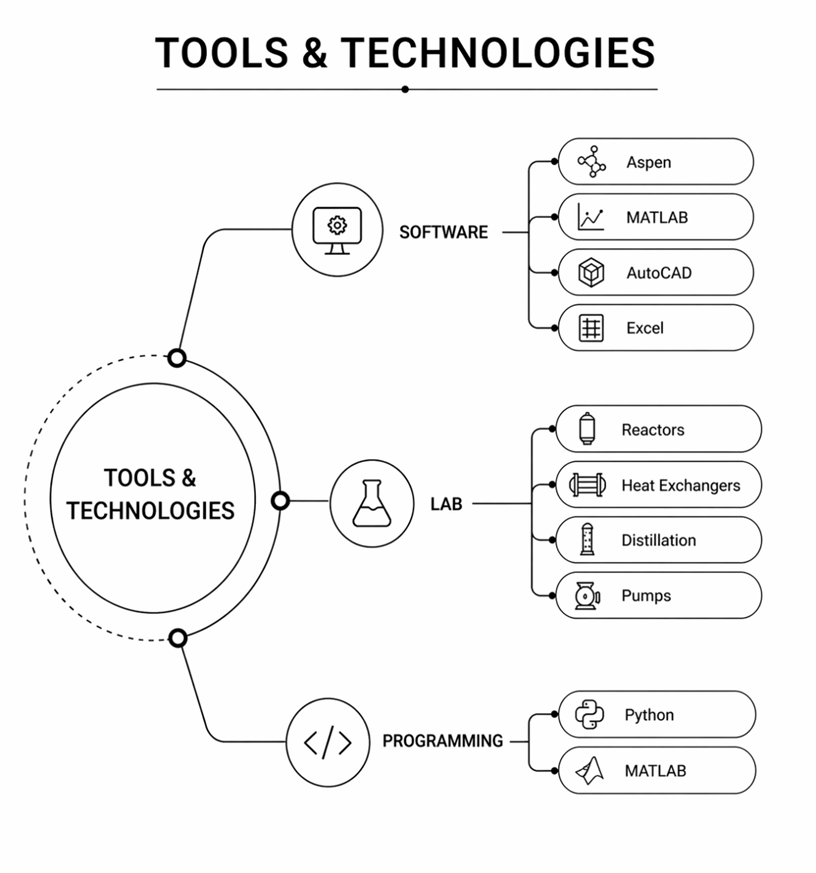
Software plays a vital role in modern Chemical Engineering. Today, almost every stage of process development—from research and design to operation, optimization, and maintenance—relies on specialized software tools. These programs help chemical engineers perform complex calculations, simulate industrial processes, design equipment, analyze data, improve safety, and optimize plant performance. Using software reduces the need for expensive physical experiments, saves time, improves accuracy, and enables engineers to evaluate multiple design alternatives before building an actual plant.
At the beginner level, students use software mainly for basic calculations, data analysis, simple simulations, and laboratory work. As they progress, they learn advanced simulation, modeling, optimization, automation, and design tools. At the expert level, software is used to design complete industrial plants, monitor real-time operations, and improve manufacturing efficiency.
Below are some of the most important software tools used in Chemical Engineering.
1. Aspen Plus
Aspen Plus is one of the most widely used process simulation software packages in the chemical and petrochemical industries. It allows engineers to model and simulate complete chemical processes before construction begins.
Engineers use Aspen Plus for:
- Process simulation.
- Material and energy balance calculations.
- Equipment sizing.
- Process optimization.
- Cost estimation.
- Process flow analysis.
- Environmental performance evaluation.
Aspen Plus can simulate industries such as petrochemicals, fertilizers, pharmaceuticals, food processing, and specialty chemicals.
Example: Before constructing a fertilizer plant, engineers simulate the entire production process in Aspen Plus to determine the best operating conditions and equipment sizes.
b. What hardware or lab exposure is required?
Chemical Engineering is a highly practical engineering discipline that requires significant exposure to laboratory experiments, pilot-scale equipment, and industrial machinery. While classroom learning provides the theoretical foundation, laboratory work and hands-on training help students understand how chemical processes operate in real life. Practical exposure develops technical skills, problem-solving abilities, safety awareness, and confidence in handling industrial systems.
At the beginner level, students perform simple laboratory experiments to understand basic scientific principles. As they progress through the program, they work with specialized chemical engineering equipment, process simulation tools, and pilot plants. At the expert level, chemical engineers operate, design, optimize, and troubleshoot large-scale industrial systems used in refineries, pharmaceutical plants, fertilizer factories, food processing industries, and energy plants.
Below are the major types of hardware and laboratory exposure that Chemical Engineering students typically receive.
1. Chemical Reactors
Chemical reactors are among the most important pieces of equipment in Chemical Engineering. They are vessels where chemical reactions take place under controlled conditions of temperature, pressure, and concentration.
Students learn about:
- Batch reactors
- Continuous Stirred Tank Reactors (CSTR)
- Plug Flow Reactors (PFR)
- Catalytic reactors
- Bioreactors
Laboratory experiments help students study reaction rates, conversion, product yield, catalyst performance, and reactor efficiency.
Example: Students may conduct a reaction inside a laboratory reactor to observe how changing the temperature affects the speed and yield of the reaction.
c. Which programming languages are needed?
Programming is not the primary focus of Chemical Engineering in the same way it is in Computer Science or Software Engineering. However, it has become an increasingly valuable skill in modern chemical engineering because industries now rely on automation, process simulation, data analysis, artificial intelligence, and digital technologies. Engineers who know programming can solve complex problems more efficiently, automate repetitive tasks, analyze large datasets, and optimize industrial processes.
At the beginner level, basic programming knowledge is sufficient for solving engineering calculations and working with simple simulations. At the expert level, programming is used to develop process models, optimize production, automate industrial systems, analyze real-time plant data, and apply machine learning techniques for predictive maintenance and process improvement.
Below are the most important programming languages and their applications in Chemical Engineering.
1. Python
Python is currently the most useful and widely recommended programming language for Chemical Engineering. It is easy to learn, has a simple syntax, and offers powerful libraries for scientific computing, data analysis, visualization, machine learning, and process optimization.
Chemical engineers use Python for:
- Data analysis
- Process optimization
- Numerical calculations
- Scientific computing
- Process simulation
- Artificial intelligence
- Machine learning
- Automation
- Equipment monitoring
- Predictive maintenance
Popular Python libraries include:
- NumPy
- SciPy
- Pandas
- Matplotlib
- Scikit-learn
These libraries help engineers analyze experimental data, model chemical processes, and create visualizations.
Example: A chemical engineer can write a Python program to analyze temperature data from a reactor and identify operating conditions that maximize product yield while reducing energy consumption.
d. What are the must-have technical skills for freshers?
Chemical Engineering graduates entering the industry are expected to possess a combination of strong technical knowledge, analytical ability, practical understanding, and problem-solving skills. While companies do not expect freshers to have the expertise of experienced engineers, they do expect them to understand the fundamentals of chemical processes and be capable of applying engineering principles to real-world situations.
At the beginner level, the focus is on building a solid understanding of core concepts and learning how to perform engineering calculations. At the professional level, these same skills evolve into process optimization, plant management, troubleshooting, and efficiency improvement. Therefore, freshers should focus on developing a strong foundation that can support future growth.
Below are the most important technical skills every Chemical Engineering fresher should possess.
1. Process Understanding and Engineering Calculations
One of the most important skills for a chemical engineering fresher is understanding how industrial processes work. Engineers must know how raw materials enter a process, how they are transformed, and how products are generated.
Freshers should be comfortable with:
- Material balances
- Energy balances
- Unit conversions
- Process flow diagrams
- Basic equipment calculations
- Yield and conversion calculations
These calculations form the basis of process design and operation.
Example: A fresher should be able to calculate the amount of raw material required to produce a specific quantity of fertilizer or chemical product.
e. What certifications add value in this domain?
Certifications can significantly enhance a Chemical Engineer’s knowledge, technical skills, industry readiness, and employability. While a degree in Chemical Engineering provides the fundamental scientific and engineering knowledge, certifications help students and professionals gain specialized expertise in particular areas of the industry. They also demonstrate a commitment to continuous learning, which is highly valued by employers.
In today’s competitive job market, certifications can help candidates stand out, especially when applying for internships, entry-level positions, or specialized technical roles. They expose learners to industry practices, modern technologies, safety standards, and emerging trends that may not be covered extensively in university curricula.
At the beginner level, certifications help build foundational industry knowledge and practical skills. At the expert level, certifications support specialization, leadership roles, process optimization, safety management, and advanced technical expertise.
1. Process Safety Certifications
Safety is one of the most critical aspects of Chemical Engineering because industrial plants often handle hazardous chemicals, high temperatures, and high pressures.
Process safety certifications help engineers understand:
- Hazard identification
- Risk assessment
- Accident prevention
- Emergency response planning
- Safety regulations
- Process hazard analysis (PHA)
- HAZOP studies
These certifications are highly valued in industries such as petroleum refining, chemicals, pharmaceuticals, and energy.
Benefits:
- Improves workplace safety awareness.
- Enhances employability in process industries.
- Prepares engineers for safety-related responsibilities.
- Reduces operational risks.
Example: A certified engineer can contribute to identifying potential hazards in a chemical plant and implementing measures to prevent accidents.
CONCLUSION:
Tools, technologies, and skills in Chemical Engineering focus on process design, simulation, and optimization. Mastery of software tools, industrial equipment, and analytical skills helps engineers improve efficiency, safety, and productivity in industries. Strong technical and practical skills are essential to succeed and grow in this field.
CTA (Call To Action):
- Start learning tools like Aspen, MATLAB, and Excel to build strong technical skills.
- Focus on practical exposure and certifications to improve your chances in core chemical industries.