
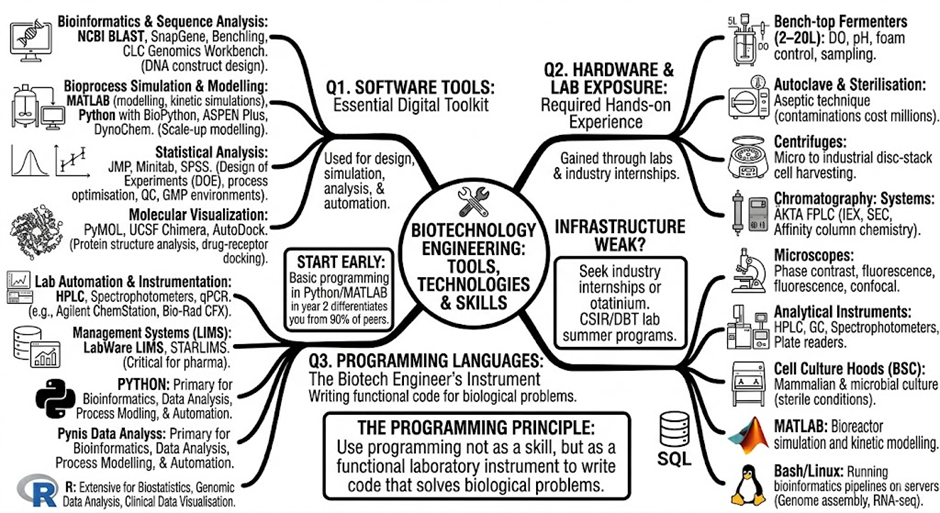
Q1. What software tools are essential?
Bioinformatics & Sequence Analysis: NCBI BLAST (sequence searching), SnapGene (DNA construct design), Benchling (digital lab notebook + molecular biology tools), CLC Genomics Workbench. These are used for designing genetically engineered constructs.
Bioprocess Simulation & Modelling: MATLAB (bioreactor modelling, kinetic simulations), Python with BioPython (data analysis, sequence analysis), ASPEN Plus (for industrial bioprocess flow simulation), DynoChem (fermentation scale-up modelling).
Statistical Analysis: JMP, Minitab, SPSS — used extensively in Design of Experiments (DOE), process optimization, and quality control in GMP environments.
Molecular Visualization: PyMOL, UCSF Chimera, AutoDock (for protein structure analysis and drug-receptor docking).
Lab Automation & Instrumentation: Working knowledge of HPLC, spectrophotometers, flow cytometers, qPCR machines, and understanding their software (Agilent ChemStation, Bio-Rad CFX).
Laboratory Information Management Systems (LIMS): LabWare LIMS, STARLIMS — critical for pharmaceutical employment.
Start with Python and MATLAB in your second year. Even basic programming skills will differentiate you from 90% of your peers in campus placements.
Q2. What hardware or lab exposure is required?
- Bench-top Fermenters: Operating 2–20 litre bioreactors, understanding dissolved oxygen (DO) control, pH control, foam control, sampling.
- Autoclave and Sterilization Equipment: Aseptic technique is non-negotiable. Contamination in a GMP plant can cost millions.
- Centrifuges: From microcentrifuges to industrial disc-stack centrifuges for cell harvesting.
- Chromatography Systems: ÄKTA (GE/Cytiva) FPLC systems — used for protein purification. Understanding column chemistry (ion exchange, size exclusion, affinity).
- Microscopes: Phase contrast, fluorescence, confocal microscopy for cell analysis.
- Analytical Instruments: HPLC (purity and quantification), GC (volatile analysis), spectrophotometers (protein and DNA quantification), plate readers.
- Cell Culture Hoods (Biosafety Cabinets): Mammalian and microbial cell culture under sterile conditions.
If your college’s lab infrastructure is weak, I strongly advise seeking out industry internships or CSIR/DBT lab summer programmes specifically to gain hands-on exposure.
Q3. Which programming languages are needed?
- Python: The primary language for bioinformatics, data analysis, process modelling, and automation scripting. Libraries like NumPy, Pandas, Matplotlib, SciPy, and BioPython are essential.
- R: Used extensively for biostatistics, genomic data analysis, and clinical data visualization. Particularly important if you wish to enter clinical research or genomics.
- MATLAB: Used for bioreactor simulation and kinetic modelling in many universities and companies.
- SQL: For managing large biological datasets in databases — increasingly important in biotech companies running large genomic or clinical datasets.
- Basic Bash/Linux: Essential for running bioinformatics pipelines on servers (e.g., running genome assembly or RNA-seq analysis).
You do not need to be a software engineer. You need to be a biotechnology engineer who can write functional code. Think of programming as a laboratory instrument — you use it to solve biological problems.
Q4. What are the must-have technical skills for freshers?
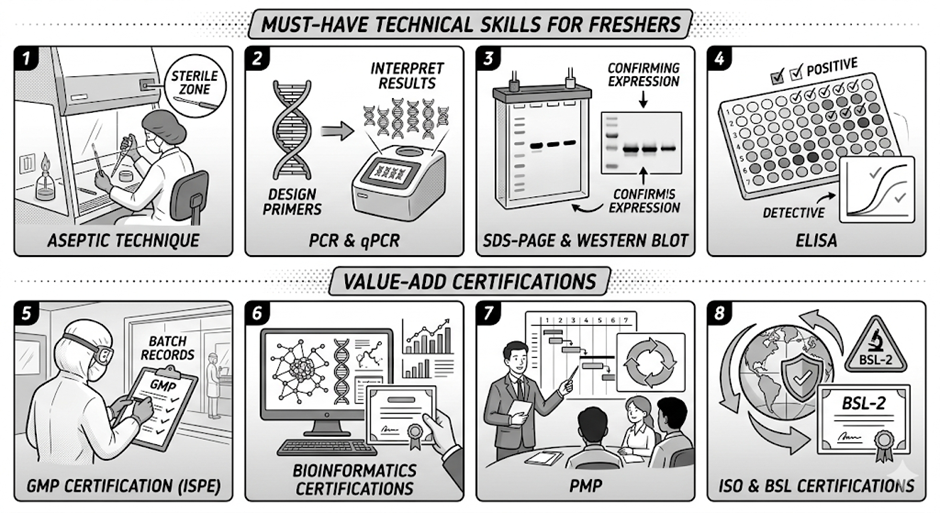
- Aseptic Technique: The most fundamental wet lab skill. Your ability to maintain sterility determines whether experiments succeed or fail.
- PCR & qPCR: Used in every biotechnology company from diagnostics to research. You must be able to design primers, set up reactions, and interpret results.
- SDS-PAGE & Western Blot: Core protein analysis techniques used to confirm protein expression and purity.
- ELISA: Enzyme-linked immunosorbent assay — used in diagnostics, drug testing, and quality control of biopharmaceuticals.
- Cell Culture (Microbial & Mammalian): Growing E. coli, yeast, and CHO (Chinese Hamster Ovary) cells — the workhorses of the biopharmaceutical industry.
- Basic Bioprocess Documentation: Writing batch records, SOPs, deviations — the language of GMP manufacturing.
- Data Analysis: Ability to process experimental data in Excel or Python, plot graphs, interpret statistical significance.
Q5. What certifications add value in this domain?
- Good Manufacturing Practice (GMP) Certification: Offered by ISPE (International Society for Pharmaceutical Engineering), this is gold standard for pharmaceutical manufacturing careers.
- Bioinformatics Certifications: Coursera (Johns Hopkins Genomic Data Science), EMBL-EBI online courses, edX Bioinformatics.
- Project Management Professional (PMP): Valuable for those moving into project or program management in pharma companies.
- Regulatory Affairs Certifications: RAC (Regulatory Affairs Certification) from RAPS — highly valued in Indian and global pharma companies.
- ISO 9001 / ISO 13485: Quality management certifications relevant to medical device and pharma companies.
- Biosafety Level Certifications: Understanding and certification in BSL-1, BSL-2, and BSL-3 laboratory safety — required for work with pathogens.
- CSIR-UGC NET (Life Sciences): If you are targeting research roles or academic positions, clearing this national exam significantly boosts your profile.
- Conclusion:
Tools like PCR, gene editing techniques, and bioinformatics software are crucial in biotechnology. Learning these tools helps you work on real-life biological problems and research. - CTA:
Begin learning at least one tool step by step. Follow this series and go to Day 4 to start working on practical biotechnology projects.