
a. What software tools are essential in this branch?
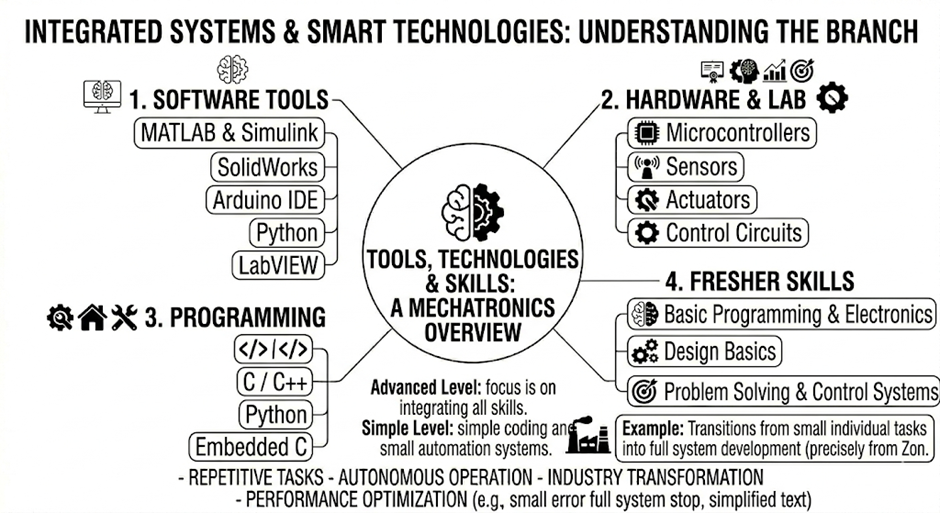
Mechatronics Engineering uses software tools to design, simulate, program, and control systems.
Key tools include:
- MATLAB & Simulink: Used for simulation, control systems, and system modeling
- CAD Software (SolidWorks / AutoCAD): Used for designing mechanical parts
- Arduino IDE: Used for programming microcontrollers
- Python: Used for automation, data processing, and AI basics
- LabVIEW: Used for system control and data acquisition
At a beginner level, you start with basic tools like Arduino and CAD.
At an expert level, you use multiple tools together to build complete systems.
Example:
You design a machine part in SolidWorks, simulate its behavior in MATLAB, and control it using Arduino.
This is full system development.
b. What hardware or lab exposure is required?
Mechatronics is highly practical, so hardware knowledge is essential.
Important hardware components include:
- Microcontrollers (Arduino, Raspberry Pi)
- Sensors (temperature, proximity, pressure, motion)
- Actuators (motors, servos, pneumatic systems)
- Control units and circuits
At a beginner level, you learn basic circuits and components.
At an advanced level, you design and integrate full systems.
Example:
A temperature control system:
- Sensor measures temperature
- Controller processes data
- Actuator adjusts cooling/heating
c. Which programming languages are needed?
Programming is a key skill in Mechatronics.
Important languages include:
- C/C++: For microcontroller programming
- Python: For automation and advanced applications
- Embedded C: For hardware-level control
At a beginner level, simple coding is enough.
At an expert level, programming is used for real-time system control.
Example:
A microcontroller uses C code to control motor speed based on sensor input.
d. What are the must-have technical skills for freshers?
Freshers need a combination of multi-domain skills.
Key skills include:
- Basic programming (C/Python)
- Understanding of electronics and circuits
- Knowledge of sensors and actuators
- Mechanical design basics
- Control system understanding
- Problem-solving and logical thinking
At a beginner level, focus is on learning fundamentals.
At an expert level, focus is on integrating all skills.
Example:
A fresher should be able to build a small automation system like an automatic ligh
e. What certifications add value in this domain?
Certifications help improve knowledge and job opportunities.
Important certifications include:
- Embedded systems certification
- Automation and PLC (Programmable Logic Controller) certification
- Robotics certification
- IoT (Internet of Things) certification
- MATLAB/Simulink certification
At a beginner level, certifications build foundation.
At an expert level, they help in specialization.
Example:
A PLC certification can help you work in industrial automation companies.

Conclusion :
Mechatronics Engineering requires a strong mix of software tools, hardware knowledge, and programming skills to build complete automated systems. It is a practical, skill-based field where integration of multiple technologies is key. Mastering these tools and skills makes you industry-ready.
CTA (Call To Action):
- Start with basics like Arduino, CAD design, and simple programming.
- Build small automation projects to strengthen your practical skills and confidence.