
1. What software tools are essential?
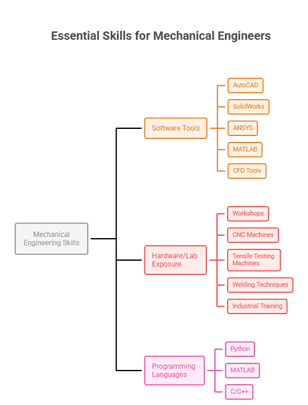
In today’s industry, software tools are critical for designing, analyzing, and optimizing mechanical systems. They reduce the need for physical testing and improve accuracy.
One of the most important tools is AutoCAD, used for creating 2D engineering drawings and layouts. It helps engineers represent machine components clearly before manufacturing.
For 3D modeling and product design, tools like SolidWorks, CATIA, and Creo are widely used. These allow engineers to create detailed digital models of machines and assemblies. For example, a complete car engine can be designed and visualized in 3D before production.
Simulation tools such as ANSYS are used for stress analysis, heat transfer analysis, and fluid flow simulation. Engineers can test how a component behaves under real conditions without building it physically.
MATLAB is another important tool used for numerical analysis, system modeling, and solving complex engineering equations. It is especially useful in control systems and dynamic simulations.
Additionally, CFD (Computational Fluid Dynamics) tools help analyze fluid flow in systems such as turbines, pipes, and aerodynamic designs.
These tools:
- Reduce design errors
- Save time and cost
- Improve efficiency and performance
In modern mechanical engineering, software knowledge is as important as theoretical knowledge.
2. What hardware or lab exposure is required?
Mechanical Engineering is a hands-on field, so practical exposure to machines and tools is essential.
Students must gain experience in workshops, where they learn operations like cutting, shaping, drilling, and assembling components. Machines like lathes, milling machines, and drilling machines are commonly used.
Modern industries also use CNC (Computer Numerical Control) machines, which automate manufacturing processes. Understanding CNC operations is very important for production roles.
In laboratories, students work with equipment such as:
- Tensile testing machines to measure material strength
- Hardness testers to evaluate resistance
- Heat transfer apparatus to study temperature changes
- Fluid mechanics setups to analyze flow behavior
For example, a student may test how a metal rod behaves under tension to understand its strength and breaking point.
Exposure to welding and fabrication techniques is also important, as joining methods are widely used in industries.
Industrial training and plant visits further enhance understanding by exposing students to real production environments.
Without practical exposure, mechanical engineering knowledge remains incomplete.
3. Which programming languages (if any) are needed?
Programming is not traditionally a core requirement in mechanical engineering, but it has become increasingly important in modern industry.
Python is one of the most useful programming languages for mechanical engineers. It is used for data analysis, automation, and simulation. For example, engineers can use Python to analyze machine performance data and predict failures.
MATLAB also acts as a programming platform for solving complex mathematical problems and simulating systems.
In some advanced fields like robotics and automation, C and C++ are used for embedded systems and control programming.
Programming helps engineers:
- Automate repetitive tasks
- Analyze large datasets
- Develop simulation models
- Work in interdisciplinary fields like AI and robotics
For example, predictive maintenance systems in factories use programming to monitor machines and detect faults early.
While not mandatory for all roles, programming skills provide a strong competitive advantage.
4. What are the must-have technical skills for freshers?
Freshers entering the mechanical engineering field must develop a combination of technical knowledge, practical skills, and problem-solving abilities.
The most important skill is a strong understanding of core concepts such as mechanics, thermodynamics, and fluid mechanics. Without this foundation, solving real-world problems becomes difficult.
Knowledge of CAD software is essential, as most industries require design and modeling skills. Freshers should be able to create and interpret technical drawings.
Another key skill is problem-solving ability. Engineers must analyze situations and find effective solutions. For example, identifying why a machine is overheating requires logical thinking and technical knowledge.
Understanding manufacturing processes such as casting, welding, and machining is also important. Engineers must know how products are made to design them effectively.
Communication skills are often overlooked but are crucial. Engineers must explain technical ideas clearly to teams and managers.
Awareness of industrial safety standards is essential, especially in plant environments where risks are high.
Adaptability and willingness to learn new technologies are also important, as the field is constantly evolving.
A fresher with strong fundamentals, practical exposure, and communication skills is considered industry-ready.
5. What certifications add value in this domain?
Certifications are an excellent way to enhance a mechanical engineer’s profile and demonstrate practical expertise beyond academic knowledge.
One of the most valuable certifications is in CAD software, such as AutoCAD, SolidWorks, or CATIA. These certifications are highly demanded in design roles.
Six Sigma certification is widely recognized in industries for quality control and process improvement. Engineers with Six Sigma knowledge can improve efficiency and reduce defects in production.
CNC programming certifications are important for manufacturing roles, as they demonstrate expertise in automated machining processes.
For thermal engineering roles, HVAC certifications are valuable. These are used in industries related to building systems and cooling technologies.
Certifications in robotics and automation are becoming increasingly important due to the rise of Industry 4.0.
For example, a certified CAD engineer can work in design companies, while a Six Sigma-certified engineer can work in quality and operations roles.
These certifications:
- Improve job opportunities
- Increase salary potential
- Show practical competence
- Provide specialization
Investing in certifications is a smart step toward career growth.

CONCLUSION
Tools, technologies, and skills are what transform a mechanical engineering student into a professional engineer.
✔ Software tools enable design and simulation
✔ Hardware exposure builds practical understanding
✔ Programming enhances analytical capability
✔ Technical skills prepare you for industry challenges
✔ Certifications increase employability and growth