
a. What software tools are essential in this branch?
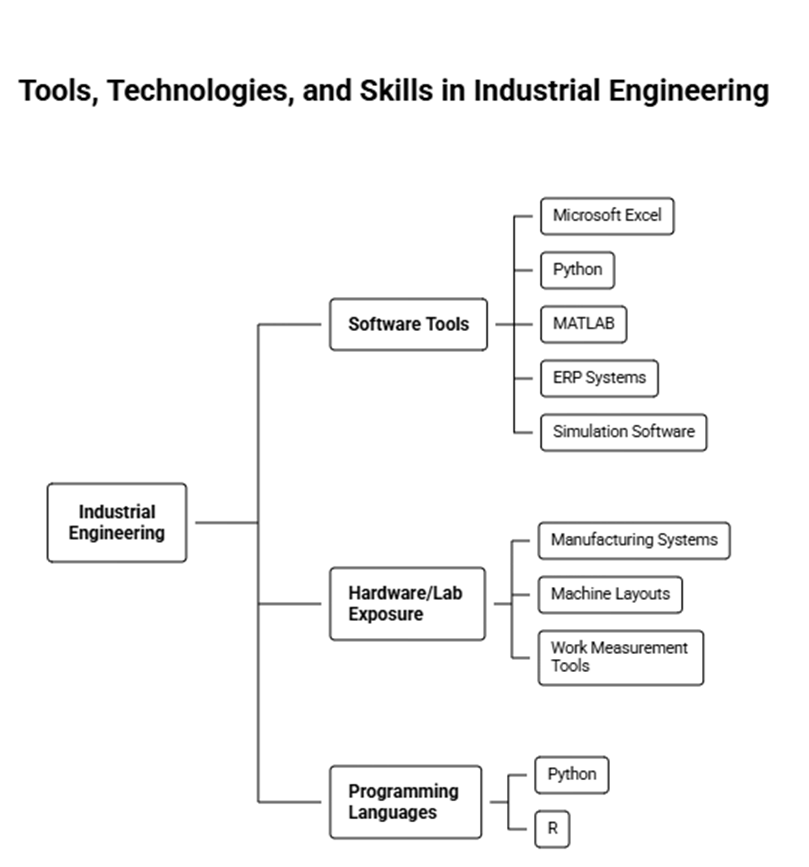
Industrial Engineers rely heavily on software tools to analyze data,design systems, and improve processes.
Key tools include:
- Microsoft Excel: Used for data analysis, forecasting, and reporting
- Python: Used for automation, data analysis, and optimization
- MATLAB: Used for mathematical modeling and simulations
- ERP Systems (e.g., SAP): Used for managing business operations like inventory, production, and finance
- Simulation Software (e.g., Arena): Used to model and test systems virtually
At a beginner level, Excel is the most important tool to master.
At an expert level, engineers combine multiple tools to solve complex problems.
Example:
An Industrial Engineer uses Excel to analyze past sales data and predict future demand, helping the company plan production efficiently.
b. What hardware or lab exposure is required?
Although Industrial Engineering is less hardware-intensive than some branches, practical exposure is still essential.
Students typically work with:
- Manufacturing systems and production lines
- Machine layouts and plant design
- Work measurement tools (for time and motion study)
At a beginner level, students observe processes.
At an advanced level, they redesign and optimize these systems.
Example:
In a factory lab, students may observe how products move along a conveyor belt and identify delays or inefficiencies.
c. Which programming languages are needed?
Programming is increasingly important in Industrial Engineering, especially for data-driven decision-making.
Common languages include:
- Python: Most widely used for data analysis, automation, and optimization
- R: Used for statistical analysis and modeling
At a beginner level, basic coding is sufficient.
At an expert level, programming is used to build optimization models and automate decision-making systems.
Example:
Python can be used to analyze customer demand patterns and automatically generate production schedules.
d. What are the must-have technical skills for freshers?
Freshers must develop a strong combination of analytical and practical skills.
Key skills include:
- Problem-solving ability
- Data analysis and interpretation
- Logical and critical thinking
- Process improvement mindset
- Communication skills (to explain solutions clearly)
At a beginner level, focus is on understanding problems.
At an expert level, the focus shifts to solving complex, real-world challenges.
Example:
A fresher working in a company may notice delays in product delivery.
By analyzing data and identifying bottlenecks, they can suggest improvements to reduce delays.
e. What certifications add value in this domain?
Certifications help validate your skills and improve job opportunities.
Important certifications include:
- Six Sigma (Green Belt/Black Belt): Focuses on quality improvement and defect reduction
- Lean Management: Focuses on eliminating waste in processes
- Supply Chain Certifications: Focus on logistics and operations
- Data Analytics Certifications: Focus on data-driven decision-making
At a beginner level, certifications provide basic understanding.
At an advanced level, they help professionals lead large-scale improvement projects.
Example:
A Six Sigma-certified engineer can lead a project to reduce defects in a production line, saving significant costs for the company.
Conclusion :
Tools, technologies, and skills form the practical backbone of Industrial Engineering, enabling engineers to convert theoretical knowledge into real-world solutions. Mastery of software, analytical thinking, and problem-solving skills allows professionals to design efficient systems and improve productivity. Together, they ensure that engineers can make data-driven decisions and deliver measurable results in any industr