
🔹What are some beginner-level projects?
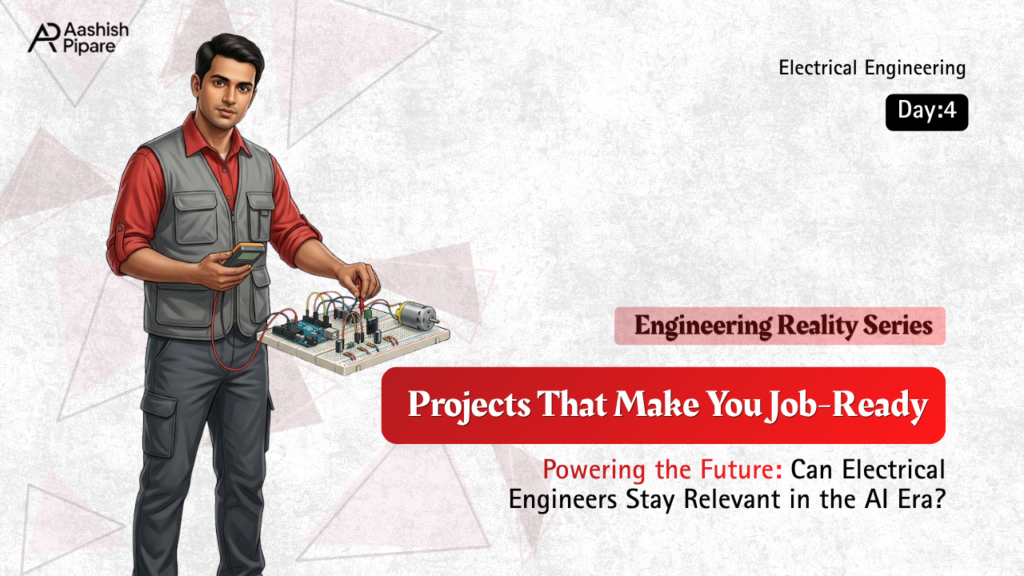
Beginner-level projects in Electrical Engineering are designed to help students connect theory with real-world applications. At this stage, the goal is not complexity but concept clarity, hands-on practice, and confidence building.
One of the most fundamental projects is the LED blinking circuit, which introduces students to basic components like resistors, capacitors, and transistors. This project helps in understanding how current flows and how timing circuits work.
Another important beginner project is building a battery charger circuit. This helps students understand concepts like voltage regulation, rectification, and energy storage. For example, designing a simple charger using a transformer and rectifier gives practical insight into how electrical energy is converted and stored.
Home wiring models are also very useful projects. These simulate real-life electrical installations and help students understand switches, sockets, fuses, and circuit protection. This knowledge is directly applicable in real-world electrical systems.
A slightly advanced beginner project is a fan regulator circuit, which introduces concepts of voltage control and power electronics. Students learn how to control speed using resistors or electronic regulators.
Other simple projects include:
- Basic DC motor control circuits
- Light-dependent resistor (LDR) based automatic lights
- Simple inverter circuits
These projects are important because they:
- Build hands-on skills
- Improve troubleshooting ability
- Develop confidence in handling circuits
For example, if a circuit doesn’t work, students learn to check connections, measure voltage, and identify faults—this is where real learning happens.
Beginner projects are the foundation of engineering practice. If you skip them, advanced learning becomes difficult.
🔹What are industry-level projects I should aim for?
Industry-level projects are significantly more advanced and focus on solving real-world engineering problems. These projects require integration of multiple concepts such as power systems, electronics, control systems, and programming.
One of the most valuable projects is designing a solar power system. This involves calculating energy requirements, selecting solar panels, designing battery storage, and implementing inverters. It directly relates to the growing renewable energy industry.
Another important project is a smart energy meter, which monitors electricity usage in real time. These systems often use IoT (Internet of Things) to send data to mobile apps or cloud platforms.
Electric Vehicle (EV) charging systems are also in high demand. Designing such a system involves understanding power electronics, safety standards, and energy management.
Projects involving PLC (Programmable Logic Controller) are widely used in industries. For example, designing an automated conveyor system using PLC teaches industrial automation skills.
A highly advanced project is a solar inverter system, which converts DC power from solar panels into AC power usable in homes. This project combines power electronics, control systems, and circuit design.
Other industry-level projects include:
- Smart grid simulation systems
- Power factor correction systems
- Industrial motor control systems
- Load management systems
These projects help students:
- Gain deep technical knowledge
- Understand industry applications
- Improve problem-solving ability
👉 Employers highly value candidates who have worked on such projects because they show real engineering capability, not just theoretical knowledge.
🔹How can I build a portfolio in this domain?
A strong portfolio is one of the most powerful tools for an electrical engineer because it demonstrates your skills, projects, and practical experience.
The first step is to document all your projects properly. Each project should include:
- Objective (What problem are you solving?)
- Design approach (How did you solve it?)
- Circuit diagrams and schematics
- Calculations and results
- Final output and observations
For example, if you design a solar system, include load calculations, panel selection, and output performance.
Include:
- Photos of your hardware setup
- Simulation outputs (MATLAB, Proteus, etc.)
- Graphs and performance analysis
Organize your portfolio clearly so that anyone can understand it easily.
You can use platforms like:
- GitHub (for code and documentation)
- Personal websites
- PDF portfolios
Highlight your role in each project. For example, mention if you handled circuit design, coding, or testing.
A good portfolio should show:
- Practical skills
- Problem-solving ability
- Technical understanding
Update your portfolio regularly with new projects and certifications.
👉 During interviews, your portfolio becomes your strongest proof of ability—it speaks louder than marks.
🔹What kind of internships should I target?
Internships are critical in Electrical Engineering because they provide real-world exposure and industry experience.
Students should target internships based on their area of interest:
🔸 Power Sector
Internships in power plants (thermal, hydro, or renewable) help understand electricity generation, transmission, and distribution.
🔸 Maintenance & Industrial Sector
Electrical maintenance companies provide hands-on experience in troubleshooting, wiring, and system repair.
🔸 Automation & Control
Automation companies teach PLC programming, SCADA systems, and industrial control systems.
🔸 Renewable Energy
Solar and wind energy companies offer experience in system design, installation, and maintenance.
For example, working in a power plant helps you understand how electricity is generated and distributed at large scale.
Internships help you:
- Apply theoretical knowledge
- Learn industry standards
- Improve communication skills
- Build professional networks
Choosing the right internship is important. Always prefer internships where you:
- Get hands-on work
- Learn real systems
- Interact with experienced engineers
Internships are often the bridge between college and job.
🔹Are there open-source or real-world problems I can work on?
Electrical Engineering offers many opportunities to work on real-world problems that have direct societal impact. These projects are highly valuable for learning and innovation.
One major problem is power loss in transmission systems. Engineers work on improving efficiency and reducing losses during electricity transmission.
Another important area is renewable energy integration. Managing solar and wind energy in existing power grids is a complex challenge.
Energy efficiency in buildings is also a key area. Students can design systems to reduce electricity consumption, such as smart lighting or energy monitoring systems.
For example, designing an automatic energy-efficient lighting system using sensors can significantly reduce power usage in homes.
Other real-world problems include:
- Smart grid development
- Load balancing systems
- Fault detection in power systems
- Electric vehicle energy management
Open-source platforms and communities provide:
- Project ideas
- Data sets
- Collaboration opportunities
Working on real-world problems helps students:
- Develop innovation skills
- Understand industry challenges
- Build practical solutions
These projects prepare you not just for jobs—but for becoming a problem-solving engineer who can create impact.
Conclusion
In conclusion, project-based learning is essential in Electrical Engineering as it bridges the gap between theory and real-world application. From beginner projects to industry-level systems, hands-on experience builds confidence, technical skills, and problem-solving ability, making students truly industry-ready.
CTA:
Start with small projects, build consistently, and showcase your work.