
a. What are some beginner-level projects in this branch?
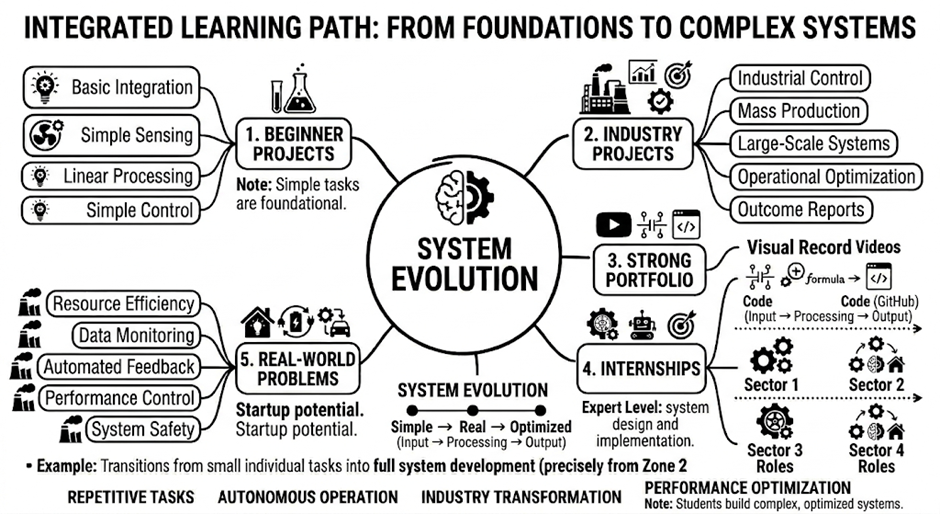
Beginner projects help you understand basic integration of sensors, controllers, and actuators.
Common beginner projects include:
- Automatic light system (turns on/off based on motion or light)
- Temperature control system (fan or heater control)
- Line-following robot
- Water level indicator
At a beginner level, the goal is to understand how input → processing → output works.
At an expert level, these basics are used to build complex systems.
Example:
In an automatic light system:
- Sensor detects motion
- Controller processes signal
- Light turns ON/OFF
This is a simple mechatronic system.
b. What are industry-level projects I should aim for?
Industry-level projects involve real automation and control systems used in companies.
These include:
- PLC-based industrial automation systems
- CNC machine control systems
- Smart manufacturing systems
- Automated conveyor belt systems
- Smart home automation systems
At a beginner level, you simulate such systems.
At an expert level, you build fully functional real-world systems.
Example:
A conveyor belt system that automatically sorts products based on size or weight using sensors and actuators.
c. How can I build a strong portfolio in this domain?
A strong portfolio should demonstrate your ability to design, build, and integrate systems.
Your portfolio should include:
- Working project videos
- Circuit diagrams and designs
- Code (GitHub)
- CAD models (SolidWorks)
- Project reports (problem + solution)
At a beginner level, small projects are enough.
At an expert level, projects should solve real-world problems.
Example:
You build a smart irrigation system that waters plants automatically based on soil moisture.
This shows practical application + innovation.
d. What kind of internships should I target?
Internships are essential for real-world exposure.
Target companies in:
- Industrial automation (PLC, SCADA)
- Manufacturing companies
- Robotics and embedded systems firms
- Automotive companies
At a beginner level, any hands-on internship is useful.
At an expert level, aim for roles involving system design and implementation.
Example:
In an internship, you may work on improving machine efficiency or automating a manual process.
e. Are there real-world or open problems I can work on?
Yes, Mechatronics offers many opportunities to solve practical real-world problems.
Examples include:
- Smart home automation
- Energy-saving systems
- Agricultural automation (smart irrigation)
- Traffic control systems
- Assistive devices for disabled people
At a beginner level, these are small prototypes.
At an expert level, they can become startups or industrial solutions.
Example:
A smart irrigation system reduces water waste by watering plants only when needed.

Conclusion (2–3 lines):
Project-based learning is essential in Mechatronics Engineering as it connects theory with real-world applications. By building systems, students develop integration skills and practical problem-solving abilities. Strong projects directly improve industry readiness and career opportunities.
CTA (Call To Action):
- Start with simple automation projects like automatic lights or water level indicators.
- Build and showcase your projects—your portfolio is the key to internships and jobs.